North Carolina’s “Animal Lovers” specialty license plate funds spay and neuter procedures for low-income pet owners through the NC Department of Agriculture. In 2023, that program supported 5,855 procedures statewide and reimbursed more than $341,000 to county and town governments (NCDA&CS Animal Welfare Section, 2025). None of them were community-cat trap-neuter-return. Community cats are not eligible.
Statewide cat and dog euthanasia in NC shelters has climbed from 22% in 2021 to 27% in 2024, according to WRAL Investigates’ November 2025 analysis of NC Department of Agriculture Animal Welfare Section data. More than 20,000 dogs and cats were euthanized in NC shelters in 2024. Counties pay the bill out of general funds, and the per-cat cost of catch-and-kill animal control runs higher than the per-cat cost of trap-neuter-return.
If you have read our post on states that got it right on spay/neuter funding, this is the fiscal sequel. We profiled the funding mechanisms. Here is the specific community-cat gap NC has left unfunded, what it costs, and what closing it looks like. If you want to help the cats in your own neighborhood right now, start with our practical guides on how to help feral cats in your neighborhood and how to start a TNR program in your community.
TL;DR: Trap-Neuter-Return costs $20 to $97 per cat in published US programs; impounding and euthanizing the same cat costs $52 to $123 (Best Friends Animal Society). A peer-reviewed Florida study documented a 66% drop in shelter cat intake in two years when TNR sterilization reached roughly 54% of an estimated community-cat population (Levy, Isaza, Scott, The Veterinary Journal, 2014). NC’s existing state spay/neuter program funds owned pets only. Community-cat TNR is not eligible. New Jersey, New Hampshire, Massachusetts, and Florida all use protected funds or specialty-plate revenue to support sterilization programs that include or could include community cats. Expanding NC’s existing program to include community-cat TNR is the single largest fiscal lever available without raising taxes. Sign the petition and email your rep.
What Is Trap-Neuter-Return?
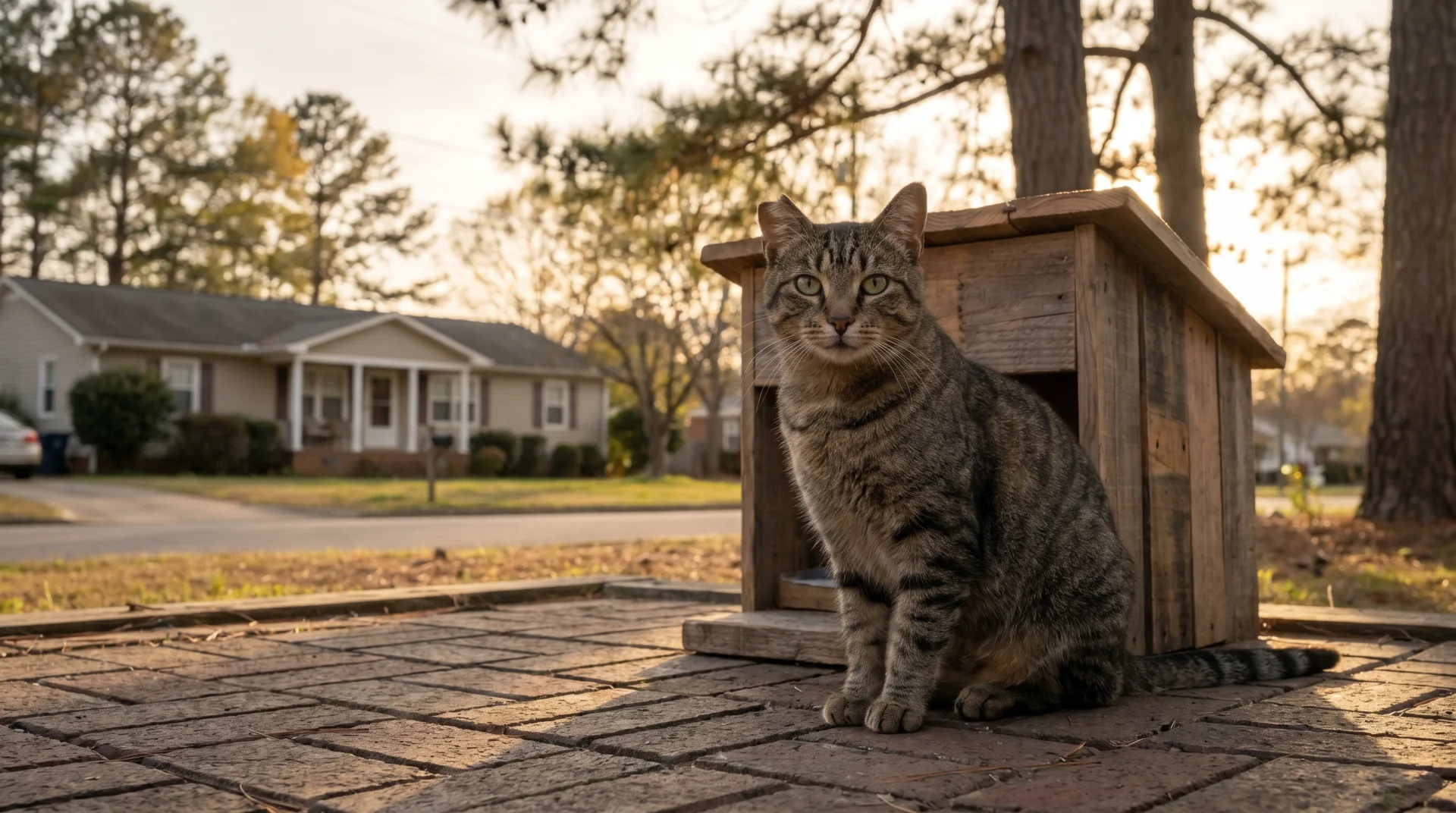
Trap-Neuter-Return (TNR), often called Trap-Neuter-Vaccinate-Return (TNVR) when rabies vaccination is included, is a managed-colony intervention for community cats. Cats are humanely trapped, sterilized, vaccinated against rabies, ear-tipped to mark them as fixed, and returned to their colony. Caretakers monitor the colony and trap new arrivals as they appear. Over time, the colony stops reproducing, ages out, and contracts.
The ear tip is the universal field marker. A clipped left ear means a cat has already been through the program, so trappers and animal control officers do not haul the same cats back to a clinic twice. Vaccination is included in most US programs because rabies is the public health concern that drives many local complaints about outdoor cats.
A community cat is any free-roaming cat without an identifiable owner. Some are feral and unsocialized; some are loosely owned by a neighborhood that feeds them; some were abandoned and have lost their handle on humans. The label matters less than the policy question: what do we do about them? The two answers on the table are catch-and-kill (impound and euthanize when adoption fails) and TNR (sterilize and return).
TNR is community-driven, run by volunteer trappers and partner vets. Return-to-Field (RTF) is the shelter-based version, where cats brought in as strays are sterilized and returned rather than impounded for adoption. Both rely on the same biology: a sterilized cat does not contribute to the next generation of kittens. For a full walkthrough of how these programs run day to day, and the outcome data from six municipal shelters that measured them, see our guide to community cat programs and why they matter.
Does TNR Actually Reduce Feral Cat Populations?
Yes, when a critical share of cats in a defined area is sterilized within a relatively short period and the program is sustained over time. The peer-reviewed evidence is consistent across more than a decade of field studies and population modeling. The 2014 Levy, Isaza, and Scott study published in The Veterinary Journal tracked targeted TNR in an 11.9-square-kilometer Florida zip code over two years. Researchers sterilized 2,366 cats, approximately 54% of the projected community-cat population in the target area. Shelter cat impoundment from that area dropped 66% in two years. In the surrounding non-target area, impoundment fell only 12%. Per-capita shelter intake was 3.5 times higher and euthanasia 17.5 times higher in the non-target area (Levy, Isaza, Scott, 2014).
Other field studies show similar patterns. Spehar and Wolf’s 2018 Chicago study followed 20 colonies and found a mean 82% reduction from peak population size; eight of the twenty colonies were eliminated entirely. In San Jose, California, the city animal services department implemented shelter-based RTF in 2010. Over the next four years, feline shelter intake dropped 29%, and the cat euthanasia rate fell from 66.6% to 34.9% over an eight-year window (San Jose Animal Care Services).
Density and pace matter. The ASPCA’s official position statement on community cats states that “to achieve the primary goal of decreasing the overall size of the community cat population over a 5- to 10-year timeline, research has shown that a critical percentage of cats in a group, neighborhood, or other defined geographic location must all be sterilized within a relatively short time period” (citing Boone et al., 2019). That is what Levy 2014 demonstrated empirically at 54% sterilization in a defined zip code over two years. TNR works when it is funded and sustained at a meaningful scale. Volunteer-only TNR usually cannot reach the density that drives decline, which is why the policy lever is funding.
What Does TNR Cost vs. Catch-and-Kill?
TNR costs $20 to $97 per cat across published US programs. Impounding and euthanizing the same cat costs $52 to $123 (Best Friends Animal Society policymaker brief). The fiscal case is closed: catch-and-kill is more expensive per cat, and it does not reduce the population in open systems where removed cats are replaced through reproduction and immigration. Taxpayers pay more for worse outcomes.
The ranges vary by methodology. Some programs include rabies vaccines, microchipping, transport, and feeding-station maintenance in their per-cat figures; some do not. The point is not the precise dollar amount. Across every published US comparison Best Friends documents in its policymaker analysis, sterilize-and-return costs less per cat than impound-and-euthanize.
| Source | TNR per cat | Catch-and-kill per cat | Notes |
|---|---|---|---|
| Best Friends synthesis (US programs) | $20 to $97 | $52 to $123 | Range across multiple US programs; methodology varies. |
| San Jose, CA (per-cat program cost) | ~$72 | n/a | Sterilize-and-vaccinate cost cited in Best Friends brief. |
| Hillsborough County, FL (HCAS) | n/a | $168 | Per-cat cost of pickup, handling, and disposal. |
| Cook County, IL | Lower | $135 | Switch to TNR saved the county over $1.5 million vs. prior catch-and-kill spending. |
The Cook County, Illinois case is the clearest single-jurisdiction figure. After switching to a funded TNR model, the county documented savings of more than $1.5 million compared to its prior catch-and-kill spending, primarily from reduced per-cat handling and euthanasia costs (Best Friends Animal Society). Per-cat catch-and-kill costs cited in the same Best Friends brief run $135 in Cook County and $168 at Hillsborough County Animal Services in Florida. Sterilize-and-return costs run $65 to $72 in replicated programs. The fiscal direction is consistent across every jurisdiction reviewed.
How NC Already Funds Spay/Neuter (And the One Gap)
North Carolina has a working state spay/neuter funding mechanism. The “Animal Lovers” specialty license plate generates a $20 fee per plate that flows into the Spay/Neuter Fund, paired with $250,000 transferred annually from the Animal Feed and Pet Food Branch and administered by the NC Department of Agriculture and Consumer Services Animal Welfare Section (NCDA&CS Spay/Neuter Program FAQ). In 2023, the program supported 5,855 procedures statewide and reimbursed more than $341,000 to county and town governments. The infrastructure exists. Counties and municipalities apply. The state reimburses. It works.
The gap is eligibility. The program reimburses only spay/neuter procedures performed on pets owned by low-income individuals, defined as those qualifying for public assistance programs or whose household income is below 100% of federal poverty level guidelines. The structure was inherited when the program lived at the NC Department of Health and Human Services from its inception in 2001 until September 30, 2010, when it moved to NCDA&CS (NCDA&CS Spay/Neuter Program).

Community-cat TNR does not fit the eligibility criteria, because community cats by definition do not have an identifiable owner enrolled in a low-income assistance program. They are not anyone’s pet. They are not eligible. The cats most likely to flood county shelters during kitten season, and the cats whose sterilization would do the most to reduce that flood, sit outside the program NC built specifically to fund sterilization.
That eligibility gap is the policy lever. Closing it requires a single statutory amendment to add community-cat TNR/TNVR as an eligible procedure category for reimbursement. The administrative infrastructure already handles intake, vendor reimbursement, and reporting. Adding a new procedure code is a routine administrative change. The change that gets it on the books is one section of a one-page bill.
How Other States Fund Community-Cat Programs
New Jersey, New Hampshire, Massachusetts, and Florida have built funding mechanisms NC could copy. None require new tax revenue. All four use a mix of protected funds, specialty license plate revenue, income tax check-offs, and dedicated appropriations. Three of the four predate NC’s program; the fourth runs through a 501(c)(3) intermediary that does exactly the work NC’s program could do if eligibility were expanded.
The four-state pattern is consistent. Each program protects revenue from general-fund reallocation and pairs a stable funding source with a public-private administrative structure. Each one extends or could extend to community-cat sterilization with a small policy adjustment. New Jersey’s Animal Population Control Program was established by P.L.1983, c.172, which created a Cat and Dog Spay/Neuter Fund supported by an income tax check-off. New Hampshire built its statewide low-income spay/neuter program in 1994 (the Peter Marsh model, frequently cited by ASPCA Pro as a reference design). Florida Animal Friend was established as a 501(c)(3) administering the state’s animal-welfare specialty license plate revenue, with a dedicated Feral Cat Program grant track. NC’s program is structurally similar to all four. It predates two of them. The piece NC has not yet pulled is the eligibility expansion.
| State | Mechanism | Funding source | TNR-eligible? |
|---|---|---|---|
| North Carolina | NC Spay/Neuter Program (NCDA&CS) | “Animal Lovers” plate + state appropriation | No |
| New Jersey | Animal Population Control Program (P.L.1983, c.172) | Income tax check-off + appropriation | Partial |
| New Hampshire | Statewide low-income spay/neuter (1994) | Designated fund + dog license surcharge | Partial |
| Massachusetts | Massachusetts Animal Fund | Income tax check-off + voluntary contributions | Partial |
| Florida | Florida Animal Friend (501(c)(3)) | Specialty license plate + grants | Yes |
Florida is the closest operational analog to what NC could do. Florida Animal Friend, a 501(c)(3) funded by specialty license plate revenue and grants, runs a dedicated Feral Cat Program grant track. NC’s “Animal Lovers” plate provides the same revenue stream. Routing some share of NC plate revenue through a similar grant track, or simply expanding the existing NCDA&CS program’s eligibility, would replicate the Florida model in NC without a structural overhaul.
But Don’t Cats Kill Birds?
Yes. Outdoor cats kill an estimated 1.3 to 4.0 billion birds and 6.3 to 22.3 billion mammals per year in the United States, according to a 2013 meta-analysis of 90 prior studies published in Nature Communications by Loss, Will, and Marra at the Smithsonian Conservation Biology Institute and the US Fish and Wildlife Service (Loss, Will, Marra, 2013). Un-owned cats, the population TNR addresses, drive most of that mortality. The strongest opposing voice on TNR, the American Bird Conservancy, argues that TNR sustains the population that does the damage.
The actual policy disagreement is not whether outdoor cats kill birds. They do, and the number is large. The disagreement is which intervention reduces the cat population faster in open systems. The ASPCA’s position statement on community cats notes that “low-level removal of cats on an intermittent basis is ineffective at decreasing cat populations as removed cats are replaced through reproduction.” Removed cats are replaced. The same statement cites peer-reviewed work (Boone et al. 2019) showing that sustained, sufficiently dense sterilization reduces populations over a 5- to 10-year timeline. The wildlife argument and the fiscal argument converge: catch-and-kill costs more per cat and does not durably reduce the population. Funded TNR at scale costs less and does.
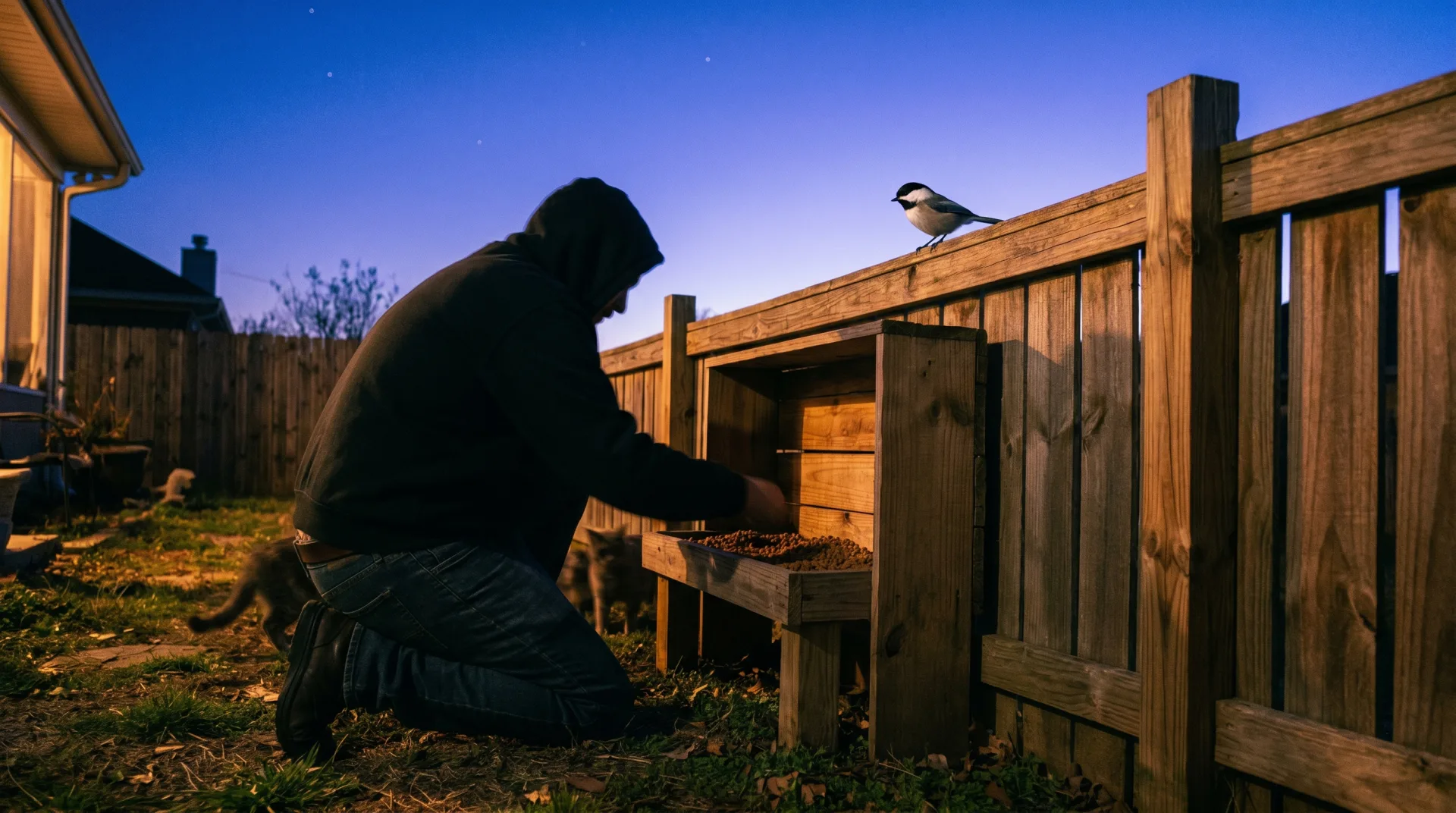
The honest synthesis is that both sides agree outdoor cats are a wildlife problem. The empirical question is which policy lever solves it. The evidence supports sustained TNR at funded scale, not unfunded volunteer effort and not catch-and-kill animal control.
What North Carolina Should Fund
Three policy changes close the gap. All three are statutory. None require new tax revenue. The first is the immediate ask; the second scales it; the third hardens the funding for the long run.
Change 1: Expand eligibility to community-cat TNR. Amend the NC Spay/Neuter Program enabling language to make community-cat TNR/TNVR an eligible procedure for state reimbursement. Existing administrative infrastructure handles intake, vendor reimbursement, and reporting. Adding a new procedure code is a routine administrative change. The legislative change is one section of a one-page bill.
Change 2: Add a recurring appropriation tied to county participation. A modest annual appropriation, in the range of $500,000 to $1 million scaled to county participation, routed through the existing program. Florida Animal Friend and the New Jersey APCP both pair plate or check-off revenue with a state appropriation. The fiscal model is documented above. Cook County, Illinois reported saving more than $1.5 million by switching to a funded TNR model, and per-cat cost differences across the programs Best Friends has reviewed are large enough that net taxpayer savings should exceed program cost within a few years of full operation.
Change 3: Add an income tax check-off. Massachusetts and New Jersey both use this. It is a low-friction revenue source with no impact on the general fund. This is most likely a 2027 or 2028 lift, not the immediate ask, but flagging it now positions the program for sustained growth. The Massachusetts model in particular is worth watching, because tax check-off revenue grows with awareness, not legislative appetite.

What to Ask Your NC Representative For
The 2026 short session is the window. Email your House and Senate members with one specific ask. Vague advocacy gets form replies; specific asks get logged, sorted, and summarized for the legislator.
Pick one of the three asks below and put it in your email. If you have time, stack two. Reference the existing NC Spay/Neuter Program by name (it lives at NCDA&CS) and reference the cost data above so your message reads as substantive rather than purely emotional.
- Introduce a bill to expand NC Spay/Neuter Program eligibility to community-cat TNR. No standards-of-care or eligibility-expansion bill specifically for community cats has been filed in the 2025-2026 session. The first ask is simply that one gets filed. Reference the structure: a one-section amendment adding TNR/TNVR as a reimbursable procedure category under the existing program.
- Add a recurring community-cat appropriation. Request a recurring annual appropriation of $500,000 to $1 million for community-cat sterilization, scaled to county participation and routed through the existing NCDA&CS program. Cite the Cook County, Illinois savings of more than $1.5 million and the per-cat cost differences ($65 to $72 TNR versus $135 to $168 catch-and-kill) documented in the Best Friends policymaker brief.
- Pass a shelter data reporting mandate. Statewide annual reporting of intake, outcome, and euthanasia data. We flagged this in our post on how to contact your NC rep, and we flagged it again in our breakdown of NC’s broader animal welfare statutory gap. Community-cat policy needs the data infrastructure to track program outcomes.
If you are not sure who your rep is, our rep lookup tool finds your NC House and Senate members from your address and auto-fills a letter template. The full walkthrough is in our post on how to contact your NC state rep. It takes under five minutes.
For the broader cluster context, see our shelter data breakdown in North Carolina’s pet overpopulation crisis, our profile of states that got it right on spay/neuter funding, and our policy gap analysis in NC’s breeder regulation gap.
Frequently Asked Questions
Key Takeaways
- TNR costs $20 to $97 per cat across published US programs; impound-and-euthanize costs $52 to $123 per cat (Best Friends Animal Society policymaker brief). Catch-and-kill is more expensive in every comparison reviewed.
- Sustained, sufficiently dense sterilization reduces community-cat populations over a 5- to 10-year timeline. Low-level intermittent removal does not, because removed cats are replaced through reproduction (ASPCA position statement, citing Boone et al. 2019).
- NC has the funding mechanism. The “Animal Lovers” license plate and existing NCDA&CS Spay/Neuter Program supported 5,855 procedures in 2023. Community-cat TNR is not eligible.
- New Jersey (1983) and New Hampshire (1994) built statewide sterilization funding mechanisms before NC’s program was launched in 2001. Florida’s specialty plate funds Florida Animal Friend, which runs a dedicated Feral Cat Program grant track NC could replicate.
- Closing the gap takes a one-section statutory amendment to add community-cat TNR/TNVR as a reimbursable procedure category. No new taxes required.
- Statewide euthanasia rose from 22% (2021) to 27% (2024) per WRAL Investigates’ analysis of NCDA&CS data. The cost of inaction is rising.
The fiscal case is closed and the public-policy case follows. Sign the petition for state-funded community-cat TNR, email your NC rep with one of the three asks above, and share this post with anyone who pays NC taxes and cares about animals.
For owned-pet spay/neuter access (separate from community-cat TNR) See our low-cost spay/neuter clinics for owned pets for the 2026 county-by-county directory of voucher programs, clinics, and mobile units.
Dealing with feral cats in your area?
NC Pet Project can help you get a TNR program started. We'll connect you with resources, training, and our volunteer network.