The most common hesitation NC Pet Project hears from dog owners who have not yet neutered their pet is some version of: “I don’t want him to change.” It is a fair concern, and it deserves a direct answer instead of reassurance that glosses over the details.
The short version: neutering does change some behaviors, specifically those driven by testosterone. It does not change personality, trainability, playfulness, or the bond your dog has with you. Whether those changes are what you were worried about depends on what your dog is currently doing. Here is the full picture.
The Behaviors That Neutering Actually Changes
Neutering eliminates testosterone production. Testosterone is the primary driver of a specific cluster of reproductive and competitive behaviors. When it drops, which happens gradually over several weeks after surgery, those behaviors reduce or disappear in most dogs.

According to the ASPCA, the evidence on specific testosterone-driven behaviors is consistent across studies:
- Roaming to find a mate: Reduced in approximately 90% of male dogs. Intact males have been known to travel miles to reach a female in heat. Neutering removes the hormonal drive entirely.
- Mounting and humping: Reduced in approximately two-thirds of dogs. This behavior has both hormonal and learned components, which is why it does not disappear in every dog.
- Urine marking indoors: Reduced in approximately half of dogs. Marking is partly territorial (not purely reproductive), so results vary. Dogs that have been marking indoors for years are more likely to continue out of habit even after hormone levels drop.
- Inter-male aggression: Reduced in approximately 60% of dogs. Again, if dog-to-dog aggression has become a learned, practiced behavior independent of hormonal arousal, neutering is less effective.
The consistent pattern across all of these: neutering is most effective when done before the behavior becomes established as a learned habit. A dog that has been roaming, marking, or fighting for three years has likely reinforced those patterns neurologically beyond their hormonal origin. This is one of the genuine arguments for not waiting too long. For small and medium breeds, earlier timing has clearer behavioral benefits. For large breeds, see the breed-size timing considerations in our spay/neuter timing guide.
What Neutering Does Not Change
This is the part that matters most to most pet owners, and the answer is reassuring.
| Behavior or Trait | Does Neutering Change It? | Notes |
|---|---|---|
| Personality and affection | No | Core temperament is genetic and shaped by environment, not testosterone |
| Playfulness and energy | No | Activity level is not hormone-dependent in adult dogs |
| Learned behaviors (barking, jumping, pulling) | No | These require training; neutering has no effect on them |
| Anxiety or fearfulness | No | Anxiety is not hormone-driven; some research suggests early neutering may slightly increase anxiety in certain breeds |
| Guarding and protectiveness | No | Territorial guarding is not primarily testosterone-dependent |
| Bond with family | No | Attachment behaviors are unaffected; many owners report their dog seems more focused on them after neutering |
| Appetite and weight | Slightly | Metabolism slows modestly after neutering; portion adjustment and exercise prevent weight gain |
| Trainability and obedience | No change or improves | Less distraction from hormonal drives can improve focus during training sessions |
The short version of this table: if the behavior you are worried about is one your dog does because it is a habit, a personality trait, or something it was taught (or allowed) to do, neutering will not fix it. And neutering will not take anything away from the dog you already love.
Does the Timing of Neutering Affect Behavior?
Yes, with important nuance. For behaviors that are hormone-driven, neutering before those patterns become established is generally more effective. A male dog that has never experienced the hormonal drive to mark indoors is far less likely to develop the habit than one who has been doing it for two years before surgery.
For small and medium breeds, this supports earlier neutering, typically in the 5–6 month window, if behavioral goals are a priority. For large and giant breeds, the picture is more complicated because early neutering before skeletal maturity is associated with higher rates of certain joint disorders. The behavioral benefit of early neutering has to be weighed against those orthopedic risks for large dogs. See our timing guide by breed size for the full breakdown, including the latest recommendations from the UC Davis research group.
One important clarification on aggression specifically: if your dog is already showing aggression toward people, neutering is unlikely to resolve it and should not be the primary intervention. Human-directed aggression requires behavioral evaluation and training. Neutering may reduce reactivity slightly in some dogs, but it is not a treatment for aggression.
What to Expect in the Weeks After Surgery
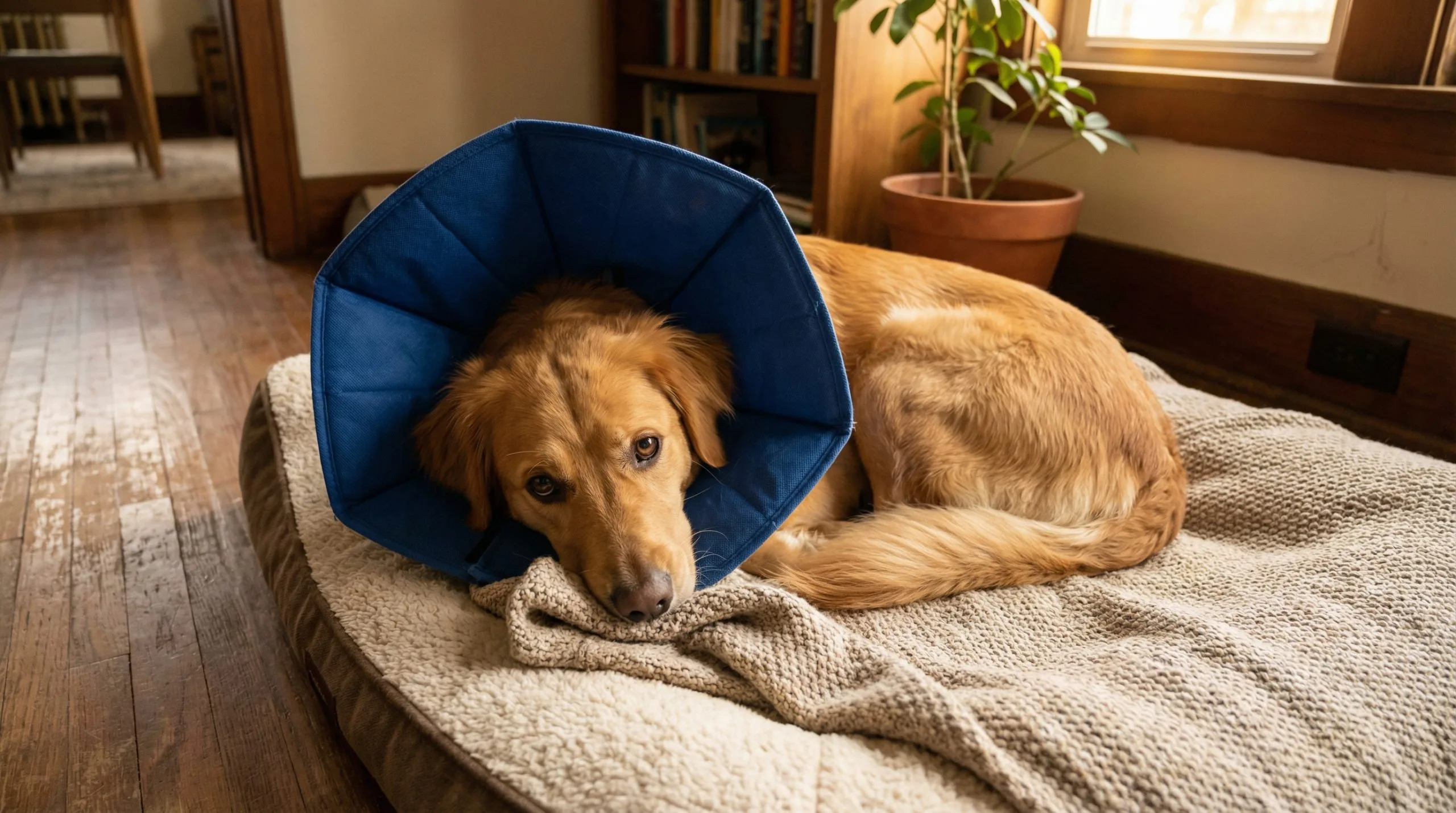
The surgical recovery and the behavioral change are two separate timelines. Here is what to expect for each:
Surgical recovery (first 7–14 days):
- Lethargy and reduced appetite for 24–48 hours after anesthesia (normal and expected)
- E-collar required to prevent licking at the incision site; most dogs adapt within a day
- Restricted activity: no running, jumping, or swimming until the incision heals
- Most dogs are back to normal energy by day 3–5; full healing takes 10–14 days
- Pain medication is typically sent home; give as directed even if your dog seems comfortable
Behavioral changes (weeks to months):
- Testosterone drops gradually after surgery, not immediately; do not expect instant behavior changes
- Roaming and marking behaviors typically reduce over 4–8 weeks as hormone levels stabilize
- Some dogs show behavior changes within weeks; others take several months
- Behaviors that have become learned habits may persist even after testosterone is gone; these are training issues, not surgical ones
The Behavior Question Is the Wrong Frame
Most veterinarians would tell you that behavior change is not the primary reason to neuter your dog; it is a secondary benefit. The primary reasons are population control and health:
- Population control: One unneutered male dog can father hundreds of offspring over his lifetime. NC shelters euthanize more than 20,000 animals per year. Neutering your male dog prevents him from contributing to that number.
- Health: Neutering eliminates testicular cancer (100% prevention) and significantly reduces the risk of prostate disease. Intact male dogs have a roughly 60% lifetime risk of developing benign prostatic hyperplasia. For a full picture of the health research, see our spay/neuter health benefits guide.
Want the full guide? Behavior is one chapter. Our Spay & Neuter 101 hub for NC pet owners covers the whole decision: cost ladders, breed-size timing, health benefits, recovery expectations, and which NC program fits your household.
Frequently Asked Questions
Cost is the most common reason pet owners delay or skip the procedure. See our low-cost spay/neuter clinic in NC for the 2026 county-by-county directory of voucher programs, clinics, and mobile units.
Need help with the cost of spay/neuter?
NC Pet Project offers spay/neuter vouchers for low-income pet owners across North Carolina. If you can't afford the surgery, we want to help.