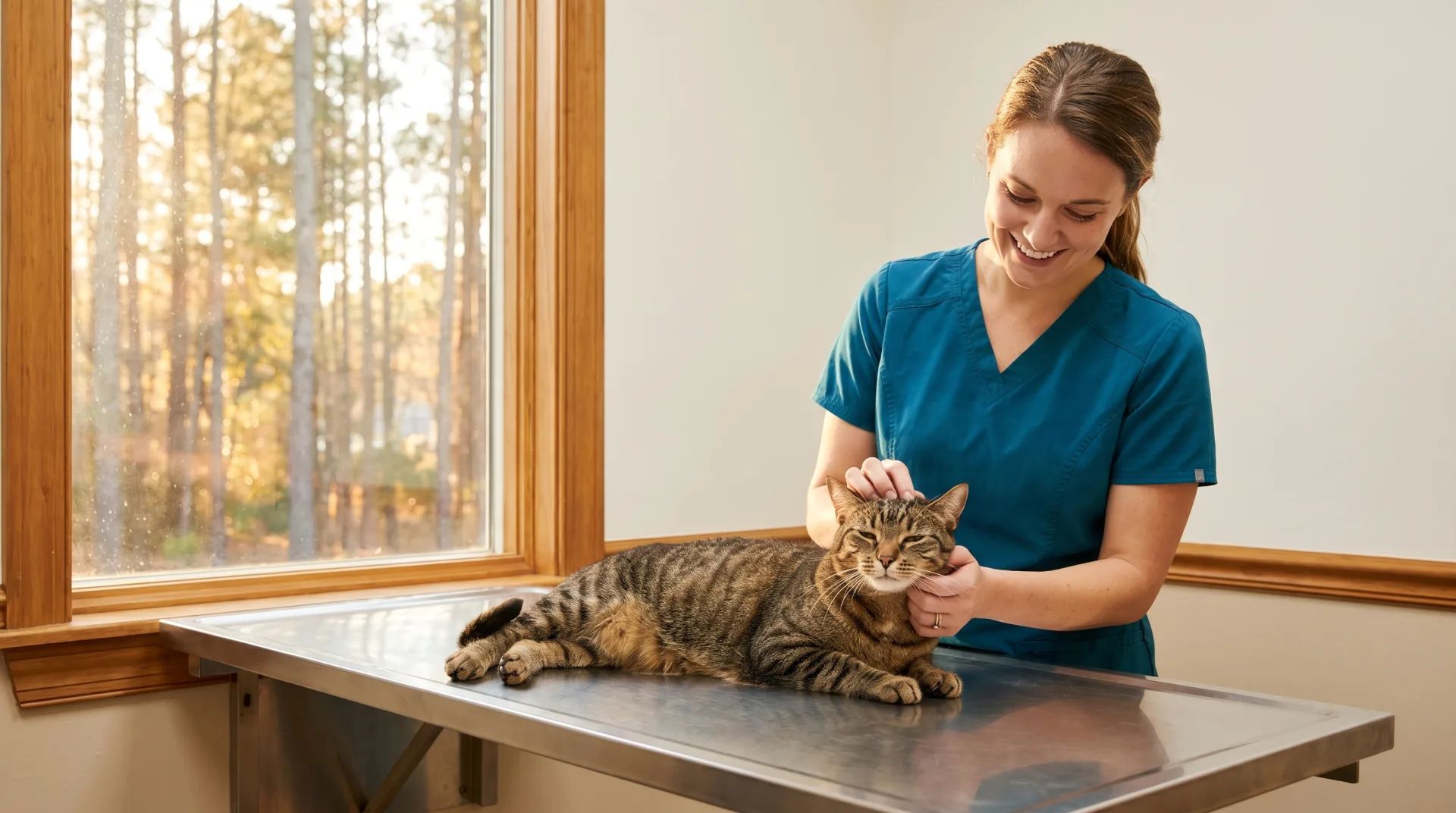
Spay & Neuter 101: The Complete Guide for NC Pet Owners
Everything NC pet owners need: when to spay or neuter, what it costs, health benefits, behavior changes, and where to get help, from the state program to low-cost clinics.
The short version: Spaying (females) and neutering (males) are routine surgeries that prevent reproduction, sharply reduce cancer and infection risk, and address the pet overpopulation crisis behind the 39,202 dogs and cats euthanized in North Carolina’s reporting public shelters in 2025. Cats are usually altered by five months; dogs anywhere from about five months to fifteen months, depending on size and sex. A dog spay averages about $426 at a private NC vet, nonprofit clinics charge about $35 to $270, and in counties that take part in the state program, the county sets what low-income owners pay. This guide answers every question a first-time NC pet owner has and links to deeper resources on each part of the decision.
If every dog and cat in North Carolina were spayed or neutered, our public shelters wouldn’t be euthanizing tens of thousands of animals a year (39,202 dogs and cats in 2025, per NC DACS). That figure isn’t a moral failing of pet owners. It’s a math problem with a surgical solution, and the math gets easier every time an owner schedules the procedure.
This is the hub guide. It covers what spaying and neutering actually are, why veterinarians and welfare groups recommend them, when most pets should be altered, what it costs in North Carolina, the health and behavior effects, and how to get help paying for it. Each section links to a deeper guide if you want the full detail, and every NC-specific path routes back to the programs that can cover your costs.
What Are Spaying and Neutering?
Spaying is the surgical removal of a female pet’s ovaries, and usually the uterus. Neutering is the surgical removal of a male pet’s testicles. Both procedures end the ability to reproduce, and both are routine. In 2019, just 212 high-volume US spay/neuter clinics performed more than 1.2 million of these surgeries (Guerios, Clemmer and Levy, 2025), on top of the many done at full-service practices.
The terminology trips a lot of new owners up. Spay refers to the female procedure. Neuter refers to the male procedure, though “neuter” is sometimes used as the gender-neutral umbrella term in clinical writing. “Sterilize” and “fix” mean the same thing in everyday conversation. When a clinic asks whether your pet is “altered” or “intact,” they’re asking whether it has been spayed or neutered.
The surgery itself is quick, usually well under an hour, depending on species, size, and whether the dog is in heat. Both are performed under general anesthesia, and most clinics discharge the pet the same afternoon. Pre-anesthetic bloodwork is often recommended, especially for older pets, to flag any anesthesia risk before surgery begins.
Most owned pets in the United States are already altered, especially in mainstream pet-owning households. The bigger gap is in underserved communities, where roughly 88% of pets are unaltered, not because owners don’t want the surgery but because cost and transportation are real barriers (Humane World for Animals “Pets by the Numbers”). That gap, plus unowned community cats, is exactly where NC’s assistance programs focus.
Why Spay or Neuter? The Case in 60 Seconds
The case for spaying and neutering comes down to three connected arguments. First, population. NC shelters take in tens of thousands of unwanted dogs and cats every year, and the math doesn’t improve without altering pets at the source. Second, health. Spayed and neutered pets have sharply lower risk of several cancers and infections, especially when the procedure is done early. Third, behavior. Hormone-driven roaming, urine marking, and intermale aggression decline significantly after surgery, which makes pets easier to live with.
The population math is striking. One unspayed female and her offspring can, in theory, produce several generations of litters within a few years. Those are theoretical ceilings rather than typical outcomes, but they make the underlying point clear: a small number of unaltered pets can drive a very large shelter intake problem.
The health case is concrete. The ASPCA reports that mammary tumors in unspayed female dogs are malignant in roughly 50% of cases, and in unspayed female cats roughly 90% of cases. Spaying before the first heat cycle dramatically reduces lifetime mammary cancer risk. Neutering eliminates testicular cancer risk in males of both species. Spaying also eliminates the risk of pyometra, a uterine infection that is common in older unspayed dogs and can be fatal if untreated.
The behavior case is the most misunderstood. We’ll cover it in detail in the behavior section below, but here’s the headline: hormone-driven behaviors decline. Personality, intelligence, energy level, and trainability do not. The dog or cat you brought home is the dog or cat you keep.
There’s also a piece of context that hasn’t shown up in most pet-owner guides yet. The COVID-19 pandemic created a significant spay/neuter capacity deficit nationally. Guerios, Clemmer, and Levy, writing in Frontiers in Veterinary Science in March 2025 (PMC11968670), tracked 212 high-volume US spay/neuter clinics from 2019 through mid-2023. They found these 212 clinics alone performed 261,763 fewer surgeries than expected over those 42 months. Extrapolated to the estimated 3,000 high-volume clinics nationally, the cumulative deficit reached about 3.7 million surgeries. In our view, NC’s shelter intake numbers in 2025 and 2026 still reflect that backlog.
When Should You Spay or Neuter Your Pet?
For most cats, the answer is by five months of age, before the first heat cycle (AVMA). For dogs expected to weigh under 45 pounds, it’s around six months, or five to six months for females so the spay comes before the first heat. For dogs 45 pounds and over, the AAHA 2019 Canine Life Stage Guidelines say males should wait until growth is complete, usually nine to fifteen months, and leave spay timing for females anywhere from five to fifteen months to your vet’s judgment. The right window depends on species, sex, breed, and size, and your vet’s recommendation should be the final word for your specific pet.
The “earlier is better” rule used to be universal. It still holds for cats and for small-to-medium dogs. Where the conventional wisdom has shifted is large and giant breeds, where multiple breed-specific studies through the 2020s found higher rates of cruciate ligament injury, hip dysplasia, and certain cancers when surgery happened before the growth plates closed. The clinical answer for those breeds is to wait, not to skip the procedure. For female dogs, that means weighing joint health against mammary tumor protection, which is strongest before the first heat.
There’s also a sex-specific timing wrinkle for female dogs. Spaying before the first heat cycle is when the mammary cancer protection is strongest. Each subsequent heat cycle the dog goes through erodes some of that protective effect. For small breeds, this aligns with the five-to-six-month window naturally. For large breeds, it’s a real trade-off, and one to discuss with your vet.
Here’s the quick reference, based on the AAHA 2019 Canine Life Stage Guidelines for dogs and the AVMA-endorsed recommendation for cats. Our timing guide explains the underlying research.
| Species & size | Typical window | Key reason |
|---|---|---|
| Cat (any size) | By 5 months | Before first heat; cats can become pregnant by 4 months |
| Small dog (under 45 lb adult) | About 6 months (females 5 to 6 months) | Before first heat; skeletal growth completes early in small breeds |
| Larger dog (45 lb and up), male | When growth stops, usually 9 to 15 months | Letting growth plates close reduces joint disease risk |
| Larger dog (45 lb and up), female | 5 to 15 months, case by case with your vet | Balance mammary tumor protection against joint and other risks |
| Giant breed | Ask your vet about breed-specific research | Latest skeletal maturation; UC Davis breed guidelines cover 40 breeds |
The reason timing matters is that reproductive hormones affect skeletal growth, especially in large breeds, and they also affect lifetime cancer risk in females. Spaying a small dog at six months and a giant-breed dog at six months are not the same decision. The growth-plate effects, the joint disease risk, and the cancer-prevention math all shift with breed size.
What Does Spay or Neuter Surgery Actually Cost?
In North Carolina, the price for the same surgery varies more than six-fold depending on where you go. At a private NC vet, a dog spay averages about $426 and a dog neuter about $459 (CareCredit, 2025 study), and a cat spay runs about $300 to $400 (MetLife). At a regional nonprofit clinic such as ASPCA Spay/Neuter Alliance in Asheville ($65 for a dog), Humane Society of Charlotte ($150 for a dog spay, plus $25 to $50 for dogs over 50 pounds) or SPCA of Wake County ($230 to $270 for a dog spay), the price drops to about $65 to $270 for dogs and $35 to $120 for cats. Through the NC Department of Agriculture’s Spay/Neuter Program, participating counties and cities are reimbursed for surgeries for low-income residents, and each county sets what the owner pays. The chart below shows the ladder for a typical dog spay, which is the procedure where the price spread is widest.
Why the spread? A few honest reasons. Larger dogs need more anesthesia, longer surgery time, and more post-op medication, which drives price up. Private practices carry higher overhead (clinical real estate, full-spectrum staffing) than high-volume spay/neuter clinics that focus on one type of surgery. Pre-op bloodwork, pain medications, and an e-collar can add to the bill at private practices and are often baked into the nonprofit price. None of this is mark-up for its own sake. It’s the structural difference between full-service and high-volume models.
The NC state program deserves a closer look because it’s how most low-income NC residents actually pay for the surgery. The program is funded by $20 from each Animal Lovers “I Care” plate sale and renewal plus a state appropriation, held in a nonreverting account (G.S. 19A-62). In 2025 that was a $250,000 appropriation plus $122,228 from plates. The program reimbursed 5,938 procedures and paid $250,954 against $659,626 in eligible county requests, about 38 cents on the dollar (NC DACS), at 2026 maximum reimbursement rates of $120.11 to $220.80 per surgery depending on species and procedure (NCDA&CS). Buy the plate, help fund a surgery. Our breakdown of the “I Care” spay/neuter license plate has the details.
What Are the Health Benefits of Spaying and Neutering?
The health benefits are real and well documented across decades of veterinary research. They split by sex and species, but the pattern is consistent: removing the gonads removes the risk of cancers and infections that originate in those organs, and it sharply reduces the risk of other hormone-sensitive conditions. The earlier the procedure, the stronger most of the protective effects.
For female dogs, spaying eliminates the risk of pyometra (a uterine infection that becomes more common in older unspayed dogs and can be fatal if untreated) and reduces the risk of mammary tumors. The mammary tumor reduction is dramatic when spaying is done before the first heat. The ASPCA reports that mammary tumors in dogs are malignant in roughly 50% of cases, so reducing their incidence in the first place is a significant lifetime health intervention.
For female cats, the same logic applies more sharply. Cat mammary tumors are malignant in roughly 90% of cases per the ASPCA. Spaying a cat before its first heat is the single most effective preventive cancer measure available in feline veterinary medicine. The protective effect is age-dependent. Spaying before six months provides the greatest reduction.
For male dogs, neutering eliminates the risk of testicular cancer and significantly reduces the risk of benign prostatic hyperplasia and perineal hernias. For male cats, neutering reduces the risk of feline immunodeficiency virus (FIV), which spreads mainly through bite wounds, because intact toms travel further from home, fight more, and bite other cats more often. The effect on feline leukemia virus (FeLV) is smaller, since FeLV also spreads through mutual grooming and shared food bowls and litter boxes (Cornell Feline Health Center).
Longevity is the other commonly cited benefit. Multiple large-scale studies have associated spayed/neutered status with longer lifespan in both dogs and cats. The causal pathway is debated. Some of the longer life expectancy reflects selection effects (people who alter their pets tend to also provide better overall care), but the avoided cancer and infection risk explains a measurable portion of the difference.
Will Spaying or Neutering Change My Pet’s Behavior?
Yes, but only the behaviors driven by reproductive hormones. Heat cycles end. Urine marking declines. Roaming declines significantly, especially in male cats and male dogs. Intermale aggression often improves. What doesn’t change: personality, intelligence, energy level, trainability, or temperament. The dog or cat you adopted is fundamentally the dog or cat you keep.
There are three myths that come up constantly, and they’re worth addressing directly because they prevent owners from scheduling surgeries that would benefit their pets.
“He’ll get fat.” The surgery itself doesn’t cause weight gain. Metabolic rate drops slightly after the procedure, so the same food portion can lead to weight gain over time. The fix is portion control. Ask your vet how much to trim portions after surgery and adjust based on body condition. This is fully manageable.
“She should have one litter first.” No mainstream veterinary organization recommends this. The opposite is true. Spaying before the first heat is when the mammary cancer protection is strongest. One litter doesn’t make your dog or cat happier or healthier. It produces more pets in a state where shelters are already euthanizing tens of thousands a year.
“He’ll lose his personality.” Personality isn’t hormone-mediated. Energy, playfulness, attachment to people, fear responses, and quirks all stay the same. The behaviors that change are the ones that exist because of testosterone or estrogen, and most owners are relieved when those go away.
Where Can NC Pet Owners Get Help Paying for Spay or Neuter?
North Carolina has one of the more robust affordability networks in the southeast, but it’s fragmented across three main paths. Many income-eligible households can get the procedure done for little or nothing if they know which door to walk through. Here’s how the three paths fit together.
Path 1: The NC state spay/neuter program. Administered by the NC Department of Agriculture’s Animal Welfare Section, this is the state’s reimbursement program. Eligible households have income below 100% of federal poverty guidelines OR receive SNAP, Medicaid, TANF, or other DHHS-administered assistance, per the NCDA&CS program FAQ. The program is administered through participating cities and counties. Coverage isn’t statewide; if your county hasn’t opted in, you need a different path.
Path 2: Regional nonprofit clinics. Our county-by-county coverage directory lists 39 organizations that perform the surgery, including ASPCA Spay/Neuter Alliance in Asheville, Humane Society of Charlotte, SPCA of Wake County, Operation Catnip-Raleigh, and many more. These clinics offer lower-than-private pricing, usually without an income test.
Path 3: Mobile clinics and statewide referral. For residents in rural counties without a fixed low-cost clinic nearby, mobile clinics travel on regular routes, and the AnimalKind Spay Neuter Network directory can route you to the closest available option.
The decision tree is simpler than it looks. If you receive means-tested benefits or your household income is below 100% of federal poverty guidelines, start with the state program through your county. If you don’t qualify for the state program or your county doesn’t take part, head to a regional nonprofit clinic. If you can’t reach any of those options, the AnimalKind directory will route you to a mobile clinic.
Find low-cost spay/neuter near you
NC Pet Project does not run its own voucher program. Our zip code finder points you to low-cost clinics and programs near you.
What to Expect on Surgery Day and During Recovery

Most clinics ask owners to fast their pet from food after midnight the night before surgery. Water is usually fine. Confirm specifics with the clinic, since requirements vary slightly between high-volume clinics and private vets. The morning of surgery, you’ll drop your pet off, sign paperwork covering anesthetic risk and pre-op bloodwork (often optional, recommended for older pets), and head home until the afternoon pickup window.
The surgery itself is the short part of the day. Your pet will be sedated, intubated, prepped, operated on (usually well under an hour), and moved to a warm recovery area. Most clinics monitor the pet for two to four hours before discharge. You’ll go home with pain medication, an e-collar, and post-op instructions.
The first 24 hours, your pet will be groggy and uninterested in food. Offer a small meal that evening, but don’t force eating. Keep them in a quiet, low-stress area, ideally away from other pets and children. Check the incision once before bed. It should be clean, dry, and the edges should be neatly aligned.
The next 10 to 14 days are about activity restriction. No running, no jumping, no rough play, no off-leash time. Walks on leash only for dogs. Keep cats in a quiet room if they’re indoor-outdoor cats normally. Check the incision daily. Healing should be steady and uneventful.
Call the clinic if you see any of these red flags: incision opening, persistent vomiting, lethargy lasting more than 24 hours, swelling at the surgical site, discharge from the incision, refusal to eat past 24 hours, or any sign of pain that pain medication isn’t controlling. Serious complications from spay/neuter are uncommon, but they’re worth catching early.
The Bigger Picture: How Spay and Neuter Connect to NC’s Overpopulation Crisis
This guide has focused on the personal decision, but there’s a policy frame that matters. Best Friends Animal Society ranks North Carolina third in the nation for the number of shelter dogs and cats that still need to be saved each year, about 36,900 (2025 data, released April 2, 2026). The single most cost-effective intervention to change that ranking is upstream prevention, which is to say spay/neuter capacity at the access-to-care end of the spectrum.
Owner-level alteration rates are already high in mainstream pet-owning households. The gap is concentrated in underserved communities, where roughly 88% of pets are unaltered (Humane World for Animals “Pets by the Numbers”), not because owners don’t want the surgery but because cost and transportation are real barriers. That’s the population the NC state program is designed to reach.
That’s where state policy can move the needle. Growing the state Spay/Neuter Account (plate revenue plus a larger appropriation), supporting funded community-cat (TNR) programs, and matching neighboring states on breeder regulation would all move NC away from its current bottom-five-state ranking. The NC pet overpopulation crisis post breaks down the state-level numbers, the state-funded TNR post covers the fiscal case for community cat management, and the no-kill movement post tracks where NC stands against the rest of the country.
If this matters to you, sign the petition to call on NC’s General Assembly to expand spay/neuter funding when the 2027 long session convenes on January 13, 2027.
Sign the petition for stronger NC spay/neuter funding
NC’s General Assembly needs to hear from constituents who want the state program scaled to match the size of the problem. Petition signatures are the simplest legislative pressure available.
Frequently Asked Questions
Yes, for healthy pets. Spay and neuter are routine surgeries; in 2019, just 212 high-volume US clinics performed more than 1.2 million of them (Guerios, Clemmer and Levy, 2025). Pre-anesthetic bloodwork and modern anesthetic protocols reduce risk further. Risk is higher for very young, very old, or chronically ill animals, which is why pre-op screening matters, but for healthy pets the safety record is well established.
Healthy puppies and kittens can be spayed or neutered as young as eight weeks, per the ASPCA. Typical timing is by five months for cats, around six months for dogs under 45 pounds, and later for bigger dogs: males of 45 pounds or more once growth stops, usually nine to fifteen months, and females case by case between five and fifteen months (AAHA 2019). The right window for a specific pet should come from your vet, with breed size as the primary timing variable.
Most pets are eating and moving normally within 24 to 48 hours, but full activity restriction lasts 10 to 14 days. The incision is typically fully healed by day 14. During the restriction period, no running, jumping, rough play, or unsupervised time. Walks on leash only for dogs. Check the incision daily for swelling, discharge, or any sign of opening.
Not directly. The surgery doesn’t cause weight gain, but metabolic rate drops slightly after the procedure, so the same food portion can lead to gradual weight gain. The fix is portion control: trim portions as your vet advises and adjust based on body condition. Weight gain is fully preventable with normal portion management.
If you’re an NC resident with household income below 100% of federal poverty guidelines OR you qualify for DHHS-administered public assistance such as SNAP, Medicaid, or TANF, the NC state program reimburses participating cities and counties for most of the procedure cost, and each county sets what the owner pays (NCDA&CS). Ask your county animal services whether it takes part. Nonprofit clinics charge about $35 to $120 for cats and $65 to $270 for dogs.
Generally no. Adult dogs and cats can be safely spayed or neutered well into senior age. Pre-anesthetic bloodwork becomes more important after age seven, and recovery is sometimes slower than in young animals. Discuss specifics with your vet, but age alone is rarely a reason to skip the procedure. Health benefits like pyometra prevention apply at any age.
The Bottom Line
Spaying and neutering reduce cancer and infection risk, eliminate heat cycles and most hormone-driven behaviors, and slow the math that fills NC shelters. The decision is well established in veterinary medicine and well supported by decades of research. The only real question for most NC pet owners is logistical: when to schedule, where to go, and how to pay for it.
The answer to “when” depends on species, sex, and breed size, and the timing guide walks through the details. The answer to “where” depends on geography and budget, and the county-by-county guide covers every NC option. The answer to “how to pay” runs through the NC state program, and the nonprofit clinics in our coverage directory.
If you want NC’s state program to scale to match the size of the problem, the petition takes about thirty seconds.