For every $1 New Hampshire spent on its state spay/neuter fund, the state saved $3.15 in reduced shelter intake and euthanasia costs (ASPCA Pro). That’s not a moral argument. That’s a return on investment. And it’s one of four state-level funding models that have worked, while North Carolina continues to lean on a single voluntary license plate.
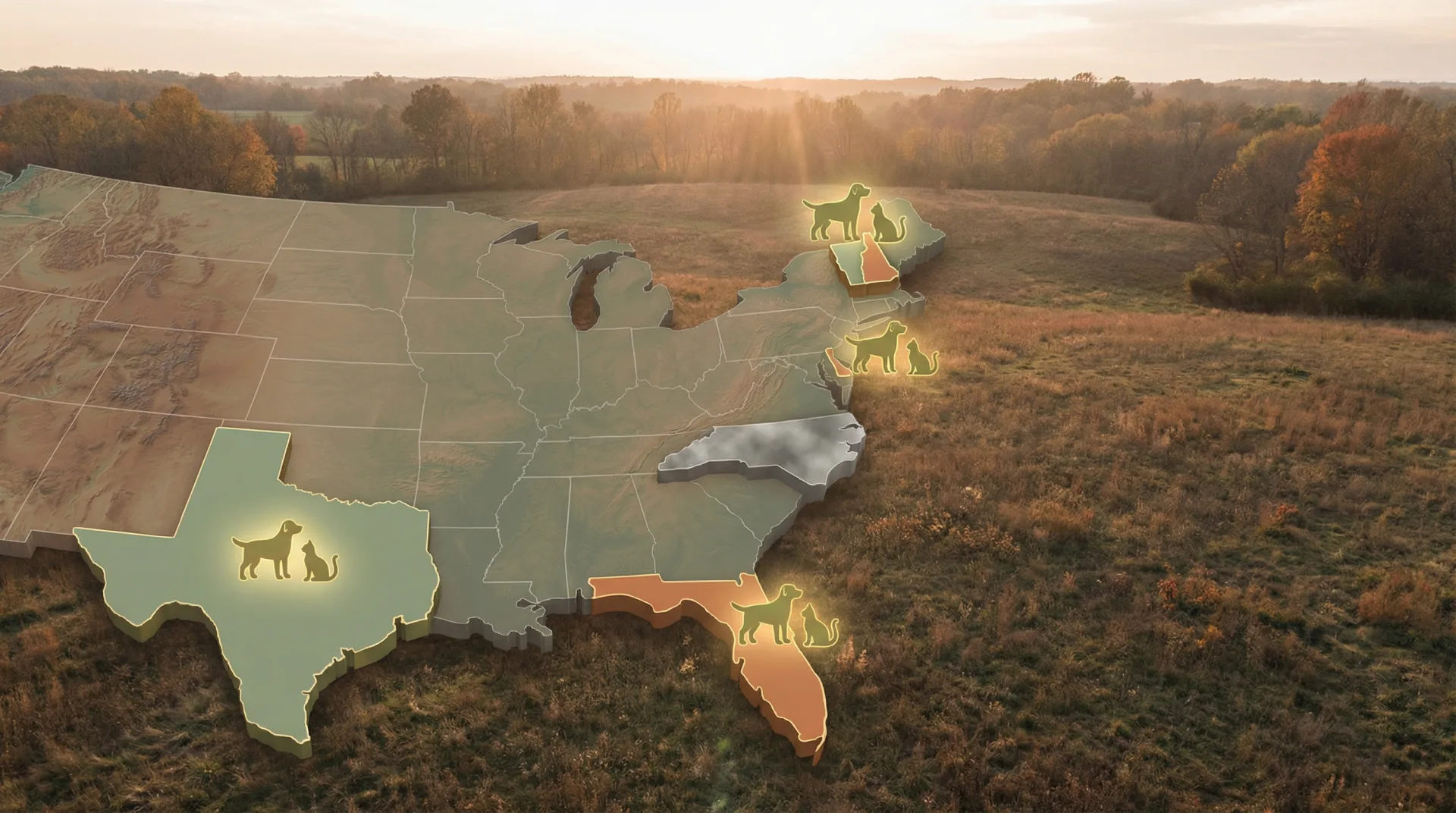
NC euthanized more than 20,000 shelter animals in 2024, more than three times the national average kill rate (WRAL Investigates, Nov 2025). Meanwhile, Texas just appropriated $13 million for a brand-new state pilot program. New Hampshire funded its program in 1994. Delaware did it in 1995. Florida’s specialty plate has been grant-making for years.
So what are they doing that NC isn’t? And what would it actually take to catch up?
TL;DR: Four states have built sustainable spay/neuter funding. New Hampshire’s $2 dog license surcharge returns $3.15 for every $1 spent (ASPCA Pro). Florida’s “Animal Friend” plate disbursed $588,650 in 2019. Texas just appropriated $13M. Delaware routes $35 per plate into a dedicated state fund. NC relies on a single voluntary plate, and it shows. Sign the petition demanding NC catch up.
Why Does State Funding Matter More Than You Think?
Per-capita euthanasia of cats and dogs in U.S. shelters has fallen more than 90% since large-scale spay/neuter clinics began opening in the 1970s (Frontiers in Veterinary Science, 2025). That progress is real. But it stalls wherever low-income pet owners can’t access the surgery.
That’s the problem NC has right now. Spay/neuter services exist in urban counties. They’re scarce in rural ones. Families on Medicaid or SNAP often can’t afford the $200 to $500 market rate, and the closest low-cost clinic might be an hour away. Without a statewide funding mechanism, the safety net has holes you can drive a truck through.
County-by-county voucher patchworks (which is what NC has today) can’t close those gaps. Counties with strong nonprofit ecosystems, think Wake, Mecklenburg, Durham, already run decent programs. Rural counties with no local clinic and no budget to build one are left out. The only level of government that can fix that unevenness is the state. And every state profiled below figured that out years ago.
There are four working models: license-fee surcharges, specialty-plate grant programs, direct legislative appropriations, and dedicated state funds. NC uses a watered-down version of the third, without the money. Here’s how the others actually do it.
How Does New Hampshire’s Spay/Neuter Program Work?
New Hampshire funds its state spay/neuter program through a $2 surcharge added to every dog license sold in the state. The revenue flows into a dedicated fund that subsidizes sterilization for pets owned by low-income families (ASPCA Pro). The fund returns $3.15 in reduced shelter costs for every $1 spent.
The legislation was championed by a Concord attorney named Peter Marsh, who spent three years pushing the bill through the NH legislature between 1991 and its passage in 1994 (Best Friends Animal Society). NH pet owners receiving Medicaid, food stamps, or one of five other public assistance programs can get a voucher. The copay started at $15 and was raised to $25 in 2005 to keep up with surgery costs. That’s it. Low admin burden, no annual appropriation fight, predictable revenue every year.
The outcomes back up the math. NH has achieved an 83% statewide live release rate and a shelter death rate of just 1.9 per 1,000 residents, described by Best Friends Animal Society as effective no-kill status at the state level (Best Friends Animal Society). Researchers have linked that outcome directly to the surcharge program and its focus on the highest-risk pet population.
Here’s the part NC lawmakers should pay attention to: this is a fiscally conservative policy. It isn’t a new tax. It’s a small surcharge on a fee pet owners already pay, and it pays itself back three-to-one by reducing the number of animals local governments have to intake, house, and euthanize. When the bill was debated in the NH legislature, that’s the argument that moved it. Animal welfare was the why. Cost savings was the how.
How Does Florida’s License Plate Program Fund Spay/Neuter?
Florida’s “Animal Friend” specialty license plate routes $25 from every plate sold or renewed into a grant pool. Those grants, up to $25,000 per organization, fund free and low-cost spay/neuter services at municipal shelters and nonprofits across the state (Florida Animal Friend). In 2019, the program disbursed $588,650 to 32 grant recipients (PR Newswire).
The structural advantage of the plate model is that revenue scales with goodwill, not politics. When Floridians who love animals renew their plates, the fund grows. There’s no appropriation fight, no budget line item to protect, no risk that a new governor zeroes it out. Over three recent years, the program has moved more than $1.7 million into grassroots spay/neuter programs (PR Newswire).
FLAspay.com, the program’s county lookup, lists at least one low-cost or free service in every Florida county that participates (FLAspay.com). That kind of statewide coverage is hard to build without a dedicated funding source behind it. NC doesn’t have anything close.
What Did Texas Just Do That No Other State Has?
On January 23, 2026, the Texas Department of State Health Services began accepting applications for the Texas Spay and Neuter Pilot Program, backed by $13 million appropriated under Rider 32 of the state budget bill over the 2026–2027 biennium (Texas DSHS). It’s the single largest state-level commitment to sterilization services in the country.
The program awards tiered contracts to clinics, shelters, and nonprofit organizations serving underserved urban and rural areas across the state. Eligible organizations compete through an open enrollment process, with awards made on a first-come, first-serve basis. The tiering matters. A rural county with a single nonprofit clinic can receive a right-sized grant. A major metro with a high-volume clinic can receive a larger one. One formula, one funding pool, broad geographic reach.
This is the direct-appropriation model in its purest form. No license plate dependency. No dog-license surcharge. Legislators looked at the scale of Texas’s pet overpopulation problem and put state general-revenue dollars against it. It’s the most politically ambitious of the four models, and also the newest. That’s important: Texas did this in 2026. Other states are watching. The window for NC to match it, before this becomes the new baseline expectation, is open right now.
The policy lesson from Texas is that state spay/neuter funding isn’t a red-state-versus-blue-state issue. Texas isn’t famous for progressive animal welfare legislation. But $13 million for a program that reduces shelter costs and saves taxpayer money passed on fiscal merits. The same math works in NC.
How Does Delaware’s Dedicated Spay/Neuter Fund Work?
Delaware created its Animal Welfare License Plate and its companion State Spay/Neuter Fund in 1995. Of every $50 plate sold, $35 flows directly into the state fund (Delaware Health and Social Services). The fund is administered by the Animal Welfare License Plate Fund Committee, which disburses money for community cat colony sterilization, neighborhood “spay days,” and supplemental support to Delaware shelters (State of Delaware News, May 2025).
What makes the Delaware model distinctive is its structural protection: this is a dedicated state fund, legislatively walled off from reallocation. Money that goes in can only be spent on spay/neuter services. When budgets get tight, legislators can’t raid it. That’s a design feature NC’s current program lacks.
Delaware also proves something important about timing. The state was an early mover: 1995 legislation, a full decade before most of its neighbors. Thirty years later, the fund is still generating revenue, still administering grants, still reducing shelter intake. Good spay/neuter policy compounds. Every year of delay is a year of avoidable euthanasia, avoidable shelter cost, and avoidable taxpayer burden.
Neighboring Maryland runs a smaller version ($25 per plate to spay/neuter). Virginia routes $15 of a $25 plate fee to the locality where the plate is registered. Both are variations on the same idea. NC is one of the few Atlantic states without a meaningful state-level funding structure to show for it.
How Does North Carolina Actually Compare?
North Carolina’s state spay/neuter program is funded almost entirely by voluntary sales of the “I Care” Animal Lovers specialty license plate, with $20 from each plate flowing to the state spay/neuter fund (NC Department of Agriculture). Cities and counties can apply for reimbursement of direct costs for spays and neuters performed on low-income residents’ pets. There’s no dog-license surcharge. No direct legislative appropriation. No dedicated fund structure.
The structural problems with NC’s model stack up fast. A reimbursement-only program requires counties to front the cost of surgery before getting paid back. Small rural counties, exactly the ones with the worst overpopulation problems, often don’t have that working capital. The plate-only revenue structure means fund size is capped by how many North Carolinians buy a single optional specialty plate. And without a dedicated fund, dollars can be redirected in a tight budget year.
| New Hampshire | Florida | Texas | Delaware | North Carolina | |
|---|---|---|---|---|---|
| Funding source | $2 dog license surcharge | $25 per plate sale | $13M state appropriation | $35 per plate sale | $20 per plate sale only |
| Dedicated state fund? | Yes | Yes (grant pool) | Yes | Yes (dedicated) | Reimbursement only |
| Program year launched | 1994 | 2005 (plate) | 2026 | 1995 | Plate program only |
| Documented ROI | 3.15x return | $1.7M+ over 3 yrs | Too new | 30 yrs operating | Not tracked |
Every week at NC Pet Project, we process voucher applications from North Carolinians who can’t access affordable spay/neuter. Every week, we see the same pattern: a rural address, a pet owner on fixed income, a closest clinic that’s 45 minutes away. The current state funding model was not designed to serve those applicants. It cannot scale to reach them. That’s not a criticism of the people running it. It’s a structural limit. You cannot close a statewide gap with a voluntary revenue stream.
For the full breakdown of NC’s shelter data, see our post on North Carolina’s pet overpopulation crisis. And the connection to unregulated breeding, which pours more unwanted animals into the same shelter system, is covered in our piece on puppy mills in NC.
What Should NC Copy From These States (And What Would It Cost)?
The simplest fix is a hybrid. Add a $2 surcharge to NC dog licenses (the NH model). Create a legislatively dedicated state spay/neuter fund, walled off from reallocation (the Delaware model). Keep the existing “I Care” plate as a supplemental revenue source. Together, those three changes would turn a voluntary, capped program into something that can actually cover the state.
The math is straightforward. NC has roughly 2 million licensed dogs statewide. A $2 surcharge would generate around $4 million a year in dedicated spay/neuter funding, roughly seven times what the “I Care” plate brings in today. Apply NH’s 3.15x ROI, and the program would be projected to save local governments around $12.6 million annually in shelter intake and euthanasia costs.
The objection will be predictable: “We can’t afford a new program.” The data says the opposite. Spay/neuter funding isn’t a cost. It’s cost avoidance. Every sterilization reduces future shelter intake. Every litter prevented is one fewer set of puppies flowing into a county system that’s already over capacity. This is the conservative fiscal case, not the compassionate one, and it’s the case NH used to pass its program in 1994.

Frequently Asked Questions
Key Takeaways
- Four working state funding models exist: license surcharge (NH), specialty plate grants (FL), direct appropriation (TX), and dedicated state fund (DE).
- NH returns $3.15 for every $1 spent on its program, and has the lowest per-thousand shelter euthanasia rate in the country.
- Texas appropriated $13 million for a state spay/neuter pilot in January 2026, the largest single commitment of its kind.
- NC relies on a single voluntary license plate generating $20 per sale, with no surcharge, no appropriation, and no dedicated fund.
- A $2 NC dog license surcharge would generate roughly $4M annually and could save local governments approximately $12.6M in shelter costs.
- For the specific NC TNR funding gap (community-cat sterilization is currently ineligible under the existing program), see our breakdown of why NC needs a state-funded TNR program.
North Carolina doesn’t have to invent anything new. Four states have already done the policy work and shown the results. The only thing missing is political will, and that comes from constituent pressure. Sign the petition, email your NC state representative, and share this comparison with anyone who cares about how NC treats its animals.
Your voice matters in Raleigh.
Contact your NC state representative and sign our petition to push for stronger animal welfare legislation in North Carolina.