Trap-Neuter-Return is the only proven method for reducing community cat populations over time, and starting a TNR program in your North Carolina community is more practical than most people expect. The ASPCA emphasizes that sterilizing a critical percentage of a colony’s cats within a relatively short time period is essential for population decline over the following five to ten years (ASPCA). In practice, TNR experts widely target 75% or more of the colony within the first few months.
If you’ve been helping feral cats in your neighborhood by feeding and sheltering them, starting a TNR program is the natural next step. It’s the difference between managing symptoms and actually solving the problem. NC already has free and low-cost TNR clinics across the state, organizations that will loan you traps and coach you through the process, and a growing number of counties with formal TNR ordinances on the books.
This guide walks through exactly how to do it: why TNR works when removal doesn’t, what to line up before your first trap night, the step-by-step trapping process, where to find NC-specific help and affordable vets, and what it actually costs.
- Sterilize a critical percentage of a colony quickly, with most TNR experts targeting 75% or more in the first few months, for population stabilization and decline (ASPCA).
- TNR costs $0 to $50 per cat at NC clinics vs. $52 to $168 for catch-and-kill animal control (Best Friends).
- NC has free TNR clinics in Raleigh (Operation Catnip) and Asheville (ASPCA Spay/Neuter Alliance).
- Wake County, Greenville, and Elizabeth City have formal TNR ordinances protecting colony caretakers.
- Sustained TNR programs reduce colony populations by 54% to 85% over time (peer-reviewed studies at UCF and in Chicago).
Why Does TNR Work When Trap-and-Remove Doesn’t?
In 2018, a peer-reviewed study of TNR colonies across Chicago found that colony populations declined by a mean of 54% from their entry size and 82% from their peak levels (NCBI/PMC, 2018). TNR works because sterilized cats hold their territory, prevent new arrivals from breeding in, and the colony contracts as cats age out naturally. Removing cats, by contrast, creates a territorial vacuum that new, unsterilized cats rush to fill.
That rebound is called the vacuum effect. When cats are removed from an area, the resources that supported them don’t vanish. New cats move in, the remaining ones breed at higher rates, and within months the population is right back where it started. Catch-and-remove is a treadmill. A sterilized colony that no longer reproduces is the only approach that shrinks numbers permanently. If you want the institutional version of this, how shelters and counties run community cat programs at scale, we cover the models and the measured results separately.
The ASPCA calls TNR “the most important and effective approach” for decreasing community cat populations and opposes trap-and-euthanize strategies as “impractical, ineffective, and often inhumane” (ASPCA Position Statement). The longest-running study, at the University of Central Florida, documented an 85% decline in the campus cat population over 23 years of sustained TNR and coordinated adoptions (Faunalytics/UCF, 2019). And across six large-scale shelter TNR programs tracked by HumanePro, the median decline in feline euthanasia was 83% (Humane Society).
What Do You Need Before Your First Trap Night?
An estimated 30 to 40 million community cats live across the United States, and roughly 10% of the American public feeds outdoor cats they don’t own (Humane Society). If you’re already feeding, you’ve done the hardest part: the cats trust your schedule. Before you trap, there are a few things to line up.
Start by assessing the colony. Spend a week or two at feeding time counting cats and noting which ones are ear-tipped (already fixed) and which aren’t. Sketch a rough map of where the cats eat, sleep, and move. This tells you how many traps you’ll need and where to place them. Don’t rush this step. A clear count is the difference between a one-weekend project and a month-long scramble.
Next, check your local rules. North Carolina has no statewide law prohibiting TNR, but some cities and counties have formal ordinances that protect colony caretakers, and knowing your local status matters. Wake County’s TNR ordinance means caregivers can’t be fined or cited for managing a colony, and they can retrieve impounded cats from the shelter. Greenville and Elizabeth City have similar formal ordinances. Durham County is actively working toward one, with Best Friends Animal Society campaigning for a cat ordinance there now. If your area doesn’t have one, it doesn’t mean TNR is illegal; it just means there’s no formal framework yet.
Talk to your neighbors before trapping. Let them know what you’re doing and why. “I’m getting these cats fixed so the colony stops growing” wins people over far more reliably than feeding quietly and hoping no one notices. A brief conversation now prevents a complaint later. And finally, book a vet appointment or TNR clinic slot before you set a single trap, because a caught cat with no clinic lined up is a caught cat with nowhere to go.
Step by Step: Your First TNR Event
The standard TNR process follows seven steps, and none of them requires rescue experience. If you can operate a feeding schedule and carry a 10-pound trap, you can do this. Here’s the sequence.
1. Establish a feeding schedule. Feed the cats at the same time and place every day for 7 to 10 days before trapping. This trains them to show up on cue and makes trap night predictable instead of chaotic. Remove all other food sources in the area during this period.
2. Get your traps. Borrow humane box traps from a local TNR group, shelter, or clinic. In NC, the Humane Society of Charlotte rents traps for $10 with a 14-day loan period. Operation Catnip in Raleigh loans traps for free. You’ll need one trap per cat you plan to catch, plus one or two extras. Standard size is 36 inches long for adult cats.
3. Withhold food 24 hours before trap night. A hungry cat is a trappable cat. This is the single most common piece of advice from every TNR group, and skipping it is the single most common reason traps sit empty.
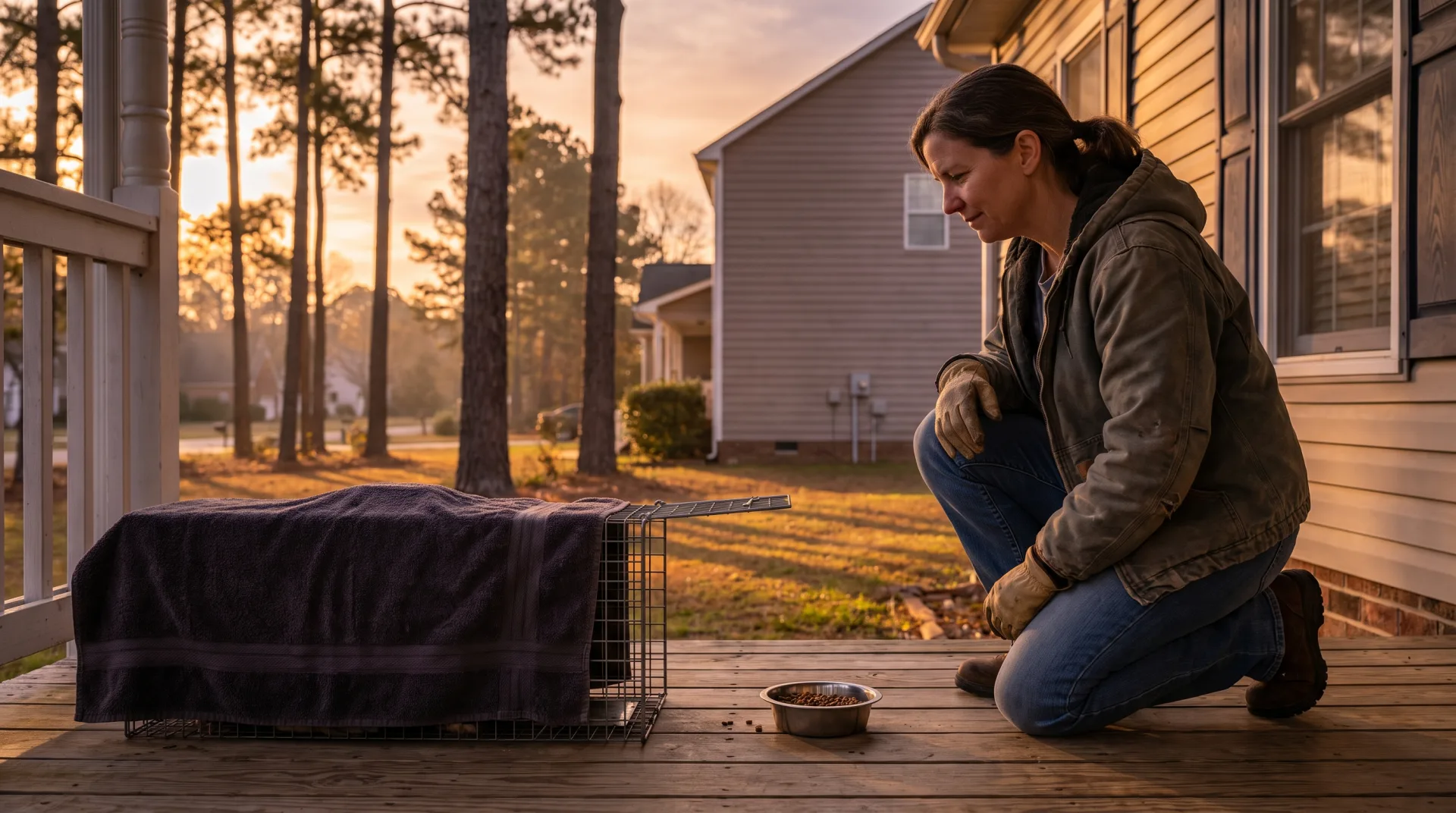
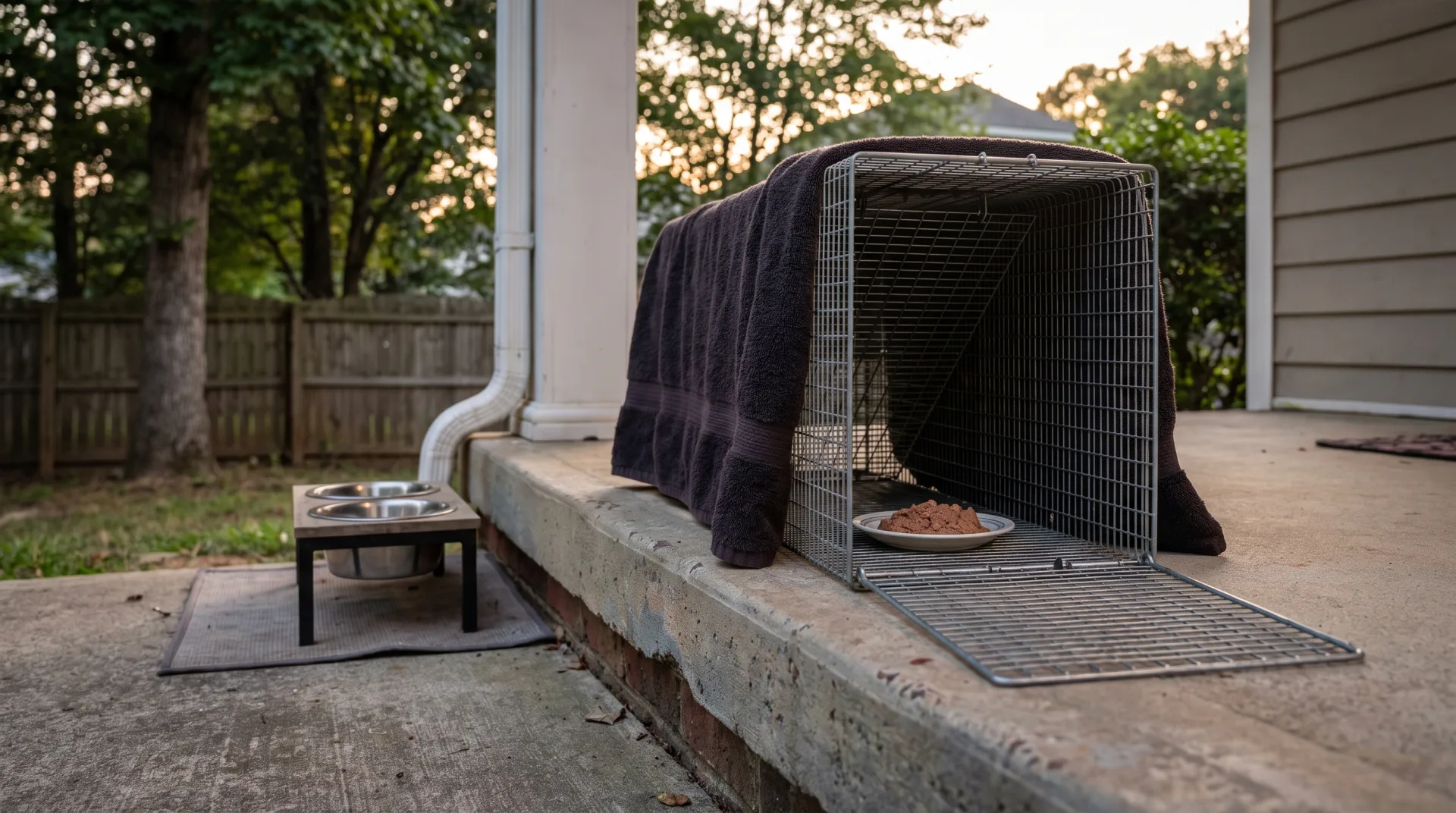
4. Set traps at dusk near the feeding station. Place traps on level ground along the cats’ usual paths, with the back of the trap against a wall or fence. Bait with a spoonful of smelly wet food (tuna, sardines) placed at the far end. Cover each trap with a sheet or towel, leaving the entrance open. This calms cats once caught and reduces stress. Stay nearby but out of sight, and check traps every 30 minutes. Never leave traps unattended overnight.
5. Transport to the clinic. Keep cats in their traps, covered, in a temperature-controlled vehicle. Don’t transfer them to carriers; the trap is the safest container. Most TNR clinics and vets expect cats to arrive in traps. Cats are spayed or neutered, vaccinated against rabies, and ear-tipped during a single visit.
6. Recover for 24 to 72 hours. After surgery, cats stay in the trap in a warm, quiet indoor space (garage, bathroom, spare room). Males typically need 24 hours; females need 48 to 72 hours. Keep the trap covered, check the incision site through the wire, and provide water and a small amount of food through the trap door. Do not open the trap or attempt to handle the cat.
7. Return and resume feeding. Bring the cat back to its territory, open the trap door, and step back. Most cats bolt immediately. Resume your regular feeding schedule. The cat is now fixed, vaccinated, and ear-tipped, which means it won’t reproduce, won’t fight as aggressively, and can be identified at a glance as part of a managed colony.
Where to Get Traps, Vets, and Help in NC
| Organization | Region | TNR Cost/Cat | Trap Loans |
|---|---|---|---|
| Operation Catnip | Raleigh / Triangle | Free | Yes, free |
| ASPCA Spay/Neuter Alliance | Asheville / Western NC | Free | Contact clinic |
| Feral Cat Assistance Program | Greensboro / Triad | $10 | Contact org |
| Kitty Clip (Friends of Wake) | Wake County | $15 | Contact org |
| Humane Society of Charlotte | Charlotte | $50 | $10 rental (14-day) |
| SNAP-NC | Statewide (mobile clinics) | $90 | No |
| SAFE Care Clinic | Raleigh / Triangle | Sliding scale | Contact clinic |
| Catman2 | Cullowhee / Western NC | Low-cost (varies) | Contact org |
North Carolina has more TNR infrastructure than most residents realize. Here are the major organizations offering community-cat spay/neuter, by region. Many also provide trap loans, training, and mentoring for first-time trappers. Our county-by-county guide to low-cost spay/neuter in NC and the Get Help page have additional resources.
What Does TNR Cost in North Carolina?
In 2025, the per-cat cost of TNR at North Carolina clinics ranges from free to about $90, depending on the organization. Operation Catnip in Raleigh and the ASPCA Spay/Neuter Alliance in Asheville both offer free community-cat spay/neuter, including rabies vaccination and ear-tipping. Greensboro’s Feral Cat Assistance Program charges $10 per cat for a full TNR package: spay or neuter, rabies vaccine, distemper vaccine, deworming, flea treatment, and ear-tip. The Humane Society of Charlotte runs its program at $50 per cat.
Compare those numbers to what catch-and-kill animal control costs taxpayers. A Best Friends Animal Society policymaker brief documented per-cat costs of $52 to $168 for impounding and euthanizing community cats, with Cook County, Illinois, spending $135 per cat before switching to funded TNR and saving over $1.5 million (Best Friends Animal Society). The math isn’t ambiguous. Even the most expensive NC TNR option costs less than the cheapest catch-and-kill estimate, and the free options cost taxpayers nothing at all.
The ASPCA Spay/Neuter Alliance in Asheville alone has spayed or neutered more than 500,000 cats and dogs since 1994, performing roughly 350 surgeries per week across partnerships with more than 45 welfare organizations in 44 North Carolina counties (ASPCA). That infrastructure exists. The question for most NC communities isn’t whether TNR is available; it’s whether enough people know about it.
Keeping the Colony Stable After TNR
Trapping once isn’t enough. A TNR program is an ongoing commitment, and the colonies that decline are the ones where someone keeps showing up. After your initial trapping event, there are three things that keep a colony on the path to shrinking rather than rebounding.
Trap newcomers fast. New cats will occasionally appear, especially unfixed strays dumped by owners or young cats dispersing from nearby unmanaged colonies. When a new cat shows up without an ear-tip, get it to a TNR clinic within two weeks. Every unsterilized cat that stays is a potential litter of four to six kittens, and a single lapse can undo months of progress.
Sterilize as many cats as possible, as fast as possible. The ASPCA stresses that a critical percentage of the colony must be sterilized within a short time period for population decline to take hold. In practice, TNR practitioners widely target 75% or more of the colony in the first few months. Partial TNR, where only some cats get fixed, often fails because the remaining intact cats breed fast enough to replace the decline. That’s why lining up affordable, high-volume clinic access before you start is so important.
Keep records. Photograph each cat (especially the ear-tip), log the date it was fixed and the vet that did it, and note any health issues. If your county has a colony registry, like Wake County’s TNVR program managed through Wake County Animal Services, register the colony. A documented colony is easier to defend if a neighbor complains, and it helps animal control officers distinguish a managed group from an unmanaged nuisance.
The Policy Gap, and How You Help Close It
Everything in this guide is something one person or a small group of neighbors can do right now. But the reason it falls on volunteers is that North Carolina hasn’t built a system to support it at scale. The state’s existing spay/neuter program, funded by the “Animal Lovers” license plate and a $250,000 annual appropriation, supported just 5,855 procedures in 2023, and community cats aren’t eligible for any of them (NCDA&CS, 2025).
Meanwhile, NC shelter euthanasia climbed from 22% in 2021 to 27% in 2024, with more than 20,000 dogs and cats put down statewide (WRAL Investigates, November 2025). Other states that fund TNR see fewer cats in shelters and lower costs, and we lay out the full fiscal case in our pillar post on why NC needs a state-funded TNR program. The gap between what NC’s volunteers are doing and what state policy supports is the gap that keeps shelter numbers climbing.
Trap, fix, and return the cats in your community, then help close the policy gap: sign the petition for state-funded community-cat TNR, email your NC representative, or support the organizations making it happen.
Frequently Asked Questions
The Cats Are Waiting. Start This Weekend.
Starting a TNR program doesn’t require a nonprofit charter or a veterinary degree. It takes a bag of kibble, a borrowed trap, a clinic appointment, and the willingness to show up at dusk. The science is settled, the infrastructure exists across North Carolina, and the cost is a fraction of what communities already spend on catch-and-kill animal control.
If you’re already feeding community cats, get them fixed through TNR. If you’ve already done TNR, register the colony, trap newcomers, and keep the numbers from bouncing back. And when you’re ready to push for change beyond your own block, sign the petition for state-funded TNR, email your NC representative, and read the full case for why it saves North Carolina money as well as lives.
Dealing with feral cats in your area?
NC Pet Project can help you get a TNR program started. We'll connect you with resources, training, and our volunteer network.