TL;DR: A barn cat, also called a working cat, is a sterilized, vaccinated, ear-tipped cat who is too unsocialized to live in a house and is placed on a barn, farm, warehouse or garden property instead of being euthanized. North Carolina shelters euthanized 29.8 percent of the cats they took in during 2025, a higher share than dogs, and unsocialized adult cats are the hardest group to place. Working cat programs across NC give those cats an outcome. The catch is the acclimation period: two to six weeks of confinement in a crate or closed room, with food at the same time every day, is what makes the cat stay. Skip it and the cat leaves.
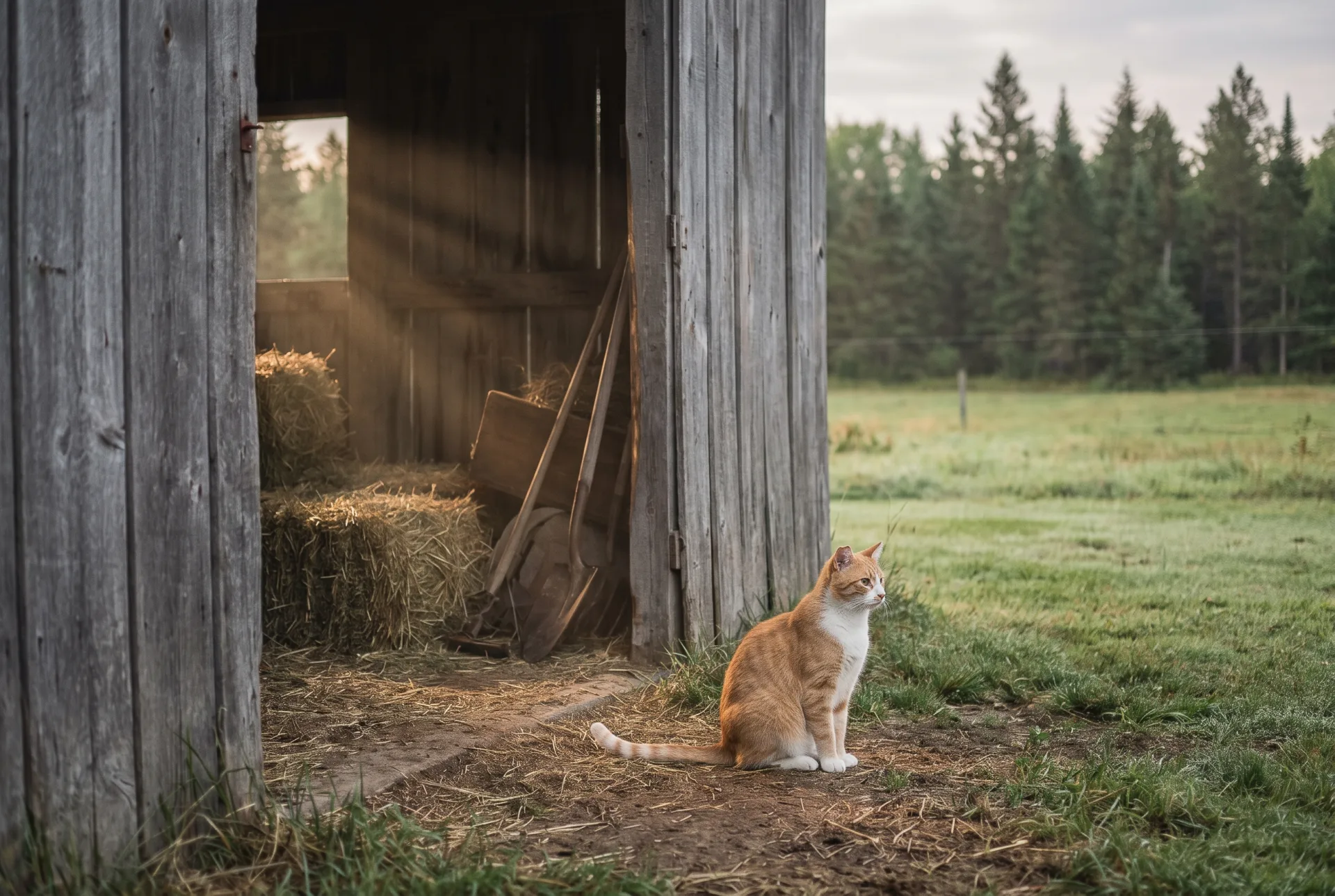
There is a cat in a North Carolina shelter kennel right now who is doing everything wrong. She flattens against the back wall when staff open the door. She has not eaten in front of a person in four days. She is healthy, she is spayed, and by every adoption-floor measure she is unadoptable, because nobody walks a shelter aisle looking for a cat who hates them.
That cat is not a lost cause. She is a barn cat, and there are people in this state actively looking for her. This guide covers what a barn cat actually is, whether working cats really earn their keep as rodent control, where to find one in North Carolina, and the part most people get wrong: the confinement period that decides whether the cat you take home is still there in a month.
What a Barn Cat Actually Is
A barn cat is not a breed. There is no barn cat bloodline, no coat type that hunts better, no size that makes a cat suited to a hay loft. Ask a working cat program what kind of cat makes a good barn cat and the honest answer is a temperament and a history, not a pedigree.
The definition used by placement programs is narrow and practical. A working cat is a cat who has been spayed or neutered, vaccinated, ear-tipped and often microchipped, who is not socialized enough to live indoors with people, and who is placed on a property that offers permanent shelter, daily food and water, and a job description of being present. Best Friends Animal Society describes the goal as finding adopters “who are looking for natural rodent deterrents for enclosed properties such as barns, warehouses, churches, factories or other facilities.”
The confusing part is that three different kinds of outdoor cat get talked about interchangeably, and the right answer for each one is different. A community cat with an established colony and a caretaker should almost never be moved. A stray who is friendly should go up for adoption. Only the third group, the unsocialized cat with nowhere to return to, belongs in a working cat program.
| Which cat | Where it belongs | What a shelter should do |
|---|---|---|
| Socialized stray Approaches people, tolerates handling, likely had a home |
Indoors, with a family | Hold for the owner, then place on the adoption floor. Never a working cat candidate. |
| Community cat with a territory Unsocialized, but has a known outdoor home and often a caretaker |
The territory it already lives in | Trap, neuter, vaccinate, ear-tip and return to the same location. See our guide to community cat programs. |
| Unsocialized cat with nowhere to return Colony site destroyed, impounded with no found address, or an undersocialized former kitten |
A new property, after confinement | Working cat placement. This is the group barn cat programs exist for. |
If you are unsure which of the three you are looking at, the behavior tells you before the paperwork does. Our post on telling a feral cat from a stray walks through the identification signals in detail. Get that call right first, because placing a friendly stray on a farm as a working cat is a downgrade, not a rescue.
The Cats North Carolina Shelters Cannot Place
The case for working cat programs in this state is a math problem, and cats are on the losing side of it.
Shelters sort incoming animals by the outcome each one can realistically reach. A dog with a wagging tail has several. A friendly cat has a few. An adult cat who screams at the kennel door has, on paper, one, and every day she spends in a kennel makes her less adoptable rather than more, because confinement does not socialize a cat who was never socialized to begin with. That is the pressure a working cat program relieves, and the state’s own reporting shows how much pressure there is.
North Carolina’s public animal shelters reported 69,332 cat intakes in calendar year 2025 to the NC Department of Agriculture and Consumer Services. Of those cats, 35,110 were adopted, 2,283 went back to an owner, and 20,662 were euthanized. That is a 29.8 percent euthanasia share for cats, against 22.8 percent for dogs in the same file. The gap in the return-to-owner column is even starker: 17.6 percent of dogs went home, compared with 3.3 percent of cats.
Those two numbers explain each other. A dog who slips a fence has a person looking for it. An unsocialized cat has neither an owner filing a lost report nor a temperament that survives an adoption meet-and-greet. She is a healthy animal with no available outcome, which is exactly the vacancy a working cat program fills.
Two caveats on the data, because they matter. The 2025 file is still preliminary, covering 64 of 100 counties as of its July 27, 2026 posting, and several large county shelters including Wake and Forsyth had not filed. It also carries no transfer-to-rescue column, so the reported shares do not add to 100 percent and counties that transfer heavily look worse on paper than they are. For the statewide euthanasia picture across both species, see our breakdown of how many animals are euthanized in NC each year.
Do Barn Cats Really Control Rodents?
Here is where most barn cat articles oversell, and we are not going to. The rodent-control pitch is the reason working cat programs get placements, and the evidence behind it is thinner than the marketing.
The best-documented look at cats hunting urban rats came out of a Brooklyn waste recycling facility. Researchers tracked a rat colony and five resident feral cats from December 27, 2017 through May 28, 2018, capturing 306 videos across 79 days and 259 recorded cat behaviors. In all that time they documented 20 stalking events and three predation attempts. Two of the three were successful, both cases where a cat plucked a rat from under a hiding spot. The single attempt in the open failed when the rat simply stopped running (Parsons et al., 2018, Frontiers in Ecology and Evolution).
That study did find a real effect, just not the one people expect. In the presence of cats, rats changed their behavior. They were seen less often, moved differently and spent more time in burrows. The cats did not clear the site. They made it less comfortable.
| The common claim | What the evidence actually supports |
|---|---|
| “A couple of barn cats will wipe out the rats.” | Not supported. Five cats over five months at a rat-heavy Brooklyn site produced three predation attempts and two kills. Adult rats are large, aggressive prey. |
| “Cats keep rodents away.” | Partly supported. The same study found rats shifted their movement and spent more time in burrows when cats were present, so presence acts as a deterrent even when predation is rare. |
| “Barn cats handle mice, not just rats.” | Plausible and untested here. The Brooklyn work measured rats specifically. Mice are far smaller prey and a different proposition, but we found no controlled study measuring barn cat impact on farm mouse populations. |
| “Working cat programs have decades of proven results.” | Anecdotal. The model dates to 1999, when Melya Kaplan of Voice For The Animals placed cats at the Los Angeles Flower Mart. Program reports are journalistic, not experimental. |
| “A cat is cheaper than an exterminator.” | Misleading framing. A cat is a lifelong animal with food, shelter and veterinary costs, not a pest-control product with a service interval. |
So adopt a working cat for the right reason. You are giving a healthy animal an outcome it would not otherwise have, and you are getting a deterrent presence in the bargain. If your barn has an active rat infestation, the cats belong alongside exclusion, feed storage in sealed containers and sanitation, not instead of them.
Where to Find a Working Cat in North Carolina
North Carolina has more working cat placement than most people realize, run by a mix of county animal services departments and private rescues. Nearly all of them are free or close to it, because the alternative outcome for these cats costs the shelter money and costs the cat everything.
A few patterns hold across programs. Cats come already sterilized, vaccinated and ear-tipped, so you are not paying for the veterinary work. Most programs place in pairs or trios rather than singles, on the reasoning that cats who want nothing to do with people still need feline company. And most will not let you meet the cat first, because a barn cat in a shelter carrier does not audition well.
Expect an application, a few questions about your property, and in some cases a site visit or a delivery appointment rather than a pickup. Wait lists are normal in both directions. Some months a shelter has eight working cats and nobody with a barn, and some months the list of approved properties is longer than the list of cats. Get on the list before you need to be on it.
| Program | Area served | Cost and terms |
|---|---|---|
| Wake County Animal Center Working Cats | Wake County, with placement restrictions inside Raleigh city limits, Holly Springs and Garner | Free. Cats are spayed or neutered with a tipped left ear, and come with first FVRCP and rabies vaccination plus a one-time flea and parasite treatment. |
| Guilford County Animal Shelter Barn Cats | Guilford County and the Triad | $10 per cat, vaccinated, spayed or neutered, microchipped and ear-tipped. The shelter asks adopters to confine cats for two to four weeks. |
| Orange County Animal Services Working Barn Cats | Orange County | Sterilized and vaccinated, with care instructions provided. A wait list operates when no cats are available. Adopters typically do not meet the cats beforehand. |
| Brother Wolf Animal Rescue Working Cat Placement | Asheville and western NC | No adoption fee. Placed only in pairs or trios. Requires outdoor access plus indoor shelter from weather and predators. |
| Alley Cats and Angels Barn and Garden Cat Program | Rural sites across central and eastern NC, from Chapel Hill and Garner to Rocky Mount and Roanoke Rapids | Free, donations welcome. Minimum of two cats. The group supplies the confinement cage, dishes, carrier and litter box, and handles delivery and setup. |
| Charlie’s Angels Animal Rescue Barn Cat Program | Monroe and the southern Piedmont | Wait list by email. Adopters must agree to provide shelter, food, water and veterinary care. Placements go to barns, farms, warehouses and shops. |
If your county is not on that list, call your county animal services department and ask whether they place working cats, then ask the same question of the nearest cat-focused rescue. Programs open and close with staffing. Before you commit to any group, it is worth running through how to tell a legitimate NC rescue from a bad one, because a program that will hand you an unaltered, unvaccinated cat with no confinement instructions is not running a working cat program.
The Acclimation Period Is the Whole Program
Every experienced placement coordinator will tell you the same thing: the confinement period is not a formality, and it is the single step adopters skip.
A cat has a map in its head of where home is. Move it, open the carrier, and it will try to walk back to the old map. Confinement in a crate or a closed room overwrites that map. The cat learns where the food appears, learns the sounds and smells of the building, and by the time the door opens the new place is the one it defends.
This is also the step that goes wrong quietly. The cat seems settled after five days, the crate is a nuisance to clean, and somebody opens the door early with the best intentions. The cat is gone that night, and the program never hears about it, which is why placement coordinators keep repeating a warning that sounds excessive until you have watched it happen.
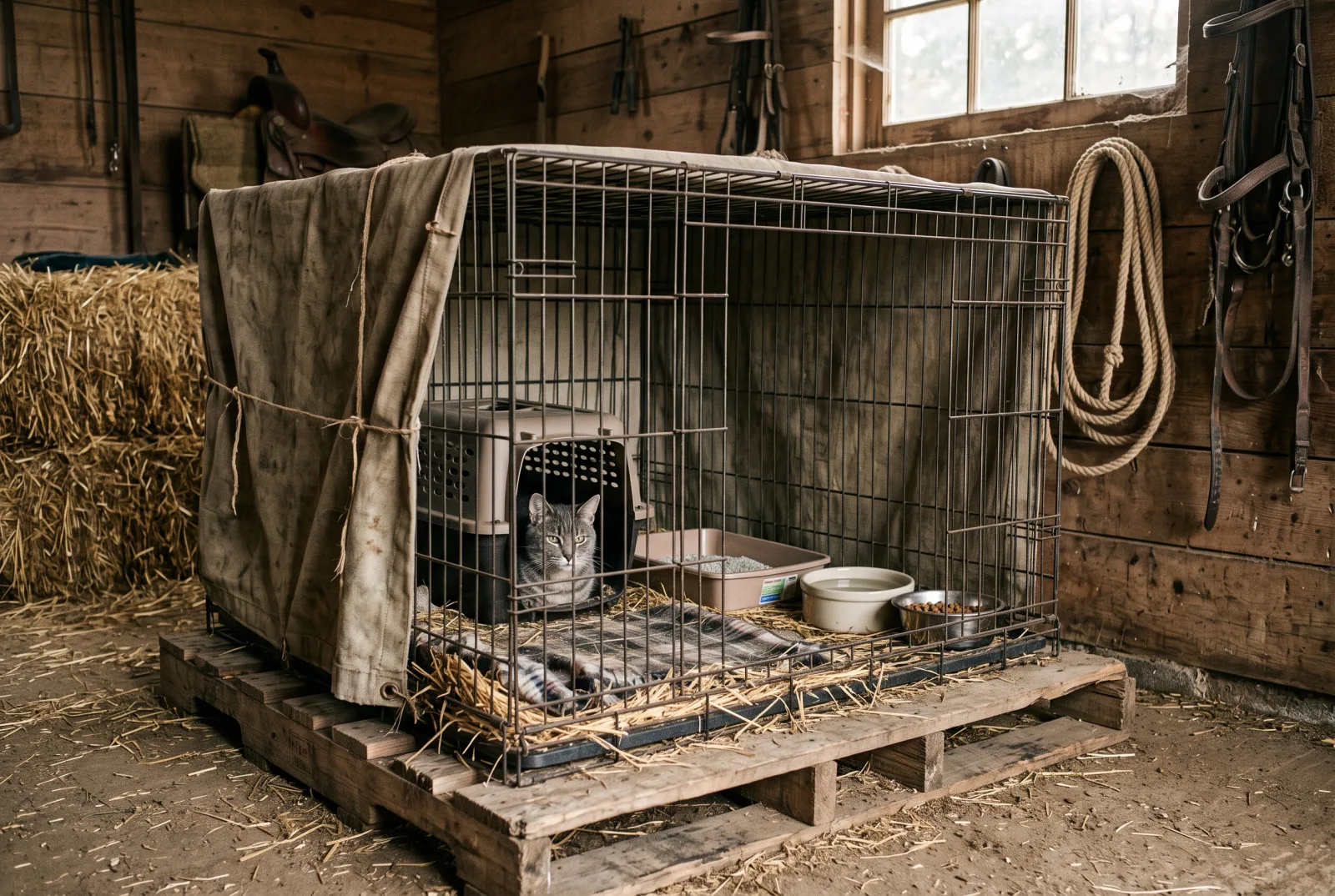
The setup is simple. A large wire crate or a small closed room, raised off a cold floor, with a covered hide box the cat can retreat into, a litter pan scooped daily, fresh water and food delivered at the same time each day. Alley Cat Allies recommends appealing canned food during confinement, switching to dry after release. Talk to the cat every day, even if it never comes out. You are not trying to make it friendly. You are teaching it that this human, this door and this feeding time are the shape of home now.
Two details separate a setup that works from one that only looks right. The crate needs to be big enough that the litter pan and the hide box are not touching, because a cat that has to sleep next to its own litter will stop using one or the other. And the crate should sit somewhere the cat can watch normal activity without being handled, not in a sealed back room. The point of the confinement is exposure to the property’s rhythm, not isolation from it.
Feed at a fixed hour and stay for a minute afterward, in view but not reaching. Over three weeks that turns into the cat associating a person walking through the door with food arriving, which is the only relationship a working cat needs to have with you. Many adopters report that the cat is still hiding on release day and shows up at the food bowl on schedule anyway. That is a success, not a failure.
Recommended confinement lengths vary, and the spread is worth understanding before you pick one.
| Source | Recommended confinement | Setting |
|---|---|---|
| Best Friends Animal Society | Two weeks | An enclosed room of roughly 14 by 14 feet |
| Guilford County Animal Shelter | Two to four weeks | Confined to a small space with food and water provided |
| ASPCA “Barn to Be Wild” program | Three to four weeks | Confinement with daily feeding on a predictable schedule and permanent shelter available after release |
| Alley Cats and Angels (NC) | About three weeks | A large cage, supplied by the program, inside the barn or building |
| Alley Cat Allies, for relocating community cats | Six to eight weeks | Pre-installed large outdoor enclosures with hide space, food, water and daily scooped litter |
The range is not a contradiction. Shorter periods come from programs placing cats into enclosed indoor spaces they cannot bolt from, and longer ones from relocating established community cats who have a territory pulling them back. Take the longest period your setup allows. Nobody has ever lost a cat by confining it a week too long, and the failure mode of confining it a week too short is a cat that disappears the first night.
What the Adopter Actually Signs Up For
A working cat is not low-maintenance livestock. It is a cat that lives outside, and North Carolina law and basic decency both attach obligations to that.
The commitment is long. A sterilized, fed, sheltered outdoor cat can live many years, so the honest planning horizon is closer to a decade than a season. That is worth saying plainly because the language around these programs sometimes borrows from pest control, where the arrangement ends when the problem does. This one does not end. If you sell the farm, the cats are part of the conversation with the buyer, and most programs will ask you to call them rather than leave the animals behind.
Here is what placing organizations across North Carolina actually expect of an adopter, stated as commitments rather than as a wish list.
| Commitment | What it means in practice |
|---|---|
| Daily food and water, year round | Not “there are mice, it will figure it out.” A fed cat hunts as much as a hungry one and stays on the property. Water needs a heated or frequently broken surface in a Piedmont or mountain winter. |
| Shelter from weather and predators | A barn, garage, shed, stable or warehouse that stays accessible year round. Not a porch, not a lean-to, and never a building that gets locked for the season. |
| Rabies vaccination | North Carolina law requires it. Under G.S. 130A-185, the owner of a cat, dog or ferret over four months of age must have the animal vaccinated against rabies. Working cats come with a first rabies shot; keeping it current is on you. |
| Veterinary care for injury and illness | Programs expect it, and several make it a condition of placement. Budget for the abscess, the truck-clipped leg, the upper respiratory flare. |
| Companionship | Most NC programs will only place pairs or trios. Take the pair. |
| Honest expectations | These cats will not sit on your lap. Some warm up over years and some never do. Adopting one hoping it becomes a pet sets both of you up to fail. |
There is also a real risk conversation that good programs have up front. Outdoor cats face traffic, coyotes, dogs and severe weather. Placement is a better outcome than euthanasia by a wide margin, and it is not the same as safety. A property near a busy road or with a resident dog that hunts cats is not a placement site, and a program that does not ask about either is not screening.
When a Barn Cat Placement Is the Wrong Answer
Working cat programs work because they are narrow. Widen them and they become a relocation service, which is a different and worse thing.
Alley Cat Allies is blunt about this. Relocation is “an absolute last resort,” appropriate only in a short list of situations: construction or demolition that will destroy the site with no cooperation available, an animal control demand for removal that would otherwise end in euthanasia, or a disaster that makes the area uninhabitable. The organization warns that “even if done with proper protocol, relocation can be ineffective and even dangerous for cats,” because cats try to return to where they came from.
The practical test is whether the cat has somewhere to go back to. If it does, and that place is not about to be bulldozed, moving it is a downgrade dressed up as help. If it does not, placement is the whole point. Here is how the common situations sort out.
| The situation | The right answer |
|---|---|
| Feral cats living behind your building that you would rather were somewhere else | TNR in place, not relocation. Removing them opens the territory for unaltered cats to move in. Start with how to run TNR in your community. |
| A colony you feed and can no longer afford to sterilize | Low-cost spay/neuter access, not placement. See our county-by-county low-cost spay and neuter guide. |
| A friendly cat who follows you around the barn | The adoption floor. A socialized cat placed as a working cat is losing a home it could have had. |
| Kittens found on your property in spring | Neither. Read what to do during NC kitten season first, because moving a litter away from a nursing mother is usually the wrong call. |
| A colony site being demolished, with no way to keep the cats safe | This is the case relocation exists for. Work with a program, and plan on the long confinement. |
| An unsocialized cat already impounded at a shelter with no return address | Working cat placement, and quickly. This is the cat the program is for. |
The distinction matters most when someone calls a working cat program to make cats go away. That is a removal request wearing a rescue costume, and the cats usually pay for it.
Why This Matters for North Carolina
Barn cat placement is a good outcome for individual cats and a poor strategy for the state. Every working cat placed is one animal who lived, and the pipeline producing those cats does not slow down because the shelter found homes for a dozen of them.
North Carolina takes in roughly 69,000 cats a year at its public shelters, and the state’s own spay/neuter fund cannot keep pace with the local governments applying to it. In the second quarter of 2026 the NC Spay/Neuter Program had $76,832 available against $230,257 in eligible requests, after a first quarter with $79,914 available against $210,231 eligible. Local governments are asking for roughly three dollars of sterilization for every one the state can fund. That is the upstream problem, and it is a funding problem with a known fix. We have made the case for a state-funded TNR line item in why NC needs a state-funded TNR program, and the arithmetic there is the same arithmetic that fills barn cat wait lists: a cat sterilized in April does not become five cats by October.
So take the working cat if you have the barn. Then sign the petition and tell your legislator that the state should be paying for the surgery that prevents the next wait list. The placement saves a cat. The policy saves the next several thousand.
Is Your Property a Fit? Run This Checklist
Before you contact a program, answer these honestly. Programs will ask most of them anyway, and a no on the first three is usually disqualifying.
| Question | Why it decides the placement |
|---|---|
| Do you have a building the cats can always get into? | Permanent, year-round shelter is the baseline requirement of every program listed above. |
| Can you confine them for two to six weeks? | Without it, the cats leave. This is the most common reason placements fail. |
| Will you feed at the same time every day, indefinitely? | The feeding routine is what anchors the cat to the property after release. |
| Are you near a highway or a busy road? | Traffic is the leading avoidable risk to a placed cat. Set-back rural properties place better. |
| Do you have dogs, and how do they treat cats? | A cat-aggressive farm dog rules out the property. A cat-neutral one usually does not. |
| Will you take at least two? | Most NC programs require pairs. Plan for it rather than negotiating it. |
| Can you cover a vet bill for an injured cat? | Several programs make this an explicit condition of adoption. |
| Do you use rodenticide on the property? | Poisoned rodents kill cats. You will be asked to stop, and you should. |
If you cleared that list, call your county animal services department this week and ask for the working cat coordinator. Somewhere in that building there is a healthy cat pressed against the back of a kennel who has been waiting for exactly your barn.
Frequently Asked Questions
Sources
- NC Department of Agriculture and Consumer Services, 2025 CY Public Animal Shelter Report (preliminary, 64 counties, as of 7/27/2026)
- Parsons, M. H., et al. (2018). Temporal and Space-Use Changes by Rats in Response to Predation by Feral Cats in an Urban Ecosystem. Frontiers in Ecology and Evolution
- Alley Cat Allies, Relocation and Safe Relocation
- Best Friends Animal Society, Working Cat Program
- ASPCA, These Hard-Working, Unique Cats Are “Barn to Be Wild!”
- N.C.G.S. 130A-185, Vaccination of cats, dogs and ferrets
- Voice For The Animals Foundation, Working Cats Program history
- Wake County Animal Center, Working Cats
- Guilford County Animal Services, Barn Cat Adoption Gallery
- Orange County NC Animal Services, Working Barn Cats
- Brother Wolf Animal Rescue, Working Cat Placement Program
- Alley Cats and Angels, Barn and Garden Cat Program
- Charlie’s Angels Animal Rescue, Barn Cat Program
Dealing with feral cats in your area?
NC Pet Project can help you get a TNR program started. We'll connect you with resources, training, and our volunteer network.