Pet Food Pantries in North Carolina: Where to Get Free Pet Food
Need help feeding your dog or cat? Our list of North Carolina pet food pantries, checked November 2026, shows who qualifies, what to bring and where to go.
The short version: Free pet food is out there in North Carolina, but it's scattered. We found 24 pet food pantries and pet food programs across the state that describe their help on their own websites, and we checked every one on November 9, 2026. They're listed below by region, with who qualifies and how to reach them. Some limit visits to once a month, and several serve only their own county's residents and ask for an ID. SNAP benefits can't be used to buy pet food. If nothing below is near you, call your county animal shelter and ask, or dial 2-1-1.
Running short on pet food is one of the most fixable problems a pet owner can have, and one of the most stressful. A lost job, a medical bill or a fixed income that didn't stretch this month can put a family in the position of choosing between feeding themselves and feeding the dog. Some people in that spot end up at a county shelter's front desk asking to surrender a pet they love.
This guide is a starting point. It lists pet food pantries and pet food programs we could confirm on each organization's own website, organized by region, along with Meals on Wheels programs that deliver pet food to seniors. It also covers what to bring, what to ask, and where to look if your county isn't on the list.
How We Built This List
We searched for pet food pantries and pet food assistance programs in every region of North Carolina: humane societies, SPCAs, county animal services, rescues, churches, food banks and senior meal programs. A program made this list only if the organization describes it on its own website. Most of those pages also showed some sign of being current, such as posted hours, a live request form, a 2025 or 2026 date, or an upcoming distribution. Seven did not, and we've marked them "page undated" in the tables, so call those first. We checked every listing on November 9, 2026.
We left out programs we could only find on Facebook, in a news story, or in a third-party directory, because those are the listings most likely to be out of date. That means some real, active pantries aren't here. Small church and volunteer pantries often post only on Facebook. If you know one, the best move is still to call it.
A few honest limits. Pantries run on donations, so any of them can run low or pause new sign-ups. The Humane Society of Charlotte, for example, says on its Pet Food Bank page that "due to limited food supplies, we are temporarily pausing submissions for new clients," so it isn't in the tables below. Hours change, too. Call before you drive anywhere, especially if it's far.
We also found far fewer programs in some parts of the state than others: the 24 programs below are in just 18 of the state's 100 counties. In parts of the mountains and much of the east, we couldn't confirm a single pantry in many counties. That may reflect how hard these programs are to find, not whether help exists. Your county shelter is often the best source for what's happening locally.
| Region | Programs listed | Counties with a listed program |
|---|---|---|
| Western NC and the foothills | 7 | 6: Buncombe, Henderson, Watauga, Haywood, Catawba, Polk |
| Piedmont | 9 | 7: Wake, Iredell, Orange, Forsyth, Durham, Guilford, Union |
| Eastern NC and the coast | 5 | 5: Pitt, Pender, Brunswick, Currituck, Wayne |
| Meals on Wheels pet programs | 3 | Buncombe, Orange, Guilford (already counted above) |
| Total | 24 | 18 of North Carolina's 100 counties |
Western NC and the Foothills
The mountains and foothills have some of the most organized pet food help in the state, much of it run by humane societies working with human food pantries. Asheville Humane Society, for instance, offers pet food through partner pantries. Its page says it offers "pet food assistance through several local food pantries," and it lists partner pantries with their hours, so you can pick up pet food at the same place you get groceries.
Watauga Humane Society's pantry in Boone has some of the clearest rules we found. It asks for a voucher from the Watauga Hunger and Health Coalition, an ID that matches the name on the voucher, and written proof from a vet that your pet is spayed or neutered or has surgery scheduled, and it says the food is meant to "supplement your supply of pet food and not to be the only source of food for pets." Catawba County has two separate programs, one run by the county and one by the Humane Society of Catawba County, and both ask for an online application.
In Henderson County, Blue Ridge Humane Society gives out pet food and litter through community events and partners. Its Community Support Market is open to the public every Tuesday from 1 to 4 p.m., with no appointment. In Haywood County, Sarge's Animal Rescue Foundation keeps posted pantry hours twice a week. Polk County's Foothills Humane Society lists a pet food bank among its services but gives no hours online, so call first.
We didn't find a pantry described on an organization's own website in Transylvania, Jackson, Macon, Madison, Wilkes, Burke, Caldwell, Rutherford, McDowell, Cleveland, Yancey, Mitchell or Avery counties. If you live there, start with your county animal shelter.
| County | Program | What to know | How to reach it |
|---|---|---|---|
| Buncombe | Asheville Humane Society pet food assistance | Pet food is handed out through partner food pantries; the page lists them with hours | Go to a listed partner pantry |
| Henderson | Blue Ridge Humane Society community pet food | Pet food and litter through community events and partners; its market is open to the public | 353 Banner Farm Rd, Mills River; market Tue 1 to 4 p.m.; (828) 692-2639 |
| Watauga | Watauga Humane Society Pet Food Pantry | Watauga residents; Hunger and Health Coalition voucher, matching ID and a vet's proof of spay/neuter (or a scheduled surgery) | 312 Paws Way, Boone; Tue, Thu and Sat, 12:30 to 5 p.m.; 828-264-7865 |
| Haywood | Sarge's Animal Rescue Foundation Community Pet Pantry | Open 11 a.m. to 4 p.m. on Wednesdays and Saturdays | 256 Industrial Park Dr, Waynesville; (828) 246-9050 |
| Catawba | Catawba County Animal Services Pet Food Assistance Program | Catawba residents; ID plus a WIC, Medicaid or SNAP benefit statement in your name; once every 30 days | Online application, then pickup in Newton |
| Catawba | Humane Society of Catawba County Pet Food Pantry | Temporary help; proof of a benefit such as Medicaid, SNAP, WIC, SSI or SSD, or a written hardship statement | Online application; (828) 464-8878 |
| Polk | Foothills Humane Society Pet Food Bank | Listed as a community service; no hours or rules online. Page undated; call first. | 989 Little Mountain Rd, Columbus; (828) 863-4444 |
The Piedmont
The Triangle, the Triad and the Charlotte region have the most programs, but they work in very different ways. Some hand food across a counter on set days. Others ask you to fill out a form first and then call you to schedule a pickup. A few give out food only through partner pantries, so the humane society's own building isn't where you go.
SPCA Wake, in Raleigh, says its Pet Food Assistance program "provides free pet food and supplies to people facing financial hardship," and that it may be able to help "while supplies are available." You start with a request form on its Pet Helpline page. Paws4ever, near Mebane in Orange County, has a Pet Supply Pantry whose page says it has no income test. Requests go through an online form and pickup is at its shelter. Lake Norman Humane and Iredell County Animal Services run a shared pantry in Statesville: you must live in Iredell County, bring a valid ID, and can receive food once a month per household.
Forsyth Humane Society gives out food only through partner sites around Winston-Salem, each with its own schedule, so check its page for the nearest one. In Durham, the Animal Protection Society runs its community pet pantry with the Salvation Army for Durham County residents. Orange County Animal Services helps county residents facing financial hardship at its front desk, while supplies last.
Guilford County has two options. The Humane Society of the Piedmont's Fill The Bowl program sends food to the Salvation Army of High Point and Greensboro Urban Ministry pantries, and Guilford County Animal Services says on its owner surrender page, "If you're in need of temporary food assistance, we are happy to help."
Farther south, the Humane Society of Union County in Monroe holds a pantry on the third Saturday of each month and asks you to register ahead of time.
| County | Program | What to know | How to reach it |
|---|---|---|---|
| Wake | SPCA Wake Pet Food Assistance | Short-term help for people facing financial hardship, while supplies last | Request form on the Pet Helpline page; (919) 772-2326 |
| Iredell | Lake Norman Humane and Iredell County Animal Services Community Pet Food Pantry | Iredell residents with a valid ID; once a month per household | 430 Bristol Dr, Statesville; Mon to Fri 12 to 5 p.m., Sat 12 to 2 p.m.; 704-663-3330 |
| Orange (Mebane area) and nearby | Paws4ever Pet Supply Pantry | No income test; typically dog food, cat food and cat litter; for nearby residents who can pick up | Online request; pickup at 6311 Nicks Rd, Mebane; (919) 241-8438 |
| Forsyth | Forsyth Humane Society Pet Food Pantry | Free food through partner sites, each with its own schedule | See the page for partner sites; (336) 721-1303 |
| Durham | Animal Protection Society of Durham, with the Salvation Army | Community pet pantry for Durham County residents, as available. Page undated; call first. | 919-688-7306 ext. 67101 |
| Orange | Orange County Animal Services Pet Food Assistance Program | Orange County residents facing financial hardship, while supplies last. Page undated; call first. | Front desk, 1601 Eubanks Rd, Chapel Hill; 919-942-7387 |
| Guilford | Humane Society of the Piedmont, Fill The Bowl | Food goes out through Salvation Army of High Point and Greensboro Urban Ministry pantries. Page undated; call first. | Contact those pantries |
| Guilford | Guilford County Animal Services | Offers temporary food help to owners who ask. Page undated; call first. | Ask at the shelter |
| Union | Humane Society of Union County Pet Food Pantry | Third Saturday of each month, 9:30 to 10:30 a.m.; register ahead of time | 4015 Waxhaw Hwy, Monroe; 704-283-9126 |
Eastern NC and the Coast
Eastern North Carolina was the hardest region to map. Many of the pantry leads we found here appeared only on Facebook, in news stories or in directories, so they didn't meet our rule of a description on the organization's own website. We found five that did, and they cover a wide stretch of the east, from the Outer Banks edge down to Brunswick County.
The Pet Food Pantry of Eastern NC in Greenville is a group built around feeding pets. Its monthly assistance program asks you to be approved in person at a one-time application appointment with a photo ID, proof of income and proof of spay/neuter, and its page says it doesn't serve large cat colonies, independent rescuers or breeders. Pender County's animal shelter uses a written application. Its form says pets over 4 months must be current on rabies vaccines, pets must be spayed or neutered within 6 months, and people on SSI, unemployment, disability or other government help qualify automatically with current proof of that help.
In Brunswick County, Paws-Ability's Paws Pantry stocks county food pantries with dog and cat food, so you pick it up at partner pantries such as Southport Oak Island InterChurch Fellowship or Brunswick Family Assistance. Currituck County's animal shelter keeps a food pantry in its foyer for residents in a hard spot. The Animal Welfare League of Wayne County gives donated pet food to local owners who need help; its page asks you to contact it with questions.
If you're in Onslow, Carteret, Craven, Cumberland, New Hanover, Dare, Pasquotank, Robeson or another eastern county not listed here, call your county animal shelter or a local humane society and ask whether it keeps food for owners in need. Some eastern groups show up in older news stories about pantries that we couldn't confirm online today, so it's worth asking.
| County | Program | What to know | How to reach it |
|---|---|---|---|
| Pitt | Pet Food Pantry of Eastern NC, Monthly Assistance | One-time in-person approval with photo ID, proof of income and proof of spay/neuter | 408 W. Arlington Blvd, Greenville; Fridays 12 to 2 p.m.; (252) 689-6122 |
| Pender | Pender County Animal Shelter Pet Food Bank (application PDF) | Written application; rabies vaccines and spay/neuter required; donated food, first come, first served, as available | 3280 New Savannah Rd, Burgaw; 910-259-1484 |
| Brunswick | Paws-Ability Paws Pantry | Dog and cat food supplied to county food pantries for food-insecure families | Pick up at partner pantries; Paws-Ability 910-269-6885 |
| Currituck | Currituck County Animal Shelter Food Pantry | Currituck residents facing financial hardship or a temporary need | Shelter foyer, 140 Aviation Pkwy, Barco; Tue to Sun 12 to 4 p.m.; 252-453-8682 |
| Wayne | Animal Welfare League of Wayne County Pet Food Distribution | Donated pet food for local owners in need; no hours or rules online. Page undated; call first. | Contact form on the site (Goldsboro) |
Why Pet Food Help Keeps Pets Out of Shelters
It's easy to think of a pet food pantry as a small kindness. It can also help keep animals out of North Carolina's crowded shelters. When money is the problem, a few weeks of food can be the difference between a pet staying home and a pet entering a county kennel.
The research points the same way. In a national survey by ASPCA researchers, the team reached 590 people who had rehomed a dog or cat in the past five years (Weiss and colleagues, published in 2015; survey fielded in 2014). Those with household incomes of $50,000 or less were more likely than others to rehome because of cost or housing. When the researchers asked that lower-income group which free or low-cost services might have helped them keep their pet, 30 percent chose free or low-cost pet food. Vet care, training help and pet-friendly housing ranked a bit higher.
A separate study by the same research group, published in 2015 with data from 2014, looked at one shelter in a low-income part of Los Angeles and found that 76.9 percent of people surrendering a dog named cost as a reason. That's one shelter, not a national rate, but it fits the same pattern.
North Carolina's shelters feel that pressure. Our county-by-county shelter report breaks down how many dogs and cats public shelters took in and euthanized in 2025. A pet that stays home because its family got through a hard month can mean one less intake.
How Pet Food Pantries Work
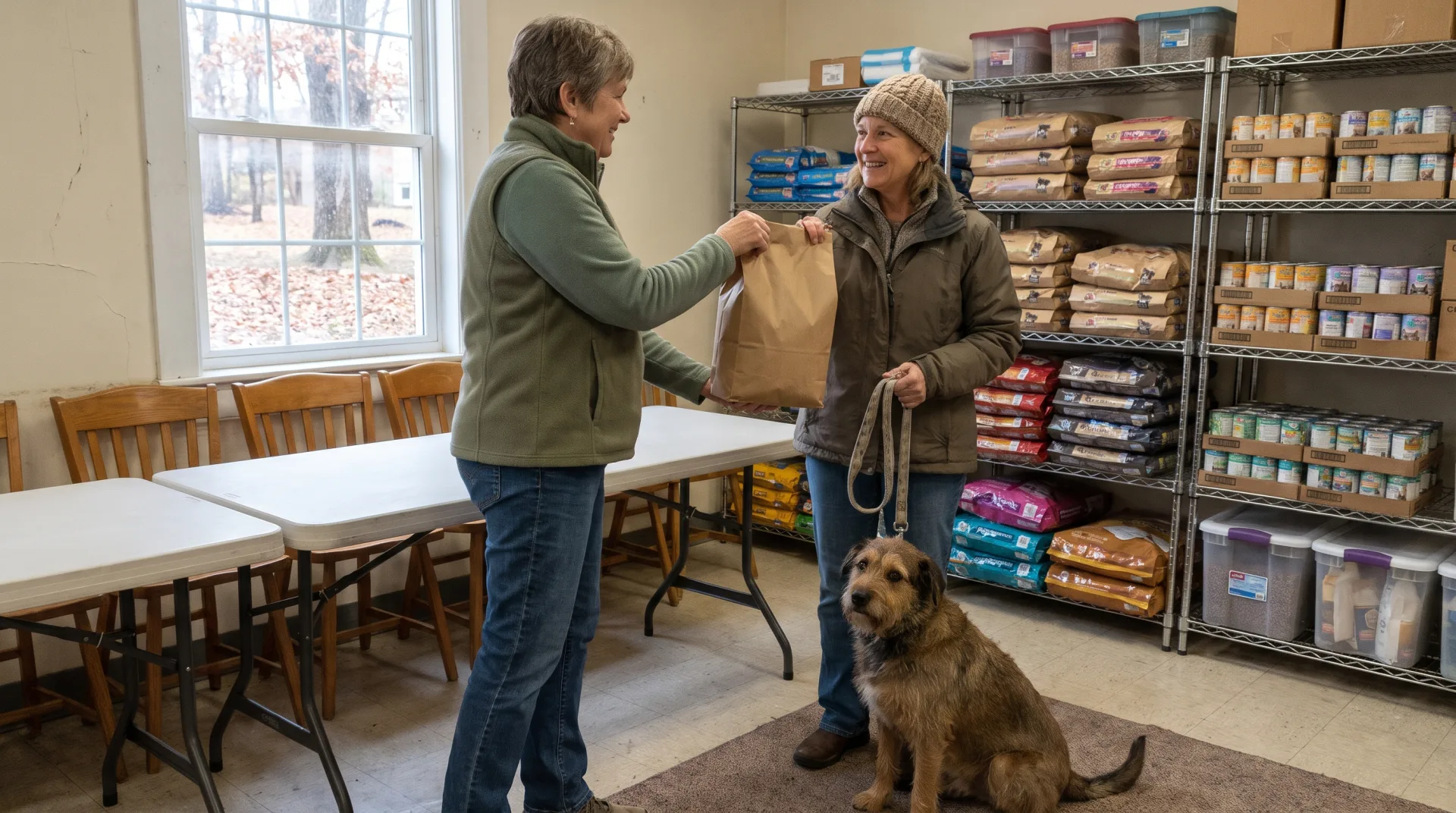
A pet food pantry gives out donated dog and cat food for free to people who are having a hard time affording it. The ones in our list are run by humane societies, county animal services, rescues and nonprofits, and some hand out food through partner pantries, including church-run ones. The food comes from donation bins, pet food drives, businesses and individual donors. Volunteers sort it and hand it out on set days or by appointment.
Pantries are meant to bridge a gap, not to feed a pet forever. Watauga Humane Society says its food is meant to supplement, not replace, what you buy, and Paws-Ability says its food "is not meant to provide all of a pet's monthly nutritional needs." Some programs in our tables limit how often you can come, such as once a month, and several serve only residents of their own county. Some ask about income or public benefits.
Several pantries tie food help to spay/neuter, either requiring it or asking for proof that surgery is scheduled. If cost is what's stopping you, our low-cost spay/neuter guide and Get Help page list options by area.
Supply changes week to week. A pantry may run low on one kind of food before another. Catawba County Animal Services says plainly that it can't guarantee it will fill every request, "especially requests for specific brands of food or specialty diets." If your pet eats a prescription diet, talk to your vet about it; a pantry is unlikely to have it.
Meals on Wheels and Senior Pet Food Programs
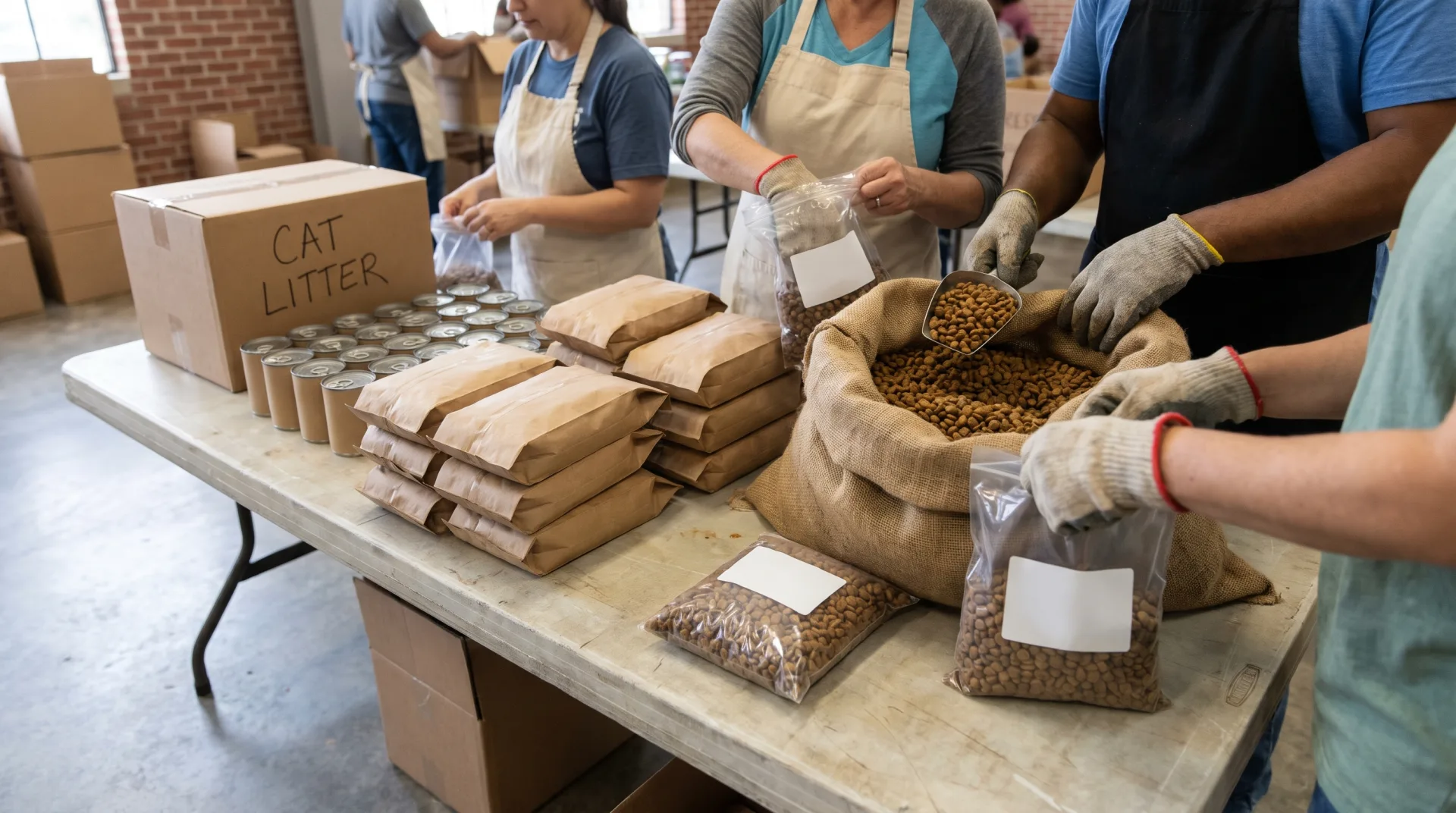
For older adults who have trouble getting out, some Meals on Wheels programs deliver pet food along with meals. It's a quiet but important piece of the safety net, because a homebound senior can't easily get to a Saturday pantry.
Meals on Wheels America, the national group, manages pet assistance grants for local programs. It took over the Banfield Charitable Trust's Pet Assistance Grant program in 2015, and in 2023 PetSmart Charities renewed a $3 million grant to fund work that includes pet food deliveries. In May 2024, the two groups marked 13 million pet meals served.
In North Carolina, several local programs describe pet help on their own sites. Meals on Wheels of Asheville and Buncombe County says, "Each week, we deliver pet food to over 200 pets." Meals on Wheels of Orange County's Kibble and Care program says on its page, as of November 2026, that it has delivered more than 7,830 pounds of pet food and supplies. In Guilford County, Senior Resources of Guilford runs Pets Eat Too, a pet food program for its Meals on Wheels participants.
These programs describe deliveries to their meal clients' pets, so signing up for meals is usually the first step. If you're a family member or caseworker helping an older adult, ask the local program how its pet help works. SPCA Wake also says its program helps homebound seniors care for their pets through community partners.
| Area | Program | What its page says |
|---|---|---|
| Asheville and Buncombe County | Meals on Wheels of Asheville and Buncombe County, Pet Care | Delivers pet food to over 200 pets each week. Page undated; call first. |
| Orange County | Meals on Wheels of Orange County, Kibble and Care | More than 7,830 pounds of pet food and supplies delivered |
| Guilford County | Senior Resources of Guilford, Pets Eat Too | Pet food program for Meals on Wheels participants; (336) 373-4816 ext. 243 |
| Pitt and nearby | Pet Food Pantry of Eastern NC, Meals on Wheels | Helps seniors' pets in 3 counties through Meals on Wheels; ask which ones (same group as its Pitt listing, counted once) |
If There's No Pantry Near You
Plenty of North Carolina counties don't have a pet food pantry with its own web page. That doesn't mean there's no help. Try these, in roughly this order.
Call your county animal shelter. Some shelters keep donated food for owners who ask. Guilford County and Currituck County both say so on their websites, and Orange, Catawba, Iredell and Pender run programs out of their county shelters. Asking also tells the staff you want to keep your pet, and they can point you to other local help.
Ask your local food pantry. Human food pantries sometimes get pet food donations, and several groups in our tables, such as Asheville Humane, Forsyth Humane and Paws-Ability, supply partner pantries.
Ask a local rescue. Some food banks pass pet food to rescues rather than to human food pantries. Second Harvest Food Bank of Metrolina, for example, says it "acquires large donations of pet food" and distributes it through a network of rescue partners in its region.
Dial 2-1-1. NC 211 is a free, statewide referral line run by United Way of North Carolina. You can call 2-1-1 or 1-888-892-1162, or search its website by ZIP code, and ask what pet food help is near you.
Use a national map, then call. Pets of the Homeless keeps a map of food and supply locations and recommends calling first to make sure they have supplies on hand. Its listings aren't dated, so treat any listing as a lead, not a promise.
Know what SNAP covers. The U.S. Department of Agriculture lists pet food among the items households cannot buy with SNAP benefits (called Food and Nutrition Services in North Carolina). Using SNAP for your own groceries can free up cash for pet food, but the card itself won't pay for it.
If a vet bill is squeezing the food budget. Our guide to help paying vet bills in NC lists charity funds, local programs and low-cost clinics around the state.
What to Bring and What to Ask Before You Go
Every program sets its own rules, so read its page or call before you go. Across the 24 programs in our tables, the same few requirements came up again and again. The table below shows the most common ones and examples of programs that ask for each, so you can gather what you need in one trip.
A few questions are worth asking on the phone: Which days are you open this month? Do I need an appointment or an online form first? How often can I come? Do you have cat food (or dog food) right now? Can someone pick up for me if I can't get there? Is there a limit on how many pets you'll feed?
It also helps to know your pets' basic details before you call: how many dogs and cats you have, their approximate weights and ages, and whether they're spayed or neutered and current on rabies shots. Several programs ask, and having the answers ready makes the conversation quicker. Bring a sturdy bag or box, too, in case the pantry doesn't have them.
If a program says no, ask why and ask where else to try. Volunteers at one pantry often know about another across the county line.
| Requirement | Examples from our list |
|---|---|
| Live in the county they serve | Watauga, Catawba County, Iredell, Orange, Durham, Currituck |
| An ID (often a photo ID) | Watauga, Catawba County, Iredell, Pet Food Pantry of Eastern NC |
| Proof of income or public benefits | Catawba County (WIC, Medicaid or SNAP), Humane Society of Catawba County, Pet Food Pantry of Eastern NC, Pender County (benefits qualify automatically) |
| Pets spayed or neutered | Watauga (or surgery scheduled), Pet Food Pantry of Eastern NC, Pender County (within 6 months of enrolling) |
| A form or registration first | Catawba County, Humane Society of Catawba County, SPCA Wake, Paws4ever, Humane Society of Union County, Pender County |
| A limit on visits | Catawba County (once every 30 days), Iredell (once a month per household), Watauga (monthly) |
How to Help a Pet Food Pantry
If you can afford to give, the programs in our list need the same few things. Unopened bags and cans of dog and cat food are the most useful donation. Some, like Paws4ever and Blue Ridge Humane, also give out cat litter. Money lets a pantry buy what it runs out of instead of waiting for the right donation to show up. And volunteers sort and hand out food on distribution days.
Before you drop anything off, check the program's page for what it takes and where. Drop-off spots and hours vary. And if you know of a pet food pantry we missed, or one of these programs changes its rules, email us at info@ncpetproject.org so we can check it and add it.
Pet food help keeps pets with the people who love them, and a pet that stays home can mean one less intake at a county shelter. If you'd like to see North Carolina do more to keep pets in homes, add your name to our petition for steady spay/neuter funding.
Frequently Asked Questions
Start with the pet food pantries and programs in our tables above, which we checked on November 9, 2026. If none is near you, call your county animal shelter, ask your local food pantry whether it has pet food, or dial 2-1-1 for a referral. Several programs serve only their own county, so call before you drive.
No. The U.S. Department of Agriculture lists pet food among the nonfood items households cannot buy with SNAP benefits. In North Carolina, SNAP is called Food and Nutrition Services. Some pet food pantries accept a SNAP, WIC or Medicaid letter as proof that you qualify for their help.
It depends on the program, so check its page or call. The most common requests in our list are an ID, living in the county the program serves, proof of income or public benefits, and sometimes proof that your pets are spayed or neutered. Some programs ask you to fill out a form before your first visit.
Many programs set a limit. In our list, Catawba County Animal Services allows one visit every 30 days, the Iredell County pantry allows one visit a month per household, and Watauga Humane Society serves people monthly for a set period. Pantries are meant to help you through a hard stretch, not to be a pet's only food source.
Some do. In North Carolina, Meals on Wheels of Asheville and Buncombe County, Meals on Wheels of Orange County and Senior Resources of Guilford all describe pet food help on their websites, and Pets Eat Too is for Meals on Wheels participants. Ask your local program whether it offers one and who qualifies.
Sources
- Program pages for every listing in the regional and Meals on Wheels tables above, as linked in each row, checked by NC Pet Project on November 9, 2026.
- Humane Society of Charlotte, Pet Food Bank (new client submissions paused, checked November 9, 2026).
- Pender County Animal Shelter, Pet Food Bank Assistance Application (PDF).
- Weiss E, Gramann S, Spain CV, Slater M. Goodbye to a Good Friend: An Exploration of the Re-Homing of Cats and Dogs in the U.S. Open Journal of Animal Sciences. 2015;5:435-456.
- Dolan ED, Scotto J, Slater M, Weiss E. Risk Factors for Dog Relinquishment to a Los Angeles Municipal Animal Shelter. Animals. 2015;5(4):1311-1328.
- U.S. Department of Agriculture, Food and Nutrition Administration, What Can SNAP Buy?
- NC Department of Health and Human Services, Food and Nutrition Services (Food Stamps).
- Meals on Wheels America, Banfield Charitable Trust to transition Pet Assistance Grant program to Meals on Wheels America (2015); PetSmart Charities renews $3 million grant (February 16, 2023); 13 millionth pet meal (May 30, 2024).
- Second Harvest Food Bank of Metrolina, Pet Food.
- NC 211, nc211.org.
- Pets of the Homeless, Find Locations.