How to Rehome a Dog in NC (Before You Surrender to a Shelter)
Need to rehome or surrender your dog in NC? Try the fixes first, then place your dog yourself or surrender the right way. Steps, screening and NC law.
TL;DR: Rehoming a dog yourself is almost always better for the dog than surrendering to a county shelter, and it is not hard to do well. Screen adopters by phone, meet on neutral ground, charge a modest fee, be honest about the dog’s history, and send the records along. Before you start, check whether the problem that is pushing you to rehome is one that money, housing help or a few training sessions could solve, because research says it often is. And know what you are signing: North Carolina law lets you waive the shelter’s 72-hour holding period on your own dog.
Nobody plans this part. You got the dog for good reasons, and now the lease changed, or the job did, or the second dog and the first dog never worked it out, and you’re sitting in the truck outside a county animal shelter trying to decide whether to go in.
Here is the honest version, with the numbers behind it. Going in is not the only option, and in most cases it should not be the first one. Rehoming a dog yourself takes two to six weeks of moderate effort, and it gives the dog something no shelter can promise: a direct handoff from one home to another, with no kennel in between. This guide walks the whole path, from figuring out whether you actually need to rehome at all, through screening adopters, to the narrow set of cases where the shelter really is the right call.
Have a cat instead? Our guide to rehoming a cat in NC covers the same ground for cats, including the litter box and allergy fixes that often mean you don’t have to.
First, Figure Out Which Problem You Actually Have
Most people describe rehoming as a decision about the dog. The research says it usually isn’t.
A 2026 study in PLOS One surveyed 452 owners who had recently rehomed or surrendered a dog or cat, and sorted them into three groups by what was actually driving the decision. Nearly half, 47.6 percent, fell into a group the authors called owner hardships, meaning housing and personal circumstances. Another 42.9 percent were new acquisitions, animals owned less than a year in households that already had pets. Only 9.5 percent were behavioural incompatibility, the group most people picture when they hear the word rehoming (Ly et al., 2026).
That split matters because the three groups need completely different things, and they behave completely differently. The owner hardships group was the most likely to rehome the dog themselves without ever involving a shelter, at 64.1 percent. The behavioural incompatibility group was the least likely to ask anyone for help before deciding, at 14.0 percent, and the most likely to try a shelter, get turned away and end up self-rehoming anyway.
Older national data points the same direction. Best Friends Animal Society analyzed 1.1 million classifiable owner surrenders recorded between January 2018 and September 2020, and the two most common reasons given were “too many animals” at 16.1 percent and “housing” at 13.7 percent. Non-aggressive behavior issues accounted for 7.8 percent (Best Friends, 2018 to 2020 data).
| Which situation is yours | What the data says | What to do first |
|---|---|---|
| Housing, money, health, a move, a deployment | The largest group, 47.6 percent of surrendering owners in the 2026 study. Most rehome the dog themselves and never contact a shelter. | Check the safety-net options below before you list the dog. Some of these are temporary problems and there are temporary fixes. |
| A recent adoption or acquisition that isn’t working | 42.9 percent. Highest rate of asking for help, at 54.6 percent, and the highest rate of going straight to a shelter. | If you got the dog from a rescue or breeder in the last year, your contract almost certainly requires you to contact them first. |
| Behavior you can’t live with | Only 9.5 percent, but the least likely to seek help, at 14.0 percent, and the most likely to be turned away by a shelter. | One consultation with a credentialed trainer or a veterinary behaviorist, before you list. Many of these cases are resolvable, and the ones that aren’t need disclosure, not a listing. |
None of this is a lecture about trying harder. It’s a sequencing point. If your problem is three months of rent trouble, rehoming the dog is a permanent solution to a temporary problem, and a fixable one. If your problem is a dog who has bitten someone, the answer is not a Craigslist ad.
What Surrendering to an NC County Shelter Actually Means
Ask any county animal services director in North Carolina and they will tell you the same thing: they will take your dog, and they would rather you didn’t.
The reason is capacity. North Carolina’s public animal shelters reported 75,521 dog intakes in calendar year 2025, according to the NC Department of Agriculture and Consumer Services Public Animal Shelter Report. Of those dogs, 34,995 were adopted, 13,357 went back to an owner, and 17,140 were euthanized. That is a statewide dog euthanasia rate of 22.7 percent. The state replaced its file on October 12, 2026, and it covers 66 of 100 counties. Several of the state’s largest county shelters have not reported yet, and counties that file late may still be added, so the totals will move (NC DACS, 2025 CY report).
The statewide average, though, hides the number that should actually drive your decision. Where you live changes your dog’s odds more than almost anything about your dog.
Read those bars carefully before you decide anything. A healthy, friendly, adoptable dog surrendered in Rowan County in 2025 had very good odds. The same dog surrendered ninety minutes west in Caldwell County walked into a building where more than half of all dogs taken in that year were euthanized. Neither number is a judgment about the staff. It is a function of intake volume, foster capacity, rescue transport partnerships and county budget, and none of those are things you or your dog control. Our guide to what no-kill means in North Carolina explains what the low-rate counties do differently.
Charlotte and Mecklenburg County, the largest shelter in the reporting file with 6,099 dog intakes, sat at 14.3 percent. Wake, Forsyth, Catawba and Iredell counties have not filed for 2025 yet, so the statewide figure will shift as more counties come in.
One caveat on reading the chart: the state report tracks intake, adoptions, returns to owner and euthanasia, but it does not have a column for transfers to rescue partners. Counties that move a lot of dogs to rescues look worse on adoption counts than they really are. The euthanasia share is the reported number, and it is the one that matters here. For the statewide picture over time, see our companion post on how many animals are euthanized in NC each year.
What North Carolina Law Lets a Shelter Do With Your Dog
Almost nobody reads the surrender form. It is worth ninety seconds, because the protections most people assume exist mostly don’t apply to owner surrenders.
The governing statute is N.C.G.S. 19A-32.1, and its headline provision is a 72-hour minimum holding period for animals received by an animal shelter. That is the number people remember. The parts they don’t remember are the ones that follow it.
| What the statute says | What that means for a surrendered dog |
|---|---|
| Subsection (a): a 72-hour minimum hold before an animal is euthanized or otherwise disposed of, or longer if county commissioners set a longer period. | This is the floor, not a guarantee of adoption effort. Your county may require more. Ask before you go. |
| Subsection (g): an owner-surrendered animal may be disposed of before the minimum holding period if the owner provides proof of ownership and signed written consent. | The surrender form you sign can waive the 72 hours entirely. Read what you are signing and ask what the checkbox means. |
| Subsection (b)(1): an animal found by the shelter operator to be unadoptable due to injury or defects of health or temperament need not be made available for adoption. | Adoptability is the shelter’s determination, not yours, and it is made in a kennel environment where frightened dogs do not show well. |
| Subsection (h): if you surrender a dog, you must state in writing whether the dog has bitten anyone in the preceding 10 days. | Bite history is a legal disclosure at surrender. It should be an ethical one when you rehome privately too. |
None of this means shelters are villains. It means the surrender form transfers every remaining decision about your dog to a building that is already full. If you want a say in where the dog lands, you have to keep that say, and the way you keep it is by placing the dog yourself.
Try These First: Keeping the Dog Is Often the Cheaper Fix
The most-cited research on this is a 2015 study published in the Open Journal of Animal Sciences and summarized by the ASPCA, which estimated that 6.12 million U.S. households rehome a pet every five years, meaning more than one million households a year. It also asked those households what would have helped. Among lower-income owners, 40 percent named free or low-cost veterinary care, 34 percent named free or low-cost training or behavior help, 33 percent named access to pet-friendly housing, and 30 percent each named spay/neuter services, pet food, or temporary boarding (ASPCA, 2015 study).
The ASPCA’s own position statement puts a sharper number on it: in a Los Angeles survey, 88 percent of respondents chose to explore safety-net options once they were told those options existed (ASPCA position statement). The barrier, in other words, is usually information rather than willingness.
| If the problem is | Ask for this in North Carolina |
|---|---|
| You can’t afford food this month | A county pet food pantry. Many NC humane societies and shelters run one, including Pet Food Pantry of Eastern NC and the Humane Society of Charlotte pet food bank for Mecklenburg residents. Call your county animal services and ask what exists locally. |
| You can’t afford the spay, neuter or vet bill | Start with our county-by-county guide to low-cost spay/neuter in NC, then ask your county whether it participates in the state Spay/Neuter Program. |
| A landlord, a move or a breakup | Ask local rescues about temporary or crisis fostering before you list the dog. Some NC rescues run short-term safety-net foster placements specifically to prevent surrenders. |
| Behavior you can’t live with | One session with a credentialed trainer or a board-certified veterinary behaviorist. Get a medical workup first; pain and thyroid problems masquerade as behavior problems constantly. |
| Too many animals in the house | The single most common surrender reason in the Best Friends dataset. Rehome one thoughtfully and sterilize the rest, rather than surrendering the whole group. |
| You just need a few weeks | Ask friends, family and coworkers for temporary boarding before you ask a stranger for permanent adoption. Thirty-seven percent of rehomed pets in the 2015 study went to a friend or family member. |
How to Rehome a Dog Yourself, Step by Step
If you have worked through the list above and rehoming is still the right answer, here is the process. Give yourself two to six weeks. Rushing it is what produces bad placements.
1. Get the dog vetted and documented. Best Friends recommends a veterinary checkup before rehoming, and considering spay or neuter if it hasn’t happened, and putting together a written history: likes and dislikes, current food and favorite treats, how the dog is with other animals, and preferred toys (Best Friends). An up-to-date dog with a paper trail is dramatically easier to place, and it is the difference between a serious adopter and a shrug.
2. Contact the source first. If the dog came from a rescue or a responsible breeder, your contract very likely obligates you to return the dog to them. The American Kennel Club is direct about this, noting that responsible breeders are proactive and that their priority is making sure the dogs they breed have the best life possible (AKC). For purebreds and obvious mixes, breed-specific rescue groups are the strongest single channel most owners never try, and our breed pages list the North Carolina breed rescues we have checked so far. Our guide to finding a legitimate animal rescue in North Carolina covers how to tell a real one from a hoarding operation with a logo.
3. Write a listing that tells the truth. Good photos in natural light, a short video of the dog moving and being handled, and a plain description that includes the hard parts. A dog who cannot live with cats, resource guards a food bowl, or has separation anxiety should say so in the listing. Hiding it does not place the dog; it places the dog twice.
4. Post where adopters actually look. Courtesy listings on local rescue and shelter websites, breed club rescue networks, your own social media with a request to share, workplace and neighborhood boards, and dedicated rehoming platforms such as Rehome by Adopt-a-Pet or Home To Home, which several NC shelters point owners toward. Platforms are a tool, not a substitute for your own screening.
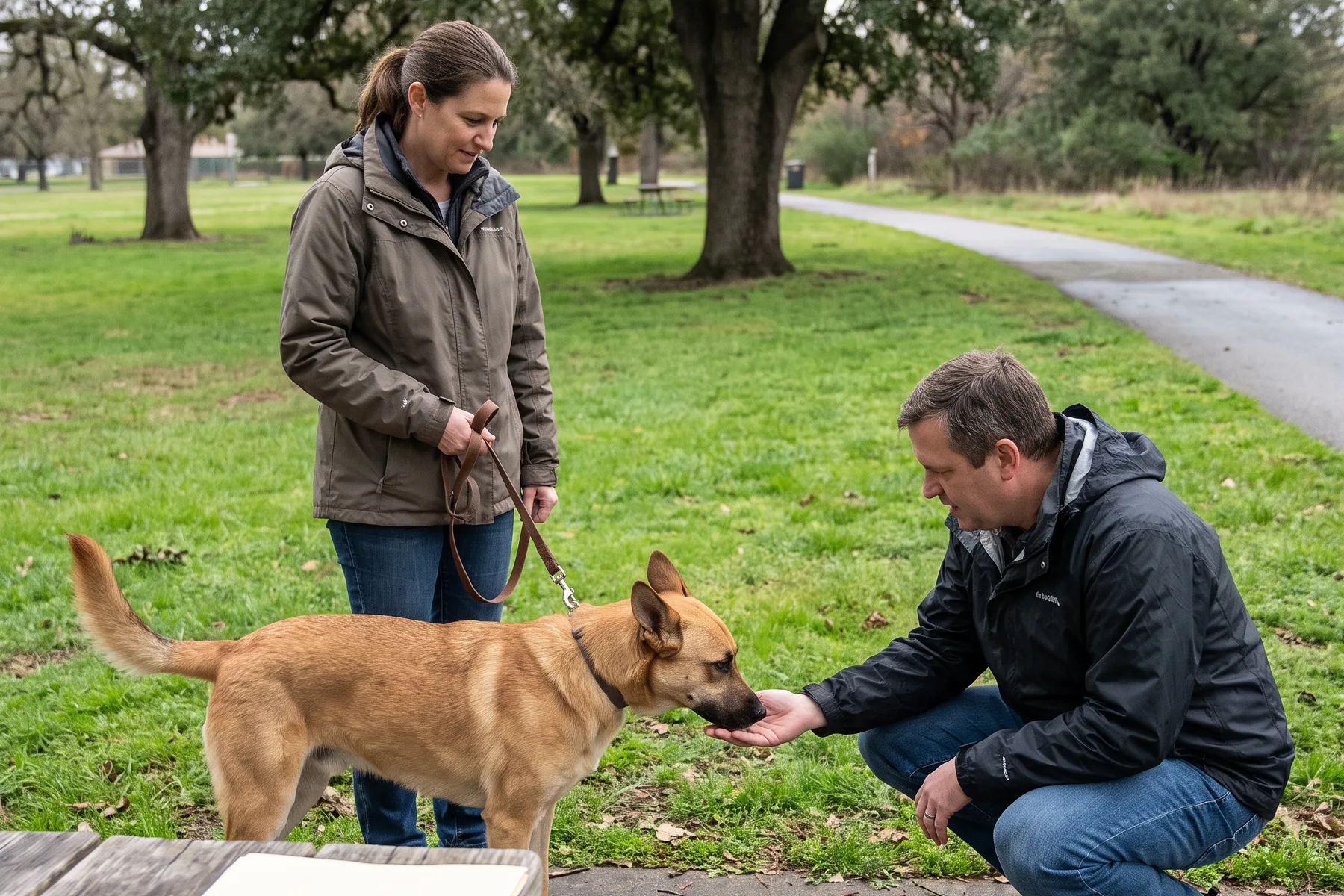
5. Meet on neutral ground, then see the home. Best Friends suggests meeting on neutral ground or at the adopter’s home so you can watch how they interact with the dog, and finalizing with an adoption contract as a safety net for both sides. A park, a quiet parking lot or the adopter’s fenced yard all work. Bring a second person. Watch the dog, not the conversation.
6. Send everything with the dog. Vaccination and medical records, microchip number and transfer instructions, the current food, a familiar blanket or toy, the written history, and your phone number. Then transfer the microchip registration. A microchip still registered to you six months later is the most common reason a rehomed dog ends up in a shelter as a stray with nobody to call.
7. Set the adjustment expectation out loud. Best Friends warns adopters that a pet can take weeks to months to adjust to new people and a new environment. Say that on the phone, before the meeting. Adopters who expect a settled dog on day three are the adopters who return one on day five.
How to Screen an Adopter Without Being Weird About It
Screening is a fifteen-minute phone call, not an investigation. The AKC’s guidance is to charge an adoption fee and check references for the new family to ensure the home will be a good fit. Best Friends recommends a phone interview before any in-person meeting, with open-ended questions about their pet experience, household, current pets and what they’re looking for.
The point of open-ended questions is that they are hard to answer with what you want to hear.
| Ask this | Why it works |
|---|---|
| “Tell me about your last dog and what happened to them.” | The most informative question you can ask. Listen for the pattern, not the incident. Three dogs who all “ran off” is a pattern. |
| “Walk me through a normal weekday. Where would the dog be at 2pm?” | Surfaces crate time, yard time and hours alone without asking a question anyone knows how to game. |
| “How quickly do you hope the dog will adjust?” | The Best Friends question. An answer measured in days rather than weeks is a return waiting to happen. |
| “Who is your veterinarian?” | Ask permission to call. A current vet who confirms the household keeps animals on preventatives is the strongest reference that exists. |
| “Do you rent? What does your lease say about dogs and weight limits?” | Housing is the second most common surrender reason in the Best Friends dataset. Verifying it now prevents the next surrender. |
| “What would make you decide this isn’t working?” | Honest adopters answer this thoughtfully. It also tells you exactly what to prepare them for. |
And say the hard things yourself. If the dog has bitten a person or another animal, the AKC’s position is that full transparency about the bite history is essential. That is not a technicality. It is the difference between a placement and a liability you handed to a stranger.
Should You Charge a Rehoming Fee?
Yes, and it is worth understanding why, because the usual explanation is partly out of date.
The warning most people have heard is that free pets get scooped up by “bunchers” who resell them to research laboratories. That pipeline was real, and it was legal: USDA Class B dealers were licensed to sell random-source dogs and cats to research institutions. It has since been largely closed at the funding end. The National Institutes of Health barred the use of NIH grant funds to procure dogs from Class B dealers for awards issued on or after October 1, 2014, following a similar restriction on cats implemented in fiscal 2013 (NIH Notice NOT-OD-14-034).
So the strongest argument for a fee is not the scary story. It is that a fee is the cheapest screening filter available to you, and the AKC recommends one on exactly those grounds. For a local anchor, our adopt or buy comparison lists what Wake and Guilford county shelters charge to adopt a dog.
| The claim | What actually holds up |
|---|---|
| “Free dogs get sold to research labs.” | Historically a real channel through USDA Class B dealers. NIH grant funds have been barred from buying Class B dogs since awards issued on or after 10/1/2014, and cats since FY13, which removed the largest buyer. |
| “A fee stops bad actors.” | A fee does not stop a determined bad actor. It does filter out impulse responders, which is most of the problem in practice. |
| “Charging feels like selling my dog.” | The fee is a commitment signal, and you can donate it. Telling an adopter the fee goes to a local rescue removes the discomfort entirely. |
| “How much?” | Enough to require a decision and not so much that it excludes good homes. Anchor it to what your county shelter charges to adopt a vaccinated, sterilized dog and be ready to explain what it covers. |
One practical note on how to collect it. Take the fee at the handoff, not as a deposit over a payment app before anyone has met. Deposits invite exactly the kind of pressure that makes people skip the meeting, and a stranger who wants to pay before seeing the dog is telling you something. If an adopter balks at a fee that is clearly below what the local shelter charges, that is useful information rather than an obstacle, and it usually arrives on the phone call rather than in the parking lot.
When the Shelter Genuinely Is the Right Answer
Everything above is written on the assumption that you have time and the dog is safe to place. Neither is always true, and there are real cases where a county shelter is the correct and responsible destination. Pretending otherwise is how people get hurt and how dogs get passed down a chain of homes that each keep them for six weeks.
The distinction worth holding onto is between a placement problem and a safety or crisis problem. A placement problem is solved by patience, honesty and a wider net. A safety or crisis problem needs infrastructure you do not have at home, and county animal services, for all the capacity pressure described earlier, is infrastructure.
| Situation | Why the shelter is the right call |
|---|---|
| The dog has a serious bite history | Private placement transfers a known danger to someone with less information and no legal framework. Disclose fully and let professionals evaluate. |
| You are in immediate crisis, tonight | Eviction, hospitalization, domestic violence, fire. A dog in a kennel is better than a dog in a car. Ask about safety-net fostering the moment you walk in. |
| The dog is severely ill or suffering | Talk to a veterinarian about humane euthanasia rather than passing a suffering animal to a stranger. This is a kindness, not a failure. |
| Weeks of honest effort produced nothing | A shelter with a working rescue transport network reaches adopters you cannot. Go in with the records, the history and the truth, and ask what happens next. |
If you do surrender, ask three questions at the counter: what is this county’s holding period, what does the consent checkbox on this form waive, and do you work with rescue partners who might pull this dog. You are allowed to ask. Very few people do.
How to Surrender a Dog in NC’s Largest Counties
Every county shelter in North Carolina sets its own intake rules, and in the biggest counties a walk-in surrender is mostly a thing of the past. Most now ask you to try rehoming first and take owner surrenders by appointment or application only, and several accept animals only from their own county. Here is how it works in six of the state’s largest counties as of October 2026, taken from each shelter’s own website. Call before you go, because these rules change with capacity.
Two patterns stand out. First, nearly every one of these shelters points owners to rehoming tools such as Rehome by Adopt-a-Pet before it will take a pet, and Wake County asks for proof, such as links to or screenshots of your listings. Second, space decides everything. Charlotte-Mecklenburg Animal Care and Control says it is currently unable to accept pet surrenders because of shelter capacity. Wake says intake appointments depend on available space, with no guarantee you will be contacted. Cumberland warns that a callback may take several weeks or more. If your county is not listed, search for its name plus “animal services owner surrender,” or use our county shelter report to see which shelter serves it.
| County | Shelter | How owner surrender works | Phone |
|---|---|---|---|
| Wake | Wake County Animal Center | Wake residents only. Try to rehome first, then request an intake appointment online. You will need proof of your rehoming attempts. | 919-212-7387 |
| Mecklenburg | Charlotte-Mecklenburg Animal Care and Control | Not accepting pet surrenders right now because of capacity. Recommends starting with Rehome by Adopt-a-Pet. | 704-336-7600 |
| Durham | Durham County Animal Shelter (Animal Protection Society of Durham) | Durham County residents. Call to make a surrender appointment. | 919-560-0640, ext. 9 |
| Guilford | Guilford County Animal Services | Guilford residents only, with proof of residency. Fill out the owner surrender application and staff set an appointment. | 336-641-3400 |
| Forsyth | Forsyth County Animal Shelter | Takes only injured dogs and cats, or animals aggressive toward people. Refers rehoming to Forsyth Humane Society. | 336-703-2480 |
| Cumberland | Cumberland County Animal Services | Requires rehoming attempts first. Email the pet information form and wait for a callback, which may take several weeks. | 910-321-6852 |
If your county cannot take your dog right away, that time is not wasted. Use it to work through the rehoming steps above, and ask the shelter whether it keeps a waiting list or a courtesy listing that can put your dog in front of adopters while the dog stays with you.
Why One Diverted Surrender Actually Matters
Nationally, owner relinquishments rose slightly to 30 percent of shelter intakes in 2025, up from 29 percent in 2024, while strays made up 59 percent. Shelters and rescues reported 320,000 dogs euthanized in 2025 (Shelter Animals Count, 2025 Annual Data Report). Roughly three in ten dogs and cats entering the system are there because a person walked them in, which means roughly three in ten intakes are, at least in principle, preventable upstream.
North Carolina’s version of that math is the 75,521 dogs who entered a public shelter here in 2025 and the 17,140 who did not leave alive. Every dog placed directly from one home to another is one kennel that stays open for a stray who has no other option, and one less dog counted in next year’s file. That is the whole logic of intake diversion, and it is why this page exists on a spay/neuter advocacy site: prevention works at the front door as well as at the clinic. For the full picture of how North Carolina got here, start with our pillar on the NC pet overpopulation crisis, and if you have a spare room rather than a dog to place, read our beginner’s guide to fostering pets in NC.
Frequently Asked Questions
The fastest safe option is usually someone who already knows the dog: a friend, relative, coworker or neighbor. Next, ask breed rescues and local rescue groups, and list the dog on a screened rehoming platform such as Rehome by Adopt-a-Pet. If you truly have to surrender, call your county animal services before you go, because some take owner surrenders by appointment only, and give staff the dog's full history so they can place it well. If you have a cat, see our guide to rehoming a cat in NC.
Sources
- Ly, L.H., McDonald, S.E., Zapata, I., Protopopova, A. “Support-seeking and rehoming pathways differ by surrender circumstances among pet owners.” PLOS One, 2026. journals.plos.org
- North Carolina General Statutes, § 19A-32.1, Minimum holding period for animals in animal shelters. ncleg.gov
- NC Department of Agriculture and Consumer Services, 2025 CY Public Animal Shelter Report (66 counties, file replaced October 12, 2026). ncagr.gov
- Shelter Animals Count, 2025 Annual Data Report. shelteranimalscount.org
- ASPCA, “More than 1 Million Households Forced to Give up Their Beloved Pet Each Year” (2015 study, Open Journal of Animal Sciences). aspca.org
- ASPCA, Position Statement on Keeping Pets and People Together. aspca.org
- Best Friends Animal Society, “Data Analysis Reveals Reasons for Owner Surrender” (24PetWatch data, January 2018 to September 2020). bestfriends.org
- Best Friends Animal Society, “Rehoming a Pet: Finding a Good New Home.” bestfriends.org
- American Kennel Club, “Rehoming a Dog Responsibly: What to Know.” akc.org
- National Institutes of Health, Notice NOT-OD-14-034, transition from use of USDA Class B dogs. grants.nih.gov
- County shelter owner-surrender pages: Wake County Animal Center, Charlotte-Mecklenburg Animal Care and Control, Animal Protection Society of Durham, Guilford County Animal Services, Forsyth County Animal Shelter and Cumberland County Animal Services, each linked in the county table above (checked October 12, 2026).