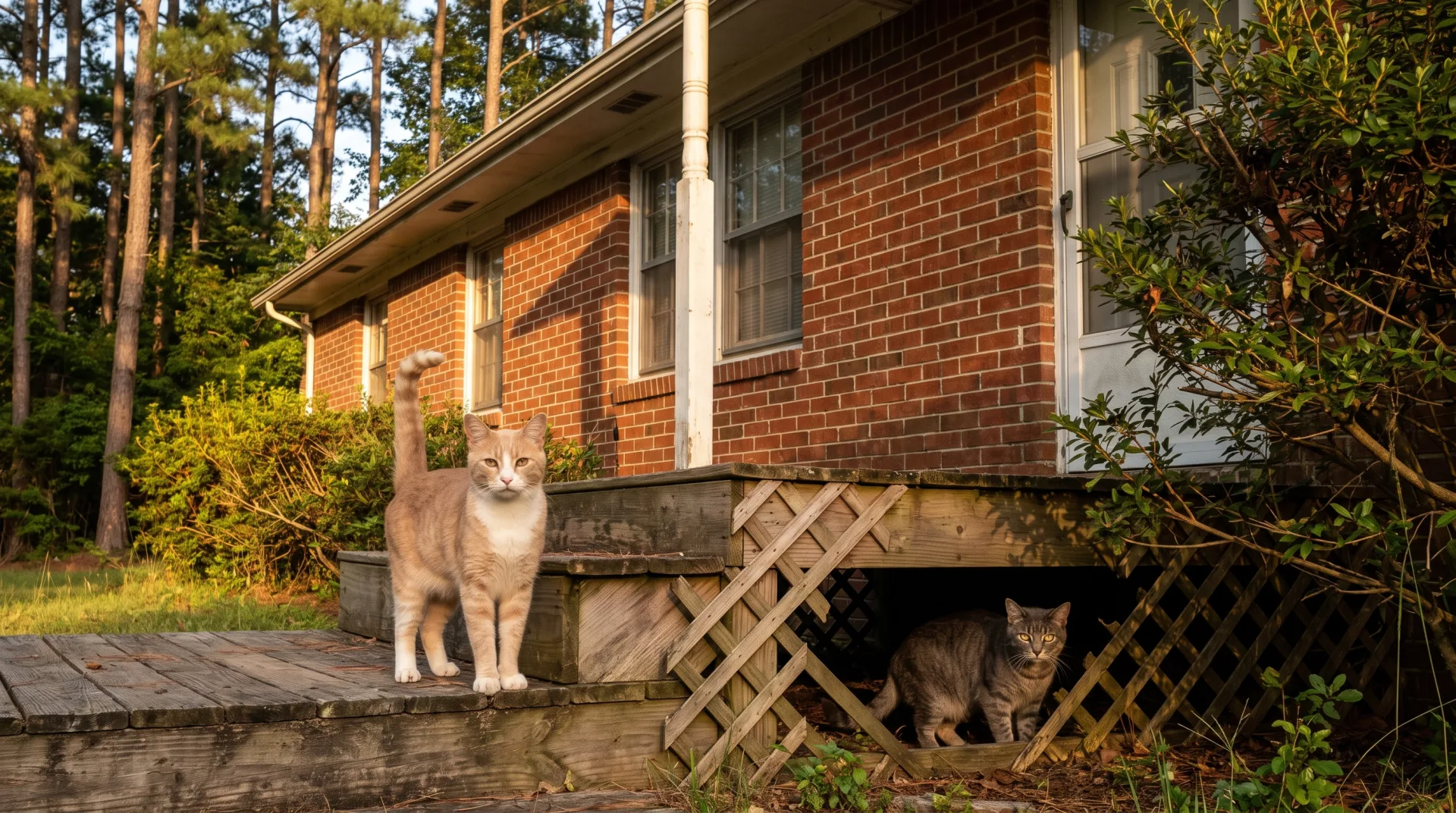
A feral cat and a stray cat can look identical from your kitchen window, but they are not the same animal and they do not need the same help. A stray is a cat who lived with people and lost or left that home. A feral cat has never been socialized to people, or lost that socialization long ago, and lives outdoors on purpose.
Getting the answer right matters more than it sounds. A friendly stray may be someone’s missing pet and can often be reunited or rehomed. An unsocialized feral cat put through the same process usually dies in a shelter. The two paths split at the moment you decide which kind of cat is standing in your yard.
This guide gives you the definitions, the six signals that tell the two apart in the field, what the ear-tip means, why the distinction decides the cat’s outcome, and the exact next steps for each type in North Carolina.
TL;DR: A stray cat was socialized to people and lost its home; a feral cat was never socialized and lives outdoors by choice (Alley Cat Allies). Judge by behavior over days, not one sighting: strays approach, meow and show up in daylight, while ferals hide, stay silent and keep low. A tipped left ear means the cat has already been through TNR. Friendly cat? Scan for a microchip and post found notices. Unsocialized cat? Call a TNR group, not the shelter. Sign the petition for state-funded spay/neuter and TNR in NC.
What Is the Difference Between a Feral Cat and a Stray Cat?
The difference is socialization, not location, not breed, and not how rough the cat looks. Alley Cat Allies defines a feral cat as “an unsocialized outdoor cat who has either never had any physical contact with humans, or human contact has diminished over enough time that she is no longer accustomed to it.” A stray cat, by the same source, is “a cat who lived indoors and was socialized to people at some point in her life, but has left or lost her home, or was abandoned” (Alley Cat Allies).
That single variable, whether the cat learned early in life that humans are safe, changes everything downstream. Socialization in cats happens in a narrow window in kittenhood. A cat who missed it does not catch up as an adult, no matter how patient you are or how much food you put out. A cat who had it does not lose it, even after months outside.
You will also hear a third term, community cat. That is an umbrella label for any cat living outdoors without an owner, feral or stray, and it is the word most NC animal-services departments and rescue groups now use in their programs. It describes where a cat lives. Feral and stray describe how the cat relates to people, which is the part that determines what help works.
One more note on vocabulary that trips people up: a feral cat is not a wild animal, and it is not a different species. It is a domestic cat, Felis catus, the same animal that sleeps on your couch. It simply grew up without human contact. And a friendly cat outdoors is not automatically homeless. Plenty of owned cats spend their days outside and go home at dinner.
| Signal | Likely stray | Likely feral |
|---|---|---|
| Approach | May approach people, houses, porches or cars | Will not approach; seeks hiding places to avoid people |
| Body language | Moves like a house cat, often walks with tail up | Crawls, crouches, stays low, protects body with tail |
| Voice | May meow, purr or answer your voice | Will not meow, beg or purr at you |
| Time of day | Visible mostly during daylight | More likely nocturnal, occasionally out by day |
| Coat | Often dirty or disheveled | Usually clean and well kept |
| Ear tip | No ear tip | May have a tipped left ear from TNR |
| Touch | May eventually be touchable | Cannot be touched, even by a longtime caregiver |
How to Tell a Feral Cat From a Stray in the Field
Almost every mistake people make here comes from judging a cat on one sighting. A terrified lost housecat behaves exactly like a feral cat for the first day or two outside, and a well-fed feral cat who trusts your feeding schedule can look calm enough to seem tame. Give it a week of quiet observation and the pattern separates cleanly.
Watch the trend, not the snapshot. A stray gets closer at every meal. Day one it watches from the fence, day three it eats while you stand ten feet away, day six it is on the step waiting for you. A feral cat’s distance does not shrink. You can feed the same cat for two years and never get within arm’s reach, and that is not a failure of patience. It is the answer.
Read the tail and the spine. This is the fastest read available and it takes three seconds. A socialized cat walks with its tail up, spine level, head high. An unsocialized cat moves low to the ground with its tail wrapped tight against its body, using cover as it goes. Alley Cat Allies lists exactly that contrast, crawling and crouching versus walking with the tail up, as a core distinction.
Listen. Strays meow at people because meowing at people used to work. Ferals do not vocalize toward humans at all. Hissing and growling from a trapped cat tell you nothing either way; any frightened cat does that. What matters is whether the cat ever tries to talk to you when it is not cornered.
Check the left ear first. An ear tip is the universally recognized sign that a cat has already been spayed or neutered and vaccinated through a Trap-Neuter-Return program. The standard protocol removes the distal one quarter of the left ear, about 3/8 inch or one centimeter in an adult cat, while the cat is under anesthesia for surgery, so it is clean and painless and the ear heals on its own (Alley Cat Allies). If you see a tipped ear, stop worrying about whether the cat needs to be fixed. Someone already did it, and the cat has a caretaker or a colony nearby.
Look at the coat, and expect a surprise. New arrivals to outdoor life get grubby fast because they were never good at it, so a matted, dirty, thin cat is more likely a lost pet than a lifelong feral. Established ferals are usually well groomed. A gorgeous glossy cat who will not let you within fifteen feet is a much better feral candidate than a scruffy one asking to be let in.
Rule out the third option. Before you decide a cat is homeless, look for a collar, ask three neighbors, and check whether the cat vanishes at the same time each evening. Owned outdoor cats get “rescued” from their own yards constantly. Alley Cat Allies notes that more than 60 percent of lost cats find their way home on their own, which is a strong argument against scooping up a healthy, friendly cat the moment you see it (Alley Cat Allies).
Why the Difference Decides What Happens to the Cat
Here is the part most identification guides skip. The label you land on does not just change your plan. It changes the cat’s odds of surviving the system it enters.
Nationally, cats are far less likely to get home than dogs. In the Shelter Animals Count 2025 Annual Data Report, 19 percent of all dog intakes ended in a return to owner compared with 3 percent of cat intakes, and among animals brought in specifically as strays, 34 percent of dogs went home against 6 percent of cats (Shelter Animals Count, 2025 data). Across both species, 638,000 dogs and cats were returned to owners in 2025, down 3 percent from 2024, while strays made up 59 percent of everything shelters took in.
For an unsocialized cat, the odds are worse still, and North Carolina law shows why. Except in narrow circumstances, every animal a shelter receives here must be held for a minimum of 72 hours before it can be euthanized or otherwise disposed of, and the shelter must make animals available for adoption in a way the public can inspect. But that adoption requirement does not apply to an animal “found by the operator of the shelter to be unadoptable due to injury or defects of health or temperament” (N.C.G.S. 19A-32.1). A cat who hisses and hides at the back of a stainless steel cage reads as exactly that. Alley Cat Allies puts the outcome bluntly: feral cats “are likely to be killed if picked up by animal control or brought to shelters, so it is in their best interest to continue living outdoors.”
Strays and ferals therefore need opposite handling. A stray needs to enter the reunification system fast, because its family is probably looking. A feral needs to stay out of that system entirely and get spayed or neutered, vaccinated and returned to its territory instead. We cover the scale of what happens when NC shelters absorb both without enough spay/neuter access in our breakdown of how many animals are euthanized in NC each year.
Found a Friendly Cat? Do These Five Things First
If the cat approaches you, lets you touch it, or camps on your porch and meows, treat it as a lost pet until proven otherwise. Work through these five steps in order.
1. Look for a collar and read the tag. Obvious, and skipped constantly. Call any number on it before you do anything else.
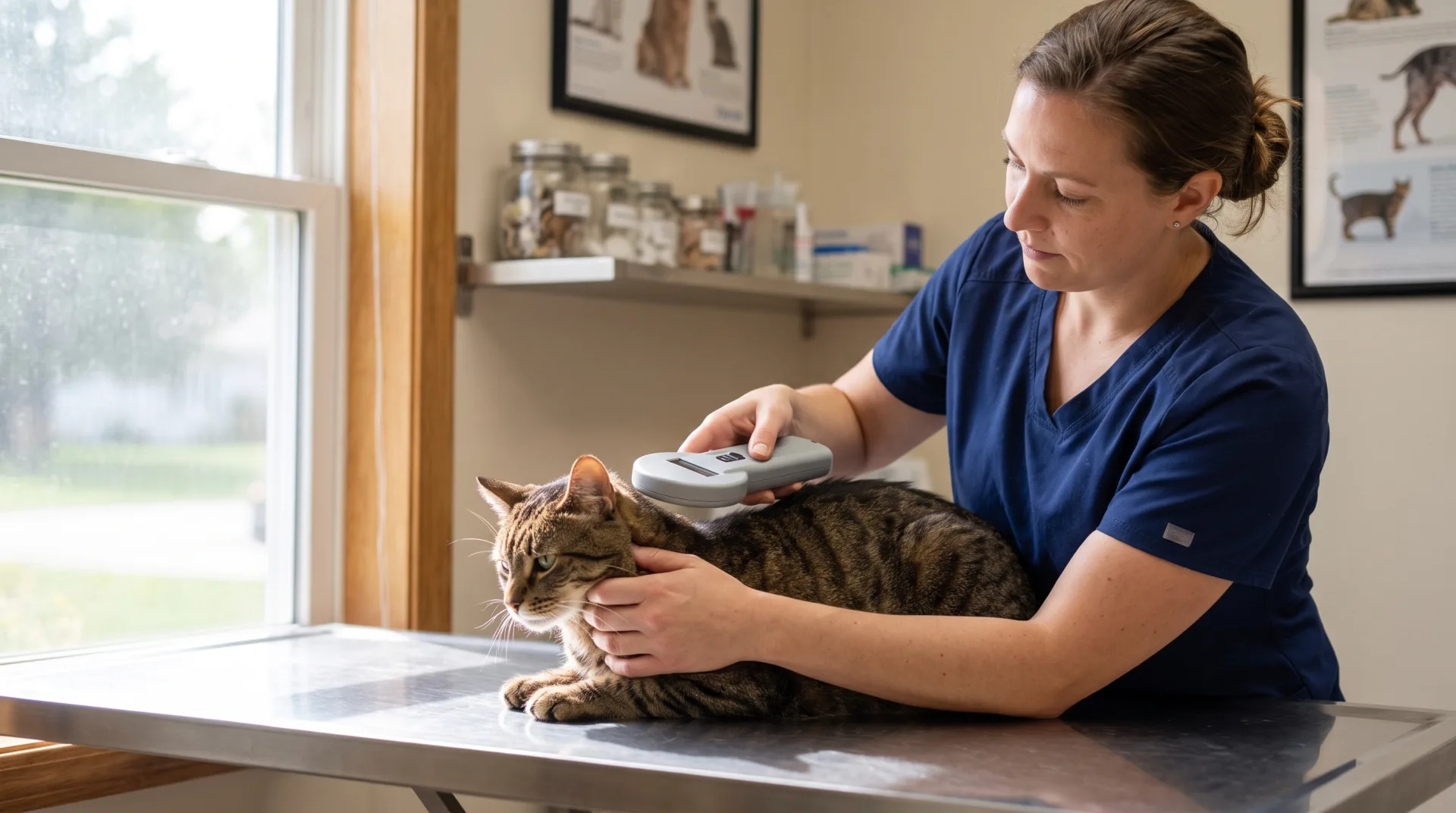
2. Get the cat scanned for a microchip. Any veterinary clinic, county animal services office or rescue group can do this in under a minute, free in most cases. It is worth the trip: in a study of 7,704 microchipped animals across 53 shelters in 23 states, the return-to-owner rate for microchipped cats was 20 times higher than the rate for all stray cats entering those shelters, and owners were located for 72.7 percent of the microchipped animals (Lord et al., Journal of the American Veterinary Medical Association, 2009, via The Ohio State University).
3. Post found notices where the cat was found. Flyers on the nearest few blocks, plus posts in the neighborhood groups people actually read. Describe the color, fur length and where you found the cat, add a photo, and hold back one identifying detail so you can verify anyone who calls. Alley Cat Allies recommends asking callers to describe the cat in depth and to name a veterinarian as a reference.
4. Call your county animal services and file a found report. Owners searching for a lost cat call the shelter first, and shelters often keep found lists and lost and found pages they match against inquiries. Filing the report is not the same as surrendering the cat, and you can usually keep it at your house while the report stands.
5. Only then consider intake. If nobody claims the cat, a friendly cat can be rehomed, and doing that yourself or through a rescue gives it better odds than a crowded county shelter in July. Our guide to finding a legitimate rescue in North Carolina covers how to vet a group before you hand a cat over. Whatever happens next, get the cat spayed or neutered and vaccinated at a low-cost NC clinic first, because an unfixed friendly cat outdoors is next spring’s litter.
The Cat Will Not Come Near You. Now What?
If a week of observation says feral, change goals. You are not going to rehome this cat, and you should not try to force it indoors. The right outcome is a fixed, vaccinated, ear-tipped cat living in the territory it already knows, with someone keeping an eye on it.
That means Trap-Neuter-Return, and North Carolina has more infrastructure for it than most residents realize, including free and low-cost community cat clinics and groups that loan traps and coach first-timers. Our step by step guide to starting a TNR program in your NC community walks through the whole sequence, and how to help feral cats in your neighborhood covers the day to day care side: feeding without creating problems, winter shelter, and keeping neighbors on your side.
What you should not do is put an unsocialized adult cat in a carrier and drive it to the county shelter. The 72 hour clock starts, the temperament exception applies, and the cat that was surviving fine in your yard becomes a statistic. Call a TNR group or a community cat program instead. If you are not sure who covers your county, start with our Get Help page.
One safety note that also protects the cat. North Carolina requires every cat, dog and ferret over four months old to be vaccinated against rabies (N.C.G.S. 130A-185), and state law is unforgiving when an unidentified animal bites someone. If a stray or feral animal bites a person and the local animal control agency cannot identify an owner within 72 hours, the local health director may authorize euthanasia so the animal’s head can be sent to the State Laboratory of Public Health for rabies testing (N.C.G.S. 130A-196). Do not grab, corner or hand-catch a cat you cannot identify. Use a humane trap, let the clinic handle the cat, and the rabies vaccine that comes with TNR removes most of this risk permanently.
Kittens Change the Math
Age overrides everything above. A feral kitten caught young can be socialized and adopted into a home, while an adult feral almost never can, so the feral or stray question matters far less for kittens than the how old is it question. The window is narrow and it closes week by week, which is why speed matters more than certainty when you find a litter.
The socialization timeline, what to do with a litter whose mother is probably nearby, and when to intervene versus leave them alone are all covered in our neighborhood feral cat guide. Read that before you touch a kitten, because the most common mistake with found kittens is taking healthy nursing ones away from a mother who was fifteen feet away the whole time.
North Carolina’s outdoor cat population keeps growing because the state funds almost no community cat spay/neuter. Sign the petition for state-funded spay/neuter and TNR, or email your NC representative.
Frequently Asked Questions
One Question, Two Very Different Answers
Feral or stray comes down to one thing: did this cat ever learn that people are safe? Watch it for a week, read the tail, listen for a meow, check the left ear, and the cat will tell you. Then act on the answer instead of on instinct. Scan and post for the friendly one. Trap, fix, vaccinate and return the one that will not come close.
What neither answer changes is the reason there are so many cats outdoors in North Carolina in the first place. The state funds almost no community cat spay/neuter, so the work falls to volunteers with borrowed traps. Sign the petition for state-funded spay/neuter and TNR, email your NC representative, and read the full fiscal case in why NC needs a state-funded TNR program.
Sources
- Alley Cat Allies: Feral and Stray Cats, an Important Difference
- Alley Cat Allies: Why the Clipped Eartip on Outdoor Cats
- Alley Cat Allies: How to Find a Stray Cat’s Home
- Shelter Animals Count: 2025 Annual Data Report
- The Ohio State University: Microchips Result in Higher Rate of Return of Shelter Animals to Owners (Lord et al., JAVMA, 2009)
- N.C.G.S. 19A-32.1: Minimum Holding Period for Animals in Animal Shelters
- N.C.G.S. 130A-185: Rabies Vaccination Required
- N.C.G.S. 130A-196: Notice and Confinement of Biting Animals
Dealing with feral cats in your area?
NC Pet Project can help you get a TNR program started. We'll connect you with resources, training, and our volunteer network.