
Kitten Season in NC: Why Shelters Flood Every Spring (and What to Do)
When kitten season starts, why daylight drives it, and exactly what to do if you find kittens outside in North Carolina. Plus the shelter data behind the spring flood.
TL;DR: Kitten season is the stretch of spring, summer and early fall when outdoor cats give birth in waves and shelters fill with kittens. It is driven by day length, not temperature, so it starts as the days lengthen in late winter and runs into fall. Nationally, kitten intake climbs in February and March and peaks in May. If you find kittens outside, the answer is almost always to wait and watch first. Mom is usually nearby, and she is better at this than any of us.
Every year, somewhere around late February, the phone calls start. A litter under the deck. Four kittens behind the church. A cardboard box left at the shelter door before it opened. By May the calls have become a flood, and by July the shelters that took those kittens in are out of foster homes, out of cage space and out of time.
That flood has a name. It is kitten season, and it is not random, not new and not really about the weather. It is a predictable biological cycle that North Carolina lives through every single year. Once you understand what drives it, you can see exactly where the leverage is, and you can see why the single most useful thing most people can do when they find kittens outside is nothing at all.
When Is Kitten Season in North Carolina?
Kitten season is the annual period when unspayed outdoor cats conceive, give birth and raise litters in overlapping waves. There is no official start date, because it is a biological window rather than a calendar event, but the veterinary literature is clear about the window itself.

Domestic cats are seasonally polyestrous, which means a female cat cycles repeatedly through a breeding season and then stops. In the United States, “queens cycle during the spring and summer (about March to September) and cyclicity stops as the days shorten in the late fall and winter (October to February),” according to a review of normal feline reproduction by Auburn University veterinarian Aime Johnson in the Journal of Feline Medicine and Surgery (Johnson, 2022).
Shelters see that biology arrive on a short delay, because conception comes first and intake comes weeks later. Shelter Animals Count, which aggregates intake and outcome records from shelters and rescues nationwide, found in its 2024 animal-level data that intake of kittens under eight weeks old starts rising in February and March and surges to its highest point in May, staying elevated through June. Juvenile cats, meaning eight weeks to five months, then peak in July as the spring kittens age up (Shelter Animals Count, 2024 data).
North Carolina does not publish monthly shelter intake data, so the month-by-month picture below comes from national figures rather than state ones. What the state does publish is the annual total, and it is large enough to make the seasonality matter.
| Time of year | What is happening biologically | What shelters see |
|---|---|---|
| January to February | Days begin lengthening. Queens start cycling again. | Quietest stretch of the year. Kittens are under 10 percent of cat intake in most regions. |
| March to April | First conceptions of the year deliver. Breeding continues. | Kitten intake climbs steadily. Neonates arrive first. |
| May to June | Peak birthing. Second-round breeding underway. | The peak. In many regions more than half of all cat intake is kittens under eight weeks. |
| July to August | Late litters. Spring kittens reach breeding age. | Juvenile intake peaks in July. Foster networks are stretched thin. |
| September to October | Cycling winds down as days shorten. | A second, smaller kitten spike, then a gradual taper. |
| November to December | Most queens are out of season. | Kitten intake at its annual low. |
One nuance worth naming: the 2025 data shows kitten intake “peaking sharply in May and September,” a two-peak pattern rather than the single May spike the 2024 data showed (Shelter Animals Count, 2025 Annual Data Report analysis). For a warm state at the southern end of the cycling window, that second peak is the one that catches people off guard. If you assume kitten season ends when school starts, you will miss the fall litters entirely.
Why Kitten Season Happens: Daylight, Not Warm Weather
Almost everyone assumes kitten season is a temperature story. It is not. It is a light story.
The feline reproductive cycle is triggered by photoperiod, meaning the number of daylight hours. A shift from short days to longer days induces estrus, a process mediated by melatonin from the pineal gland. The effect is strong enough that cats kept under 14 hours of artificial light will cycle year round regardless of season (Johnson, 2022). Alley Cat Allies has observed the front end of that cycle directly, reporting that pregnant cats brought to its clinic peaked in March, which means the cats were breeding in winter and delivering in spring and summer (Alley Cat Allies).
That is why a mild February does not create kitten season and a cold snap does not stop it. The trigger is already in motion by the time anyone notices the weather.
The second half of the explanation is arithmetic. Cats reproduce fast, start young, and can conceive again while still nursing a litter.
| Reproductive fact | Figure | Source |
|---|---|---|
| Age a female cat can first become pregnant | As young as 4 months | Alley Cat Allies |
| Sexual maturity in free-roaming cats | 5 to 6 months | Robertson, 2008 review |
| Gestation length | Average 64 days (range 52 to 74) | J Feline Med Surg, 2022 |
| Litter size | 1 to 6 kittens | Robertson, 2008 review |
| Litters per year, free-roaming cats | About 1.6 | Robertson, 2008 review |
| Kittens who die or disappear before 6 months | 75 percent | Robertson, 2008 review |
Read those last two rows together and the shape of the problem appears. Free-roaming cats produce litters of one to six kittens roughly 1.6 times a year, and about 75 percent of those kittens die or vanish within six months, most often from trauma such as vehicles and loose dogs, according to a 2008 review of feral cat control in the Journal of Feline Medicine and Surgery (Robertson). The population sustains itself anyway, because the survivors start breeding before their first birthday. A kitten born in April can be pregnant by September.
What Kitten Season Looks Like Inside a Shelter
The volume alone is striking. In 2025, kittens made up 59 percent of all cat intake at reporting organizations nationally, and 37 percent of every cat entering care was a kitten under eight weeks old (Shelter Animals Count). Those are not evenly spread across twelve months. They arrive in a compressed window, which is what turns a manageable annual number into a spring emergency.
North Carolina’s own numbers show the scale of the underlying cat problem. The NC Department of Agriculture and Consumer Services 2025 Public Animal Shelter Report, in the file the state replaced on October 12, 2026 with 66 of 100 counties reporting, records 75,263 cats taken into public shelters statewide. Only 2,406 of those cats, about 3 percent, went home to an owner. For the statewide euthanasia picture and how it has moved over time, see our companion post on how many animals are euthanized in NC each year.
The hardest part of kitten season is not the total. It is which kittens are most at risk. Shelter Animals Count’s 2024 animal-level data broke non-live outcomes down by kitten age, and the three groups it tracked account for the whole picture between them.
Kittens under eight weeks old account for 73 percent of kitten non-live outcomes, split between the under-four-week group at 35 percent and the four-to-eight-week group at 38 percent. Once kittens pass eight weeks, the share drops to 27 percent. That gap is the whole argument for what comes next.
Found Kittens Outside? The Leave Them Be Rule
Here is the instinct almost everyone has, and it is the wrong one: you find a nest of kittens with no mother in sight, you assume they are abandoned, and you scoop them up and drive them to a shelter. It feels like a rescue. Statistically, it is closer to the opposite.
A mother cat leaves her litter regularly and for good reasons, mostly to find food. She may also be watching you from ten feet away, waiting for you to leave so she can come back. Alley Cat Allies’ guidance is direct: “Do not assume that kittens are abandoned or orphaned just because you do not see their mother,” and “always wait several hours, or even a full day to see if a mother cat returns,” watching from a hidden spot or from indoors so your presence does not keep her away (Alley Cat Allies).
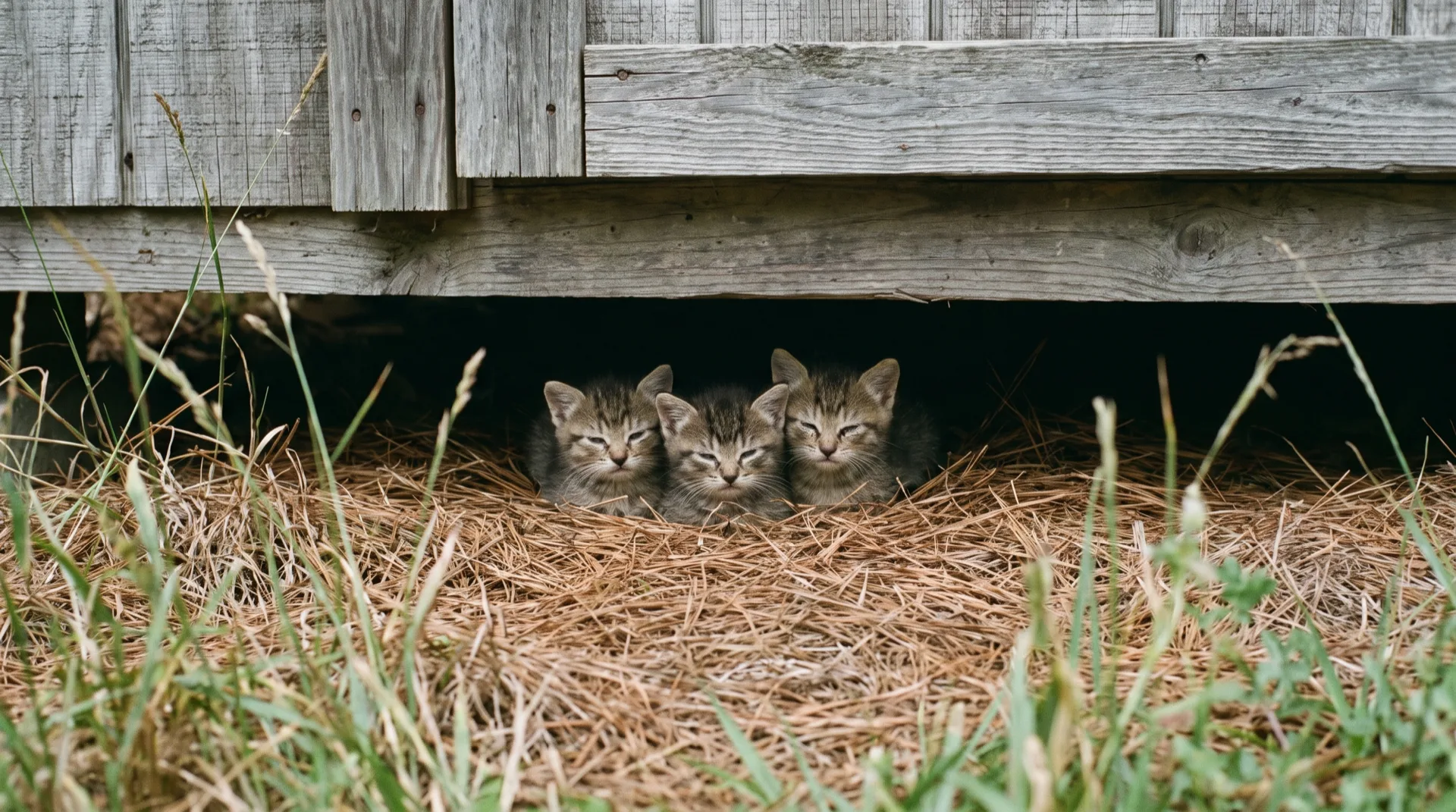
There are two easy ways to check whether mom has been back. First, look at the kittens themselves. If they are cuddled together and sleeping quietly, and they look pink, warm and clean with full bellies, she has very likely been feeding them. Cold, scattered, thin, crying kittens tell a different story. Second, sprinkle a ring of flour around the nest. If she returns, she leaves paw prints.
The reason this matters so much is the same reason the chart above looks the way it does. Neonatal kittens under four weeks old need round-the-clock bottle feeding and warmth, and most shelters simply do not have the staffing to provide it during the exact months when hundreds of them arrive at once. Alley Cat Allies puts it plainly: do not take unweaned kittens to an animal shelter. A mother cat outdoors, with food and water and a little shelter, is giving those kittens better odds than a busy intake room in May.
How Old Is That Kitten?
Every decision you make about found kittens depends on their age, and age is easier to read than most people expect. Alley Cat Allies publishes a progression chart that maps the visible milestones week by week (Alley Cat Allies).
| Age | What you can see | What it means for you |
|---|---|---|
| 1 day | Cannot stand. Eyes closed, ears folded flat. | Fully dependent. Do not move them. |
| 3 to 6 days | Ears beginning to unfold, eyes starting to open. | Still fully dependent. |
| 1 week | About 8 ounces. Eyes almost completely open. | Birth weight has doubled. Mom is doing her job. |
| 2 weeks | Eyes fully open and blue. Beginning to crawl. | Handling can begin if a caretaker is involved. |
| 3 weeks | About 15 ounces. Teeth coming in. Walking. | Litter box training and wet food mixed with formula can start. |
| 4 to 5 weeks | Sturdy on their feet. Playing. Nursing less. | Solid food is being introduced. Prime socialization window. |
| 6 weeks | Grooming themselves and each other. | Nearly independent of mom. |
| 8 weeks | About 2 pounds. Fully weaned. | Can be spayed or neutered and adopted. |
Eight weeks is the line that changes everything. Before it, kittens are nursing and belong with their mother. At and after it, they are weaned, eating on their own, and eligible for surgery and placement. Socializing them to people is also easiest in this early stretch, and it gets harder every week after; we cover that window in detail in our guide to helping feral cats in your neighborhood.
Two practical cautions on reading age. Kittens from the same litter can differ noticeably in size if one is not getting its share, so judge age from the developmental markers, especially the eyes and ears, rather than from weight alone. And a hungry three-week-old can look and sound like a much younger kitten. When you are genuinely unsure, assume the younger age and act accordingly, because the cost of being wrong runs in one direction only.
When You Should Step In, and What to Do
Leave Them Be is a default, not an absolute. There are real situations that call for intervention, and knowing which is which keeps you from making things worse in either direction. The failure most people worry about is doing too little. In kitten season, the more common failure by a wide margin is doing too much, too fast, and separating a healthy litter from a mother who was coming right back.
Intervene if you have watched for several hours to a full day and have genuine reason to believe the mother is gone, or if the kittens are in immediate physical danger, or if a kitten is visibly sick or injured. Otherwise, the best help you can give is food, water and a dry spot for the mother, and patience.
| What you are looking at | The right move |
|---|---|
| Kittens warm, clean, quiet, full bellies, no mom in sight | Leave them. Watch from a distance. Try the flour test. |
| Mom is present and the kittens are under 8 weeks | Leave the family together. Offer food, water and shelter nearby. |
| Mom clearly gone for a full day, kittens cold or crying | Step in. Warm them first, then contact a local rescue or foster network, not the shelter intake desk. |
| Kittens 8 weeks or older, weaned, mom is feral | Trap the whole family. Kittens go to adoption, mom is spayed and returned. |
| Any kitten visibly injured, wounded or struggling to breathe | Veterinary care immediately. Age rules do not apply. |
| A colony of adults with repeat litters every year | This is a TNR problem, not a kitten problem. Fix the adults. |
If you do end up caring for kittens, you do not have to do it alone or forever. Foster networks exist precisely for this, and demand for them spikes in exactly these months. Our beginner’s guide to fostering pets in NC walks through what it actually involves, including who pays for what. And if you are not sure whether the adult cat you are looking at is a lost pet or a genuinely feral cat, that distinction changes the plan entirely; we sort it out in feral vs. stray cats.
How Kitten Season Actually Ends
Fostering saves the kittens in front of you. It does not shrink next year’s wave. The only thing that does that is sterilization, done before the season starts and done on the cats who are actually producing the litters.
Two facts make this tractable. Kittens can be safely spayed or neutered at two months old, or as soon as they weigh two pounds. Our guide to spay and neuter timing goes deeper on the age question. And kittens sterilized before 12 weeks of age have fewer surgical complications than those done after 12 weeks. That standard is endorsed by the American Veterinary Medical Association, the American Association of Feline Practitioners, the ASPCA, the American Animal Hospital Association and the Association of Shelter Veterinarians, among others (Alley Cat Allies). The window between a kitten reaching two pounds and that same kitten becoming pregnant at four months is short, and it is the whole ballgame.
North Carolina has the machinery to do this. It is just badly underfunded. The state Spay/Neuter Program reimburses counties and municipalities for surgeries on pets owned by low-income residents, funded by a legislative appropriation ($250,000 in 2025) and by $20 from each Animal Lovers “I Care” license plate ($122,228 in 2025) (NC Department of Agriculture and Consumer Services). Here is what that produced in the first quarter of 2026.
| NC Spay/Neuter Program, 1st quarter 2026 | Amount |
|---|---|
| Total eligible reimbursement requests from counties and towns | $210,230.92 |
| Total funds actually available | $79,913.85 |
| Total funds reimbursed | $79,913.86 |
| Share of eligible costs covered | About 38 percent |
| Procedures funded | 1,777 |
| Participating counties and municipalities | 27 |
Local governments asked the state to help pay for roughly two and a half times more in surgery costs than the fund could cover, in a single quarter, in the exact months when queens are conceiving the spring litters (NC DACS, 2026 1st Quarter Reimbursements). Only 27 local governments statewide, counties and municipalities combined, took part at all. That is not a demand problem. That is a supply problem with a dollar figure attached to it.
The other half of the answer is the cats nobody owns. The state program covers pets belonging to low-income residents, which leaves out the unowned outdoor cats producing most of the litters. Sterilizing those cats is what community cat programs do, and North Carolina has no dedicated statewide funding for it. We make the case for that funding in why NC needs a state-funded TNR program. If you want to build that capacity where you live, start with our guide to starting a TNR program in your NC community.
What You Can Do This Kitten Season
The useful actions are unglamorous and they are all available to ordinary people. None of them require you to bottle-feed a neonate at three in the morning unless you want to. They also compound. Every surgery booked in February is a litter that never arrives in May, and every neighbor who learns the Leave Them Be rule is one fewer nest broken up by good intentions.
| If you have | Do this |
|---|---|
| An unspayed cat, indoors or out | Book the surgery now, before the next cycle. Find help through low-cost spay/neuter in NC or search our clinic finder by ZIP code. |
| Outdoor cats on your property | Trap, neuter and return the adults. One spayed female removes about 1.6 litters a year from the count. |
| A spare room and six to eight weeks | Foster weaned kittens for a local rescue. This is the bottleneck every May. |
| Room for a cat for good | Adopt a kitten or an adult cat from a shelter or rescue, which frees space for the next litter. Our list of kittens waiting at NC shelters and rescues is updated daily. |
| Found kittens and no idea what to do | Wait, watch, run the flour test, then call a rescue rather than an intake desk. |
| Ten minutes and a keyboard | Ask your county commissioners whether your county participates in the state Spay/Neuter Program. Only 27 local governments statewide did in the first quarter of 2026. |
| Concern but no capacity | Tell one neighbor the Leave Them Be rule before May. Prevention is contagious. |
Frequently Asked Questions
Sources
- Johnson, A.K. “Normal feline reproduction: The queen.” Journal of Feline Medicine and Surgery, 2022. PMC10845401
- Robertson, S.A. “A review of feral cat control.” Journal of Feline Medicine and Surgery, 2008. PMC10832895
- Shelter Animals Count, “From Data to Action: Navigating Kitten Season 2025” (2024 animal-level data). shelteranimalscount.org
- Shelter Animals Count, “Preparing for Kitten Season 2026” (2025 Annual Data Report analysis). shelteranimalscount.org
- Alley Cat Allies, “What to Do if You Find Kittens Outdoors.” alleycat.org
- Alley Cat Allies, “How Old Is That Kitten? Kitten Progression At-a-Glance.” alleycat.org
- Alley Cat Allies, “2 Months, 2 Pounds: Time 2 Spay and Neuter.” alleycat.org
- NC Department of Agriculture and Consumer Services, Spay/Neuter Program and 2026 1st Quarter Reimbursements. ncagr.gov
- NC Department of Agriculture and Consumer Services, 2025 CY Public Animal Shelter Report (file replaced October 12, 2026). ncagr.gov