Most arguments for spay and neuter funding are made on compassion. They should be. But compassion is not the only case, and in a budget hearing it is rarely the winning one. Pet overpopulation is also a public health problem with a line item attached, and North Carolina pays that line item every year in bite injuries, rabies quarantines, laboratory testing, and county shelter budgets.
The numbers are not hidden. They sit in state shelter reports, in the N.C. State Laboratory of Public Health’s rabies tables, and in a state spay/neuter fund so small it covers barely a third of what counties ask for. Put together, they describe a system that spends millions managing the consequences of unsterilized animals while spending a rounding error preventing them.
This is the fiscal and safety case for the same policy the compassion case points to. Here is what pet overpopulation actually costs North Carolinians, and where the cheapest intervention sits.
TL;DR: Unsterilized, unvaccinated, free-roaming animals drive three public health costs: dog bites (intact males are involved in 70 to 76 percent of reported bite incidents, per the AVMA task force report), rabies exposure (the cat is the domestic animal most often infected in North Carolina, per NC DPH), and county shelter operations (63 NC facilities reported $54.2 million in operating expenses for 2024). Meanwhile the entire state spay/neuter fund had $250,954.08 available in 2025 against $659,626.15 in eligible county requests. Sign the petition for state-funded spay/neuter and TNR in NC.
The Cost Nobody Itemizes
When a county commission votes on an animal services budget, the debate is usually about the shelter: kennels, staff, vet contracts, adoption events. That is the visible part. The invisible part is spread across other budgets entirely, and it never gets labeled as a pet overpopulation cost.
A single dog bite pulls in an emergency department, a health department, an animal control officer, and often a courtroom. A single unvaccinated cat that bites a child can trigger a laboratory submission, a contact investigation, and a course of rabies shots. A litter born under a porch in April becomes eight intakes in June, each one carrying a per-animal cost the county pays whether the animal is adopted or not.
North Carolina’s public health agency frames the general principle plainly. Roughly 75 percent of recently emerging infectious diseases affecting humans are of animal origin, according to the N.C. Division of Public Health. Free-roaming, unvaccinated dogs and cats are the part of that picture a state can actually control, because unlike raccoons and bats, they are legally required to be vaccinated and can be sterilized at scale.
The rest of this piece walks the three costs in order of how often they land: bites, rabies, and the shelter bill. For the scale of the intake and euthanasia numbers behind all of it, see our overview of the NC pet overpopulation crisis and the breakdown of how many animals are euthanized in NC each year.
Dog Bites Are the Most Common Cost, and Sterilization Is the Lever
Dog bites are where pet overpopulation shows up in the emergency department. The American Veterinary Medical Association’s Task Force on Canine Aggression, in the community dog bite prevention report that remains the standard reference for local programs, estimated that 4.5 million people are bitten each year in the United States. Approximately 334,000 are admitted to emergency departments annually with dog bite injuries, and another 466,000 are seen in other medical settings. Those figures come from the task force’s 2001 report, so treat them as an order of magnitude rather than a current-year count, but the structure of the problem has not changed.
Who gets hurt matters for the policy argument. Almost half of dog bite victims are children younger than 12. People over 70 make up 10 percent of those bitten and 20 percent of those killed. The direct financial trail is equally concrete: the same report cites the insurance industry paying more than $1 billion a year in homeowners’ liability claims from dog bites, plus an estimated $102.4 million in hospital expenses for bite-related emergency visits, before you count workers’ compensation, lost wages, or the litigation that follows a serious attack.
Here is the part that connects bites to spay and neuter policy rather than to breed bans. The AVMA task force found that intact male dogs represented 80 percent of dogs presented to veterinary behaviorists for dominance aggression, the most commonly diagnosed type of aggression, and that intact males are involved in 70 to 76 percent of reported dog bite incidents. The same report notes that unspayed females who are not part of a planned breeding program attract free-roaming males, which raises bite risk to people simply by increasing the number of unfamiliar dogs moving through a neighborhood.
Read that as a public safety finding, not a welfare one. The single most reliable predictor in the bite literature is not the breed on the animal control report. It is whether the dog was sterilized, contained, and socialized. A county that increases sterilization rates is running a bite reduction program whether it calls it that or not, and it is doing so at a fraction of the cost of a dangerous-dog ordinance or a single serious injury claim.
Rabies: North Carolina’s Outdoor Cats Are the Bridge Species
North Carolina lives with raccoon-variant rabies. The N.C. Division of Public Health notes that it is the most common type in the state, circulating in raccoons, skunks, red and grey foxes, coyotes, groundhogs and beavers, with bats carrying their own variant. Wild carnivores are likely to be infected in virtually every county in the state. That reservoir is not going away, and no spay/neuter program touches it directly.
What spay and neuter policy does touch is the bridge. As NC DPH puts it, “In North Carolina and across the United States, the domestic animal that is most commonly infected with rabies is the cat,” because cats kept outside unsupervised may prey on infected wildlife. An unsterilized, unvaccinated outdoor cat population is the mechanism that carries a wildlife disease onto porches and into laps.
The state’s own laboratory data show the pattern. In 2022, the N.C. State Laboratory of Public Health confirmed 258 rabies-positive animals. Raccoons led at 95, followed by skunks at 66 and foxes at 46. Among domestic animals, 15 cats tested positive out of 779 cats submitted, compared with 2 dogs out of 744 dogs submitted. Cats accounted for more than seven times as many positives as dogs in a year when roughly equal numbers of each were tested.
The national picture matches. Reporting on a Centers for Disease Control and Prevention study published in August 2025, the AVMA noted that 222 rabid cats were identified nationwide in 2023 against 33 rabid dogs. Dogs are largely a solved problem in this country because dog vaccination compliance is high and dogs are usually owned, licensed and contained. Cats are not, and the gap is the whole story.
What One Bite Actually Sets in Motion
The cost of a rabies exposure is mostly procedural, and North Carolina law spells out every step. Every cat, dog and ferret over four months old must be vaccinated against rabies (N.C.G.S. 130A-185). When a vaccinated-eligible animal bites a person, the law requires immediate notice to the local health director and confinement of the animal for 10 days in a place the health director designates. A physician attending the bite victim must report the incident within 24 hours. An owner who fails to confine the animal commits a Class 2 misdemeanor, and the health director may order the animal seized and confined for 10 days at the owner’s expense (N.C.G.S. 130A-196).
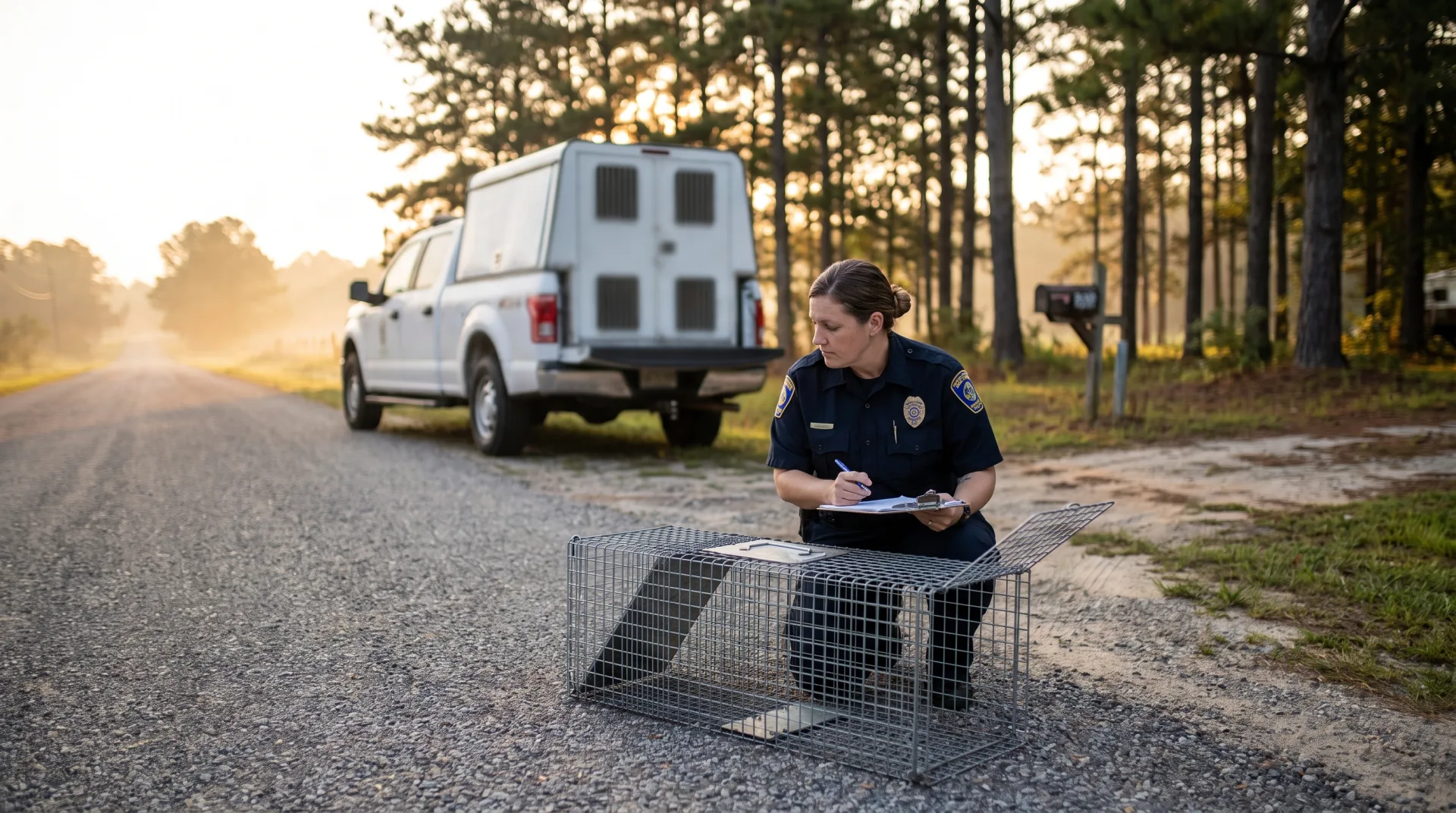
If the biting animal is a stray or feral animal, the statute puts a clock on it. Animal control must make a reasonable attempt to locate an owner, and if none is identified within 72 hours, the local health director may authorize euthanasia so the animal’s head can be sent to the State Laboratory of Public Health for rabies diagnosis. That is why the state tested 744 dogs and 779 cats in 2022. Every one of those submissions represents an investigation, a transport, a laboratory slot, and staff hours no one budgeted for at the start of the year.
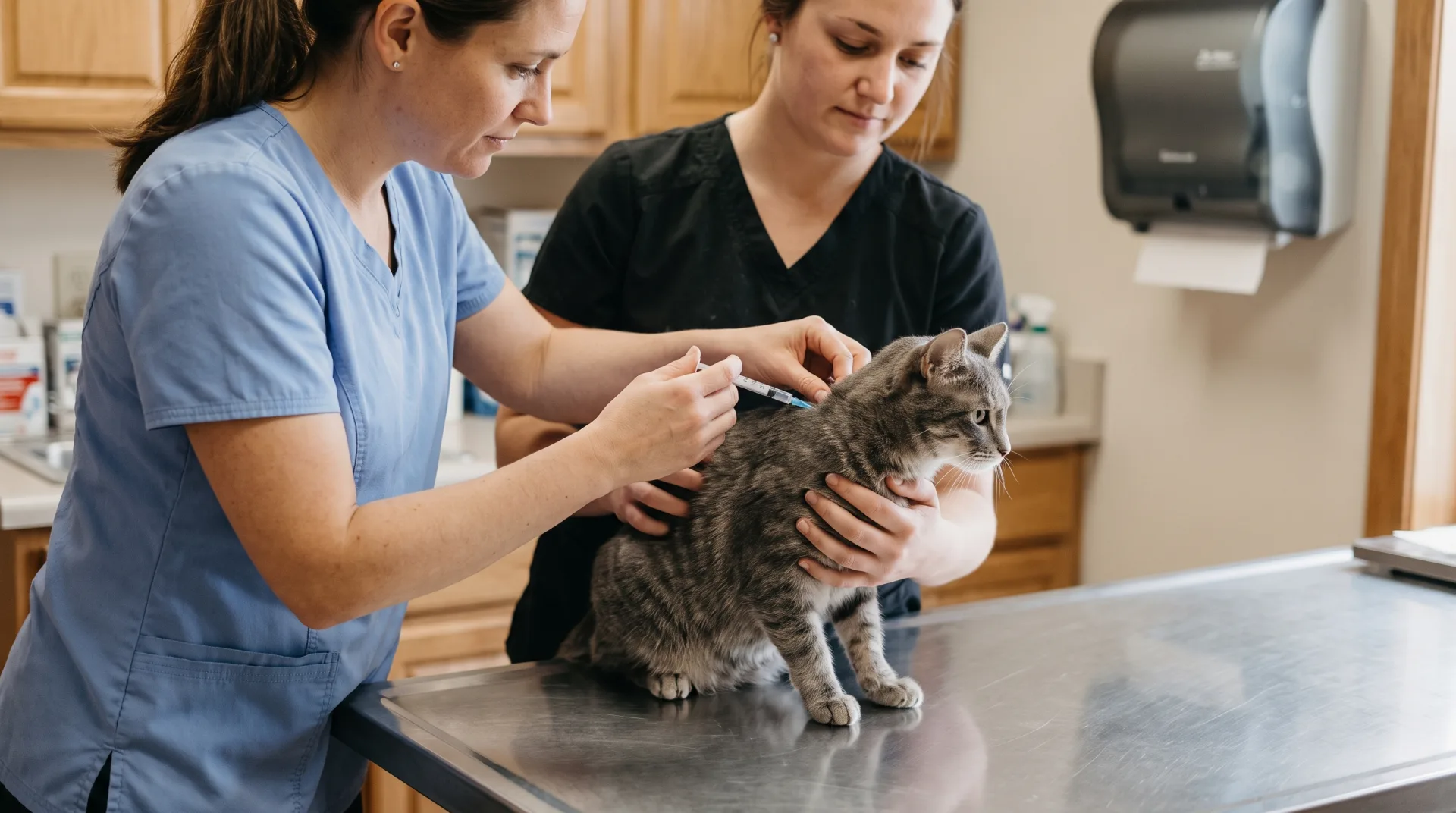
The consequences reach owned pets too. If your pet is not currently vaccinated and is bitten by an animal that is or might be rabid, NC DPH states that animal control is required by law to either quarantine the pet for six months or euthanize it, and that the choice belongs to the local health director, not the owner (N.C.G.S. 130A-197). A lapsed rabies booster is the difference between a ten day observation and half a year of confinement.
Scale that machinery up and you get the Maryland case the CDC published in 2025. A feral cat collected from an unmanaged colony of roughly 20 cats and kittens in Baltimore County tested positive for rabies in 2024. Because the animal had interacted with members of the public, health authorities initially estimated that more than 300 people might have been exposed, which triggered contact tracing across local animal control, the state health department and the CDC. The outcome was contained, and far fewer people ultimately needed post-exposure shots. The response was not cheap. “Unmanaged cat colonies pose public health risks, and extensive resources might be required to prevent negative health outcomes,” the CDC authors wrote.
Note the word “unmanaged.” The same report warned that “trap-neuter-return programs that do not incorporate rabies prevention components might inadvertently increase risks for humans and animals.” That is the correct reading and it cuts toward funding TNR properly rather than away from it. A colony that has been trapped, sterilized, vaccinated and ear-tipped is a vaccinated buffer between wildlife rabies and people. A colony nobody touches is not. If you are not sure which one you are looking at, our guide to telling feral and stray cats apart and our neighborhood feral cat playbook cover the practical side.
What North Carolina Taxpayers Pay to Run the Shelter System
The most direct cost is the one counties write checks for. The N.C. Department of Agriculture and Consumer Services Animal Welfare Section collects a public animal shelter report from licensed facilities each year, and recent editions include a total operating expenses column and a cost per animal figure. Adding up that column in the state’s published 2024 calendar-year file, the 63 facilities that reported operating expenses spent $54,205,825. The median reported cost per animal was $317.
That is not a statewide total. Not every county reported an expense figure, and the report reflects public shelters rather than every rescue and municipal contract in North Carolina. Read $54.2 million as a floor for the reporting subset, not a ceiling for the state. The preliminary 2025 calendar-year report, posted on July 27, 2026 and covering 64 counties so far, shows the same pattern with a higher median cost per animal of $380.
Individual counties give the number a shape. Cumberland County Animal Services reported just over $4.1 million in operating expenses for 2024, at $545 per animal. Gaston County Animal Care and Enforcement reported $3.2 million at about $200 per animal. The animal services division of the Chatham County Sheriff’s Office reported roughly $2.2 million at about $1,172 per animal. The spread reflects real differences in staffing, veterinary capacity, intake volume and building age, but every one of those per-animal figures is larger than the cost of preventing the animal from being born.
The shelter bill also includes work that has nothing to do with pets. In the 2024 report, NC shelters took in 1,887 rabies-vector wild animals, including 1,307 raccoons, 401 bats, 125 foxes and 27 skunks. County animal services is the public’s first call for a bat in the bedroom or a sick raccoon in the yard, and that response capacity is funded out of the same budget that is already absorbing the overflow of unwanted litters. For what happens to the animals inside that system, see our look at what “no-kill” actually means in North Carolina.
The Cheapest Intervention Is the One NC Barely Funds
North Carolina does have a statewide spay/neuter program. The Animal Welfare Section reimburses participating counties and municipalities for the direct cost of sterilizing dogs and cats owned by low-income residents, funded in part by $20 from every Animal Lovers “I Care” specialty license plate.
The state publishes exactly what a surgery costs it. For 2026, the maximum reimbursement is capped at $220.80 for a canine spay, $177.50 for a canine neuter, $148.17 for a feline spay and $120.11 for a feline neuter, with each cap set at 150 percent of the previous year’s average reimbursed cost by species and gender (NCDA&CS). Hold that next to the $317 median cost of moving one animal through an NC shelter for a year, or against the cost of a single bite investigation, and the arithmetic answers itself.
Now the part that should end the debate. In calendar year 2025, the state spay/neuter fund had $250,954.08 available for the entire state. Participating local governments submitted $659,626.15 in eligible reimbursement requests. The fund covered about 38 percent of what counties had already spent and documented, across 5,938 procedures and just 26 to 27 participating entities out of 100 counties plus municipalities. The first quarter of 2026 ran the same ratio: $79,913.85 available against $210,230.92 eligible.
Set those two numbers side by side. Fifty-four million dollars in reported shelter operating expenses. A quarter of a million dollars in the statewide prevention fund. North Carolina is spending roughly two hundred dollars on cleanup for every dollar it puts into the surgery that prevents the cleanup, and the counties doing the most sterilization work are the ones eating the largest unreimbursed share. The full fiscal modeling for the community cat side of this sits in our analysis of why NC needs a state-funded TNR program, and four states that already built the funding mechanism shows what a working program looks like.
None of this requires new science. It requires a line item. If you want the medical background on the procedure itself, start with our spay and neuter guide, and if you need a surgery now, our county-by-county low-cost clinic list is the fastest route.
North Carolina’s statewide spay/neuter fund covered 38 percent of what counties asked for in 2025. Sign the petition for state-funded spay/neuter and TNR, or email your NC representative with the numbers above.
Frequently Asked Questions
A Public Health Problem With a Veterinary Solution
The compassion argument for spay and neuter funding is true and it should be enough. It has not been. So here is the other one, in the language a budget writer uses: North Carolina is carrying an avoidable public health load in bite injuries, rabies quarantines, laboratory submissions and county shelter operations, and the intervention that reduces all of it costs the state less than $221 per animal at the outside.
The state already has the program, the reimbursement structure and the reporting. What it does not have is money in the fund. In 2025 that fund covered 38 percent of what counties had already spent, which means the counties most committed to prevention are subsidizing the state’s share out of local budgets that are simultaneously paying to house the animals prevention would have kept out.
That is a solvable gap. Sign the petition for state-funded spay/neuter and TNR in North Carolina, email your NC representative, and if you are talking to a commissioner or a legislator, bring the shelter report and the reimbursement summary with you. Both are public, both are theirs, and both make the argument better than any of us can.
Sources
- NCDA&CS Animal Welfare Section: Spay/Neuter and Public Animal Shelter Reports (2024 and 2025 calendar-year shelter reports; 2025 and 2026 spay/neuter reimbursement summaries)
- NCDA&CS: Spay and Neuter Reimbursement Requirements and 2026 Procedure Caps
- NCDA&CS: North Carolina Spay/Neuter Program
- N.C. Division of Public Health: Rabies Control and Prevention in North Carolina
- N.C. State Laboratory of Public Health: Rabies-Positive Mammals and Percent Positivity by Species, 2022
- N.C. Division of Public Health: Zoonotic (Animal-Borne) Diseases
- N.C.G.S. 130A-185: Rabies Vaccination Required
- N.C.G.S. 130A-196: Notice and Confinement of Biting Animals
- N.C.G.S. 130A-197: Management of Dogs, Cats and Ferrets Exposed to Rabies
- AVMA Task Force on Canine Aggression and Human-Canine Interactions: A Community Approach to Dog Bite Prevention (JAVMA, 2001)
- AVMA News: CDC Warns of Rabies Risks From Feral Cat Colonies (October 16, 2025, reporting CDC MMWR, August 21, 2025)
Help us end animal overpopulation in NC.
NC ranks 2nd in the nation for shelter euthanasia. Together, we can change that through spay/neuter services and legislative reform.