TL;DR: A community cat is any unowned cat living outdoors. A community cat program sterilizes, vaccinates and eartips those cats, then returns them to the spot they were trapped, instead of impounding them. Across six municipal shelters that ran integrated programs, feline intake fell by a median of 32 percent and feline euthanasia fell by a median of 83 percent (Spehar and Wolf, 2019). North Carolina has no statewide program and no state funding for one. Sign the petition for state-funded spay/neuter and TNR in NC.
What Is a Community Cat, Exactly?
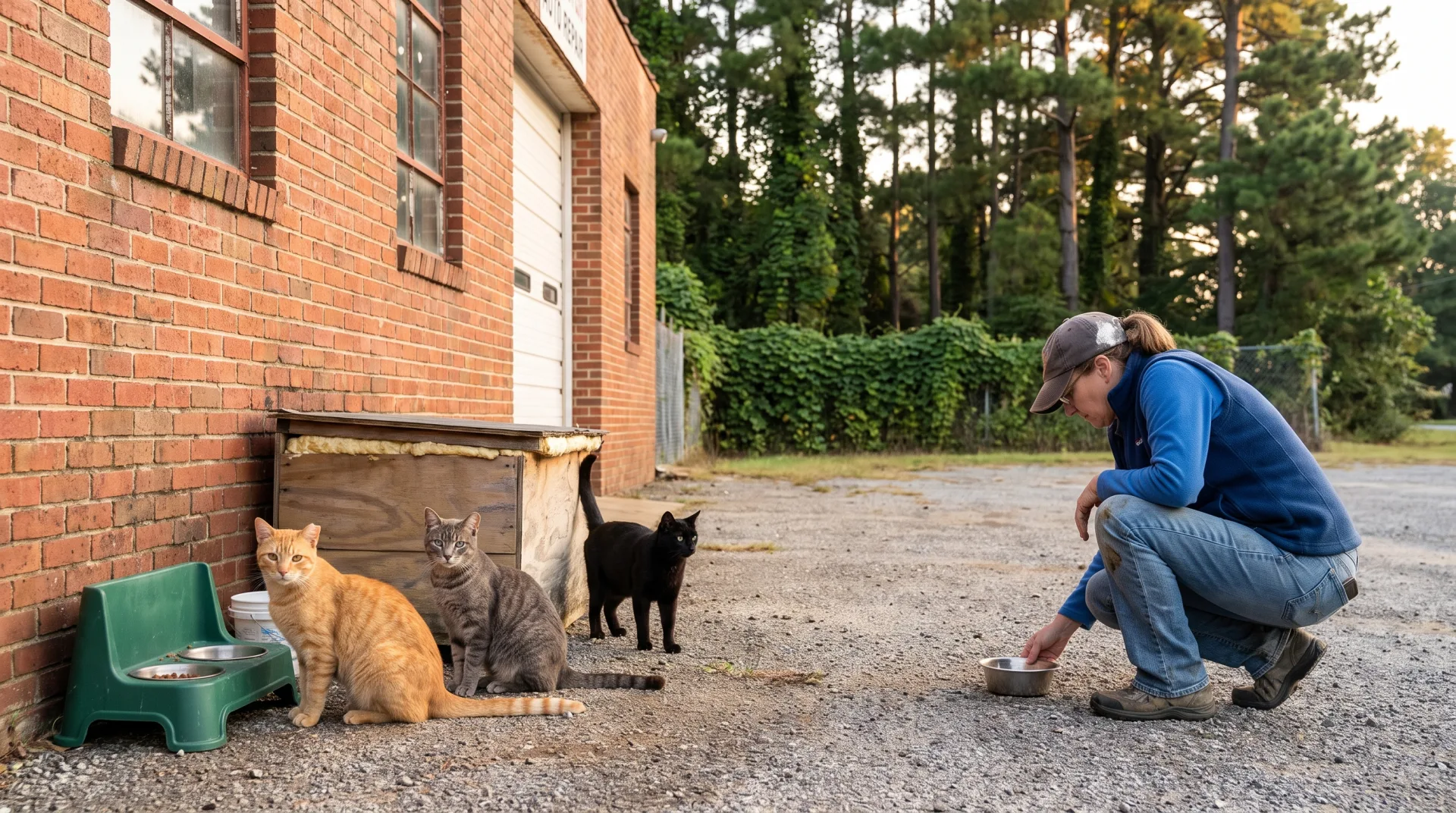
A community cat is any cat of the species Felis catus who is unowned and lives outdoors. That is the whole definition. Alley Cat Allies calls it “an umbrella term,” and the umbrella is deliberately wide, because the cats underneath it are not one kind of animal.
Some are feral, meaning they were never socialized to people or lost that socialization long ago, and they cannot be adopted into indoor homes. Some are strays who lived with a family at some point and got lost or were abandoned. Some are friendly cats who belong loosely to a whole street. The ASPCA’s working description is broader still: “outdoor, unowned, free-roaming cats” who “can be friendly, feral, adults, kittens, healthy, sick, altered and/or unaltered.”
The reason the umbrella term exists is practical, not academic. Animal control officers and shelter staff cannot reliably sort a frightened cat in a trap into “feral” or “stray” in the first ten minutes, and the legal and operational questions they have to answer, who is responsible for this cat and where should it go, are the same either way. If you need to make that call yourself for a specific cat in your yard, our guide to telling a feral cat from a stray walks through the field signals. For everything below, “community cat” covers all of them.
| Category | Socialized to people? | Right outcome |
|---|---|---|
| Feral cat | No, and adult ferals cannot be adopted to indoor homes | Sterilize, vaccinate, eartip, return to the colony |
| Stray cat | Yes, at some point; may re-socialize quickly | Scan for a microchip, find the owner, or adoption |
| Semi-socialized outdoor cat | Partly, often to one caretaker only | Case by case; sterilize first, decide placement second |
| Owned outdoor cat | Yes, has a home and an owner | Not a community cat; owner sterilizes and vaccinates |
What a Community Cat Program Actually Does
A community cat program, usually shortened to CCP, is the organized version of what one neighbor with a trap does on a Saturday. It runs on a schedule, it keeps records, and it handles cats by the hundred instead of by the handful.
The core loop is short. A cat is humanely trapped, either by a caretaker who called the program or by an animal control officer who would otherwise have impounded it. The cat goes to a clinic in the trap. There it is scanned for a microchip in case it is somebody’s lost pet, spayed or neutered, vaccinated against rabies, eartipped, and often microchipped to the program itself. It recovers overnight, still in the trap, in a climate-controlled space. Alley Cat Allies advises returning cats “24 hours after surgery if they’re clear-eyed and alert.” Then the cat goes back to the exact spot it was trapped.
The eartip is the piece most people notice and the piece that makes the whole system legible. It is the painless removal of about three-eighths of an inch from the tip of the left ear while the cat is already under anesthesia, and the ASPCA describes it plainly as “surgical removal of the tip of one ear as a visible sign that the cat has been sterilized.” An officer, a vet tech or a neighbor can read that mark from across a parking lot. It is the reason a sterilized cat never gets trapped, transported and anesthetized a second time for nothing.
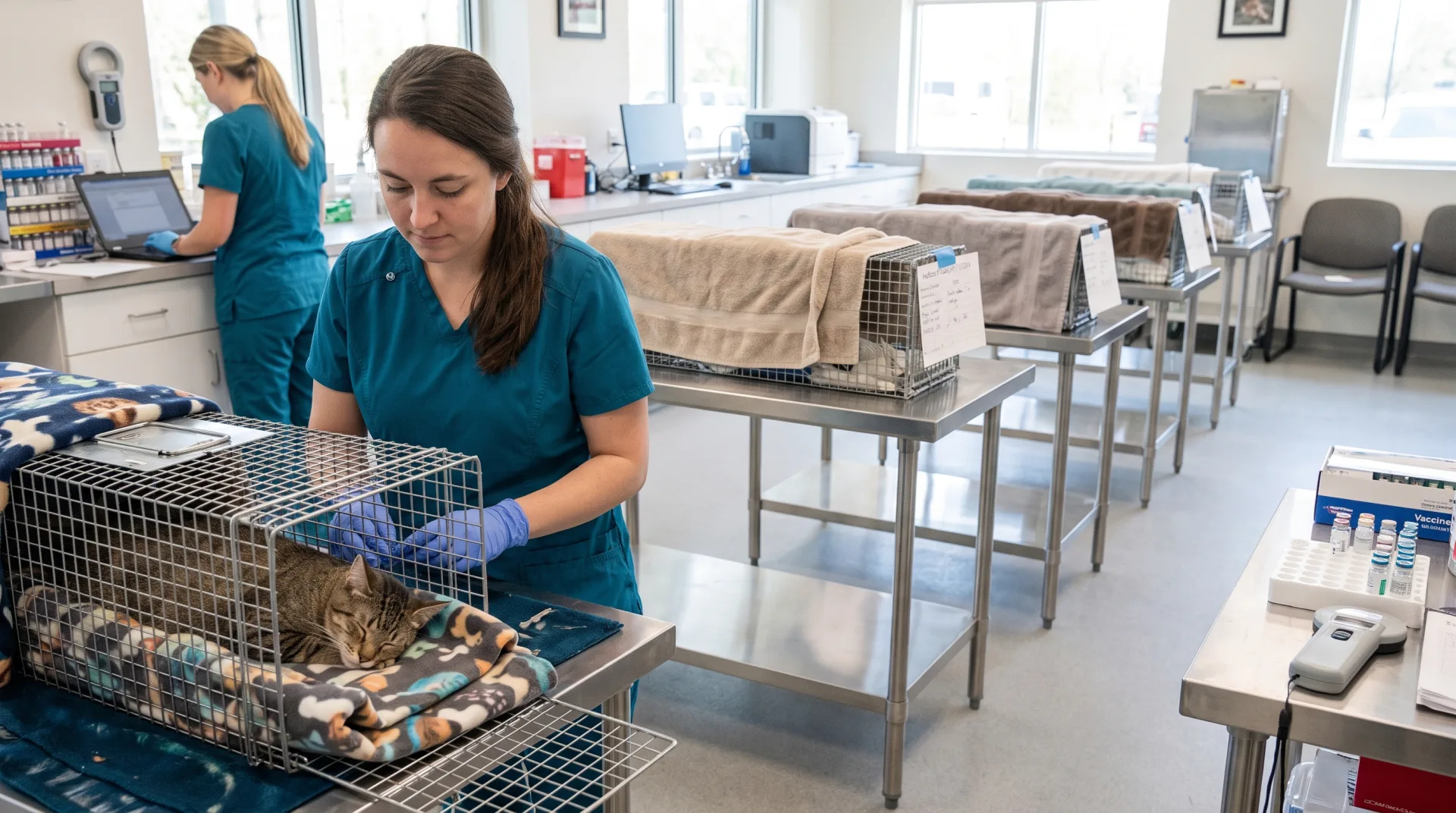
What separates a program from a good deed is the record keeping around that loop. A real CCP knows how many cats it has fixed, at which addresses, and how many are left at each one. That is what lets it work a neighborhood until the reproduction stops rather than scattering surgeries at random across a county.
TNR, TNVR, and Return-to-Field Are Not the Same Thing
Three acronyms get used interchangeably in conversation and they should not be. They describe different entry points into the same loop, and the difference matters when a county is deciding what to fund.
TNR is trap-neuter-return. Alley Cat Allies describes the three steps as trapping every cat in a colony, taking them “to a veterinarian or clinic to be neutered, vaccinated, and eartipped,” and returning them to their outdoor home. The trapping is initiated in the field, usually by a caretaker or a volunteer group.
TNVR adds the V for vaccinate to make the rabies vaccination explicit rather than assumed. It is the same process. North Carolina groups tend to use TNVR, and Wake County’s own ordinance language calls it “the practice of trapping feral cats, sterilizing them, vaccinating them and releasing them to live out the rest of their days in peace and freedom.”
Return-to-field, also called shelter-neuter-return, starts inside the shelter. A healthy unowned cat has already been brought through the door by an officer or a member of the public. Instead of being held for adoption it cannot get or euthanized for lack of a home, the cat is sterilized, vaccinated, eartipped and driven back to where it came from. Humane World for Animals states the logic in one line: if these community cats were doing well before entering the shelter, they will do well once they are returned, finding food and support from people in that neighborhood. The ASPCA is more cautious and holds that return-to-field “should only be employed in narrow circumstances when it gives cats who need to enter animal shelters or rescues the best chance for live outcomes.” For the smaller group of unsocialized cats who have no location to be returned to, the alternative outcome is placement on a new property through a barn cat or working cat program.
| Model | Where the cat enters | Who usually runs it | What it reduces |
|---|---|---|---|
| TNR / TNVR | In the field, at the colony | Caretakers, volunteer coalitions, clinics | Births, so the colony shrinks over years |
| Return-to-field | At the shelter’s front counter or in a truck | The municipal shelter itself | Impoundment days and euthanasia, immediately |
| Integrated CCP | Both, deliberately paired | Shelter plus a contracted or allied group | Both, which is why the measured results are largest |
Why North Carolina Cannot Adopt Its Way Out of This
Here is the number that explains why community cat programs exist at all, and it comes from North Carolina’s own reporting rather than from any advocacy group.
In the NC Department of Agriculture and Consumer Services 2024 calendar-year Public Animal Shelter Report, the edition posted as of November 24, 2025, the 72 reporting facilities across 67 counties recorded 74,979 cats taken in. Of those, 3,094 were returned to an owner. That is 4.1 percent. For dogs, the same shelters returned 14,053 of 78,713, or 17.9 percent.
The gap is not a rounding error, it is the whole story. A lost dog has a person looking for it, usually within a day, and often with a photo and a microchip number. A community cat, by definition, does not. Nobody files a report, nobody walks the block calling a name, nobody arrives at the front counter with a leash. When a cat enters a North Carolina shelter, the reclaim door is effectively closed, which means the only exits left are adoption, transfer to a rescue partner, or euthanasia. All three of those are slower and more expensive than a reclaim, and the last one is final. In 2024 the cat euthanasia share ran higher than the dog share, 29.8 percent against 22.6 percent, despite cats being the smaller, cheaper and easier animal to house.
The preliminary 2025 report, posted July 27, 2026 with 64 counties in so far, shows the same shape: 69,332 cats in, 2,283 returned to an owner, a 3.3 percent reclaim rate. A community cat program does not try to force those cats through a door that does not open for them. It keeps them from going through the door at all.
Does It Work? Six Cities Ran the Experiment
The strongest evidence for community cat programs is not a position paper, it is a set of shelter intake ledgers before and after. Municipal shelters count every animal that comes through the door because they are required to, which makes their own records an unusually hard thing to argue with. If a program does not work, the intake column says so within a couple of years.
In 2019, Daniel Spehar and Peter Wolf published a study in Frontiers in Veterinary Science covering six municipal shelters that ran integrated return-to-field and targeted TNVR programs for three years each, with data collected between April 2012 and June 2017. A total of 72,970 cats were enrolled. Of those, 71,311, or 98 percent, were “sterilized, vaccinated, and returned to their location of capture or adopted.” The headline result: “A median reduction of 32% in feline intake, as well as a median decline of 83% in feline euthanasia occurred across the six CCPs.”
| Shelter | Change in cat intake | Change in cat euthanasia | Live release rate |
|---|---|---|---|
| Albuquerque, NM | down 38% | down 84% | 61% to 90% |
| San Antonio, TX | down 1% | down 82% | 31% to 83% |
| Baltimore, MD | down 14% | down 59% | 63% to 79% |
| Philadelphia, PA | down 33% | down 67% | 63% to 74% |
| Tucson / Pima County, AZ | down 31% | down 91% | 51% to 83% |
| Columbus, GA | down 45% | down 85% | 54% to 85% |
Look at San Antonio. Intake barely moved, and euthanasia still fell 82 percent while the live release rate went from 31 percent to 83 percent. That is what return-to-field does on its own: it changes the outcome for cats who arrive, even in a year when the same number arrive.
The field side of the work shows up on a longer clock. Spehar and Wolf’s 2018 case study of a Chicago neighborhood tracked 20 colonies over roughly a decade, with 195 cats trapped and sterilized. Colony populations “declined by a mean of 54% from entry and 82% from peak levels,” eight of the 20 colonies were gone entirely by the end, and the last litter of kittens born outdoors in the program area arrived in 2009. Ten years is a long time to wait for a result, which is exactly why the shelter-side program runs alongside it. Our analysis of what a state-funded TNR program would save North Carolina works through the cost arithmetic behind those curves.
Who Runs the Program, and What a Caretaker Signs Up For
A community cat program needs three parties and it stalls when any one of them is missing: a clinic with surgery capacity, an organizer who keeps the records and schedules the trapping, and caretakers who know where the cats actually are.
The caretaker is the least formal role and the most load-bearing. Nobody else can tell you that the tuxedo cat behind the strip mall had kittens in April, or that there are five cats at that address and not two. Counties that run structured programs write the caretaker’s duties down. Currituck County’s animal services division publishes TNR program guidelines that ask participants to register, and states that “registering helps to maintain healthy and lawful community cat colonies within Currituck County.”
| Obligation | Why it is in the rules |
|---|---|
| Register the colony with animal services | Lets the shelter contact you if one of your cats is trapped by someone else |
| Get every cat sterilized, vaccinated and eartipped | A partially fixed colony rebuilds itself within a season |
| Keep the veterinary records | Proof of rabies vaccination is what protects the cats in a complaint |
| Scan for a microchip before returning any cat | Someone’s lost pet occasionally walks into the trap |
| Put food out briefly, then take the bowls up | Standing food draws raccoons and neighbor complaints, not just cats |
| Get the property owner’s permission before trapping | Access disputes are the most common reason a colony goes unfixed |
| Report any bite or scratch | Rabies law is triggered by the incident, not by the cat’s status |
If that list reads like a job description, that is because it is one, and it is unpaid. Our step-by-step guide to starting a TNR program in your NC community covers the trapping mechanics, and how to help feral cats in your neighborhood covers feeding, winter shelter and the neighbor conversation.
Community Cat Programs in North Carolina Right Now
North Carolina has community cat work. What it does not have is a community cat program, singular, at the state level.
The state’s own spay/neuter reimbursement program, run by the N.C. Department of Agriculture and Consumer Services Animal Welfare Section, pays counties back for sterilizing dogs and cats owned by low-income residents. Community cats have no owner, which is precisely the point of the term, so they sit outside the one funding stream the state operates. That gap is the subject of our TNR funding analysis and it has not moved.
What exists instead is a county-by-county patchwork. Wake County’s animal control ordinance defines a community cat as “a cat that is abandoned, stray, lost, or feral and cared for by a community cat caregiver,” and the county is explicit that it does not run TNVR itself, pointing residents instead to TNVR Wake, a coalition of local rescue groups and clinics operating since 2009. Currituck County publishes formal TNR guidelines through its animal services division. Many other counties have neither, which means whether a cat behind a Bojangles gets sterilized or impounded depends mostly on which side of a county line the parking lot sits on.
| County | What a resident actually gets |
|---|---|
| Wake | The ordinance defines a community cat and a caregiver, but the county does not run TNVR itself. It refers residents to TNVR Wake, a coalition of rescue groups and clinics operating since 2009. |
| Currituck | County animal services publishes written TNR program guidelines, asks caregivers to register their colonies, and may loan traps for rabies boosters. |
| Buncombe | Free spay/neuter surgery and rabies vaccination for community cats trapped in the county through the ASPCA Spay/Neuter Alliance clinic, with an eartip required as part of the package. |
| Most other counties | No written community cat policy, no colony registry, and no dedicated funding. Whatever happens depends on a local rescue group’s capacity that month. |
The practical consequence for a resident is simple. Before you trap anything, call your county animal services office and ask two questions: does the county have a TNR or community cat policy in writing, and is there a colony registry. If the answers are no and no, you are working in the patchwork, and the county-by-county low-cost spay/neuter list is where to start finding surgery slots.
Frequently Asked Questions
What North Carolina Still Needs
The evidence question is settled well enough for a budget conversation. Six shelters measured it, the reductions were large, and the mechanism is not mysterious: cats that are not born do not need to be housed.
What is missing in North Carolina is the plumbing. There is no line in the state spay/neuter fund that a sterilized community cat can be billed to, no statewide colony registry, and no model ordinance that counties can adopt without writing one from scratch. Those are three specific, unglamorous fixes, and every one of them is a decision somebody makes in a room.
| The ask | Who decides it |
|---|---|
| A written TNVR policy and a colony registry | County commissioners and the animal services director |
| Return-to-field for healthy unowned cats at the county shelter | The shelter director, within existing ordinance in most counties |
| A state reimbursement category for unowned cats | The NC General Assembly, in the spay/neuter fund statute |
Six shelters cut cat euthanasia by a median of 83 percent with programs NC does not fund. Sign the petition for state-funded spay/neuter and TNR, or email your NC representative.
The cats behind the shopping center are not waiting on a study. They are waiting on somebody with a trap, a clinic appointment and a county that will not treat the whole thing as a nuisance call. Email your NC representative and ask for a spay/neuter fund that unowned cats can actually be billed to, and if there is a colony on your street, read our TNR starter guide and get the first four cats fixed.
Sources
- Spehar and Wolf, Integrated Return-To-Field and Targeted Trap-Neuter-Vaccinate-Return Programs Result in Reductions of Feline Intake and Euthanasia at Six Municipal Animal Shelters (Frontiers in Veterinary Science, 2019)
- Spehar and Wolf, A Case Study in Citizen Science: The Effectiveness of a Trap-Neuter-Return Program in a Chicago Neighborhood (Animals, 2018)
- NCDA&CS Animal Welfare Section: Public Animal Shelter Reports (2024 CY report as of November 24, 2025; 2025 CY preliminary report as of July 27, 2026)
- NCDA&CS: North Carolina Spay/Neuter Program
- ASPCA Position Statement on Community Cats
- Alley Cat Allies: How You Can Help Community Cats, A Step-by-Step Guide to Trap-Neuter-Return
- Alley Cat Allies: Feral and Stray Cats, An Important Difference
- Humane World for Animals: Return-to-Field Handbook
- Wake County Government: Community Cats and TNVR
- Currituck County Animal Services: Trap-Neuter-Return Program Guidelines
- ASPCA Spay/Neuter Alliance: Buncombe County Community Cat Program
Dealing with feral cats in your area?
NC Pet Project can help you get a TNR program started. We'll connect you with resources, training, and our volunteer network.