TL;DR: In North Carolina, start with your county animal control office. If your county has no animal control, call the sheriff’s office. The NC Attorney General’s Animal Welfare Hotline at 1-855-290-6915 refers complaints but does not investigate or prosecute them, and it cannot take anonymous reports. Before you call, write down dates, times and the exact address, and photograph what you can see from public property. Two routes almost nobody uses: North Carolina counties can appoint volunteer animal cruelty investigators who can get a magistrate’s order to seize an animal, and under Chapter 19A any person can file a civil action to stop cruelty even without owning the animal.
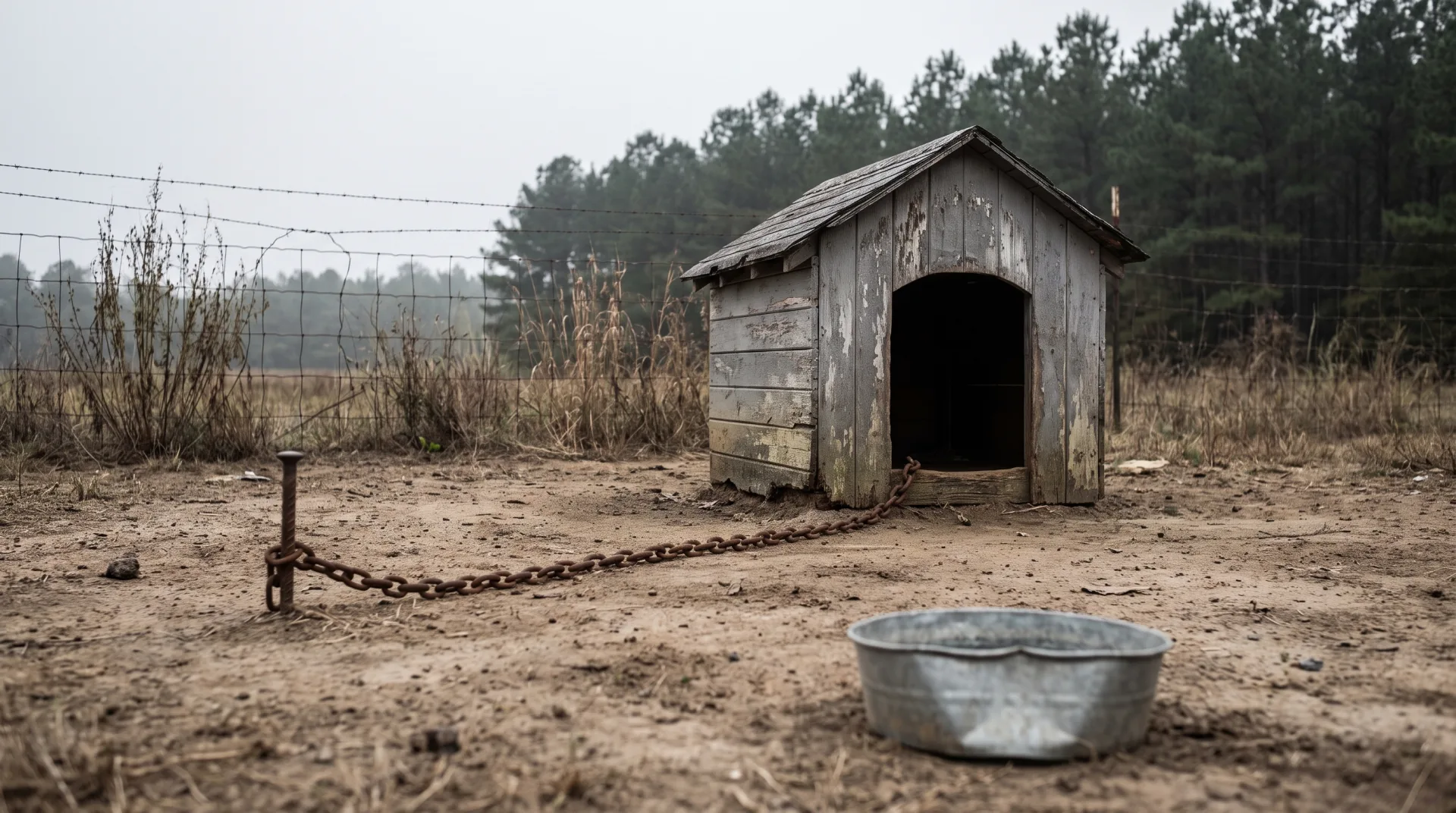
You saw something. A dog on a chain with no water in August. A yard with more animals than anybody could feed. Ribs you could count from the road. And then came the part nobody prepares you for: you did not know who to call, so you waited, and then you felt sick about waiting.
That gap is the problem this guide solves. North Carolina does not have one number for animal cruelty. It has a patchwork of county agencies, one state division with narrow authority, a hotline that only forwards mail, and two legal routes written into the General Statutes that most residents have never heard of. Knowing which door to knock on is the difference between a report that gets worked and a report that goes nowhere.
Start Here: Who to Call in North Carolina
The state agency people assume handles this mostly does not. The NC Department of Agriculture and Consumer Services runs an Animal Welfare Section, and its own guidance tells residents plainly where to go: “Contact your local Animal Control Department. If your county has no Animal Control contact the local law enforcement in your county.”
That is because the Animal Welfare Section’s authority under the Animal Welfare Act runs to facilities, not to private homes. It registers animal shelters, licenses pet shops, boarding kennels, public auctions and dealers, and inspects them. A dog chained in a neighbor’s backyard is not a facility, so it is not the Animal Welfare Section’s case.
The Attorney General’s office is the other common guess, and it is also not an investigating agency. The NC Department of Justice runs an Animal Welfare Hotline at 1-855-290-6915 and an online complaint form, and the page says so directly: “The NC Department of Justice does not investigate or prosecute animal cruelty cases.” It reviews what comes in and forwards it. It also cannot process anonymous complaints, because without a valid phone number or contact information the office cannot forward the complaint to the correct agency.
| Who to contact | Use it for | What it cannot do |
|---|---|---|
| County or city animal control Your first call in almost every case |
Neglect, no food or water, no shelter, injured or dying animals, hoarding situations, dangerous dogs, ordinance violations | Coverage and staffing vary by county, and many have no after-hours officer on duty |
| Sheriff’s office or city police Where there is no animal control, or when a crime is in progress |
Active beating, shooting or torture, animal fighting, anything happening right now, after-hours calls | Deputies may not be trained in animal law and may route you back to animal control by daylight |
| NC DACS Animal Welfare Section ncagr.gov, Veterinary Division |
Conditions inside a registered animal shelter, licensed pet shop, boarding kennel, public auction or dealer. Requests for a shelter inspection should be submitted in writing | No authority over privately owned pets or unlicensed private property |
| NC DOJ Animal Welfare Hotline 1-855-290-6915 |
A case local agencies will not act on, or when you cannot identify the right local agency | Does not investigate or prosecute, cannot take anonymous reports, and sends you back to the local agency for any follow-up |
| County animal cruelty investigator Appointed under G.S. 19A-45, where one exists |
Seizing an animal in immediate danger via a magistrate’s order | Most counties have not appointed one, and the position is unpaid |
One practical note on all of this. County animal control offices publish direct numbers, and many counties place animal control inside the sheriff’s office rather than in a standalone department, so searching your county name plus “animal control” will usually surface both. Call the local number first and the hotline second, in that order, because the hotline’s entire function is to route your complaint to the local agency you could have called yourself.
What Counts as Cruelty or Neglect Under NC Law
You do not need to make a legal judgment before you report. Describing what you saw is enough, and the responding officer decides what statute fits. But it helps to know what the law actually reaches, because it explains why some calls produce a seizure and others produce a warning.
North Carolina’s core criminal cruelty statute is G.S. 14-360, and it splits into two very different tiers. Intentional conduct is a Class 1 misdemeanor: the statute reaches any person who “shall intentionally overdrive, overload, wound, injure, torment, kill, or deprive of necessary sustenance” an animal. Malicious conduct is a Class H felony: “maliciously torture, mutilate, maim, cruelly beat, disfigure, poison, or kill” an animal, or maliciously kill an animal by intentional deprivation of necessary sustenance.
The definitions in subsection (c) matter more than the verbs. “Intentionally” means an act done “knowingly and without justifiable excuse.” “Maliciously” means done “intentionally and with malice or bad motive.” And critically for neglect cases, “torture,” “torment” and “cruelly” all include “any act, omission, or neglect causing or permitting unjustifiable pain, suffering, or death.” Omission counts. An owner who does nothing while an animal starves is inside the statute.
| Statute | Conduct | Offense class |
|---|---|---|
| G.S. 14-360(a) | Intentionally overdriving, overloading, wounding, injuring, tormenting, killing, or depriving an animal of necessary sustenance | Class 1 misdemeanor |
| G.S. 14-360(a1), (b) | Maliciously torturing, mutilating, maiming, cruelly beating, disfiguring, poisoning or killing an animal, or maliciously killing by deprivation of sustenance | Class H felony |
| G.S. 14-361 | Instigating or promoting any act of cruelty to an animal | Class 1 misdemeanor |
| G.S. 14-361.1 | Willfully abandoning an animal without justifiable excuse, as its owner, possessor or custodian | Class 2 misdemeanor |
| G.S. 14-362 | Cockfighting, including participating as a spectator | Class I felony |
| G.S. 14-362.2 | Dog fighting or baiting, including providing a dog, owning or training a dog for it, or attending as a spectator | Class H felony |
| G.S. 14-362.3 | Maliciously restraining a dog with a chain or wire “grossly in excess of the size necessary to restrain the dog safely” | Class 1 misdemeanor |
| G.S. 14-363 | Carrying an animal in or upon a vehicle in a cruel or inhuman manner | Class 1 misdemeanor |
| G.S. 19A-48 | Interfering with a county animal cruelty investigator performing official duties | Class 1 misdemeanor |
Two limits are worth knowing before you call, so you are not blindsided. First, “animal” in these statutes means “every living vertebrate in the classes Amphibia, Reptilia, Aves, and Mammalia except human beings,” so fish are outside it. Second, the exemption list is long. Lawful wildlife taking regulated by the Wildlife Resources Commission, biomedical research, livestock and poultry production, food preparation, veterinary care, lawful destruction of an animal to protect the public or public health, and lawful activities for sport are all carved out. Farm animal complaints in particular often land inside the production exemption, which is why a call about livestock frequently ends differently than a call about a dog.
What to Document Before You Call
The single biggest reason a cruelty report dies is that it cannot be verified. An officer arrives three days later, the bowl has water in it, the dog is inside, and there is nothing to write in the report. Documentation is what converts what you saw into something an agency can act on and a prosecutor can use.
Do all of it from public property or your own. Do not enter a yard, open a gate, reach through a fence, or take the animal. Trespassing gets your evidence excluded and turns you into the subject of the call, and taking an animal you do not own is its own offense. Photograph from the road, from the sidewalk, from your own window.
| What to record | Why it matters |
|---|---|
| Exact address, or nearest address plus landmarks | “The brown house on Route 24” is not dispatchable. An address and a cross street is. |
| Date and time of every observation | Neglect is proven by repetition. One empty bowl is a bad afternoon; an empty bowl logged at 4pm on six different days is a pattern. |
| Photos and video with visible context | Include something that fixes the location and scale in frame: a house number, a fence line, a tree. A tight crop of a thin dog proves nothing about where it is. |
| Number and description of animals | Determines whether animal control sends one officer or plans a multi-animal seizure with transport and housing. |
| Specific observable conditions | Write “no water in the bowl, no shade, 94 degrees” rather than “being mistreated.” Conditions are facts; conclusions are opinion. |
| Other witnesses | A neighbor who will confirm the pattern is often what moves a case from a warning to a charge. |
| Weather on the day | Heat and freezing temperatures are central to suffering claims, and the record is easy to pull later if you noted the date. |
Keep it all in one place, and keep it even after you report. A dated note in your phone works, a shared folder works better, and a plain text file with one line per observation works best of all, because it is trivially readable by someone who is not you. If the case goes to court, you may be asked for the original files with their metadata intact, not screenshots of screenshots, so do not delete the originals once you have emailed copies to an agency.
One more thing that helps more than people expect: write down what you did not see. “No animal in the yard at 7am, chain still staked” is useful, because it establishes that you looked repeatedly rather than once. And if the first agency declines, an organized log is what makes a second call down a different route credible rather than repetitive.
How to Make the Report So It Actually Gets Worked
Call rather than email if the animal is in danger now. Email is fine for a pattern you have been documenting for weeks, and it has the advantage of creating a timestamped record on the agency’s side. For anything involving heat, cold, active violence or an animal that appears to be dying, use the phone, and if animal control is closed, call the sheriff’s non-emergency line.
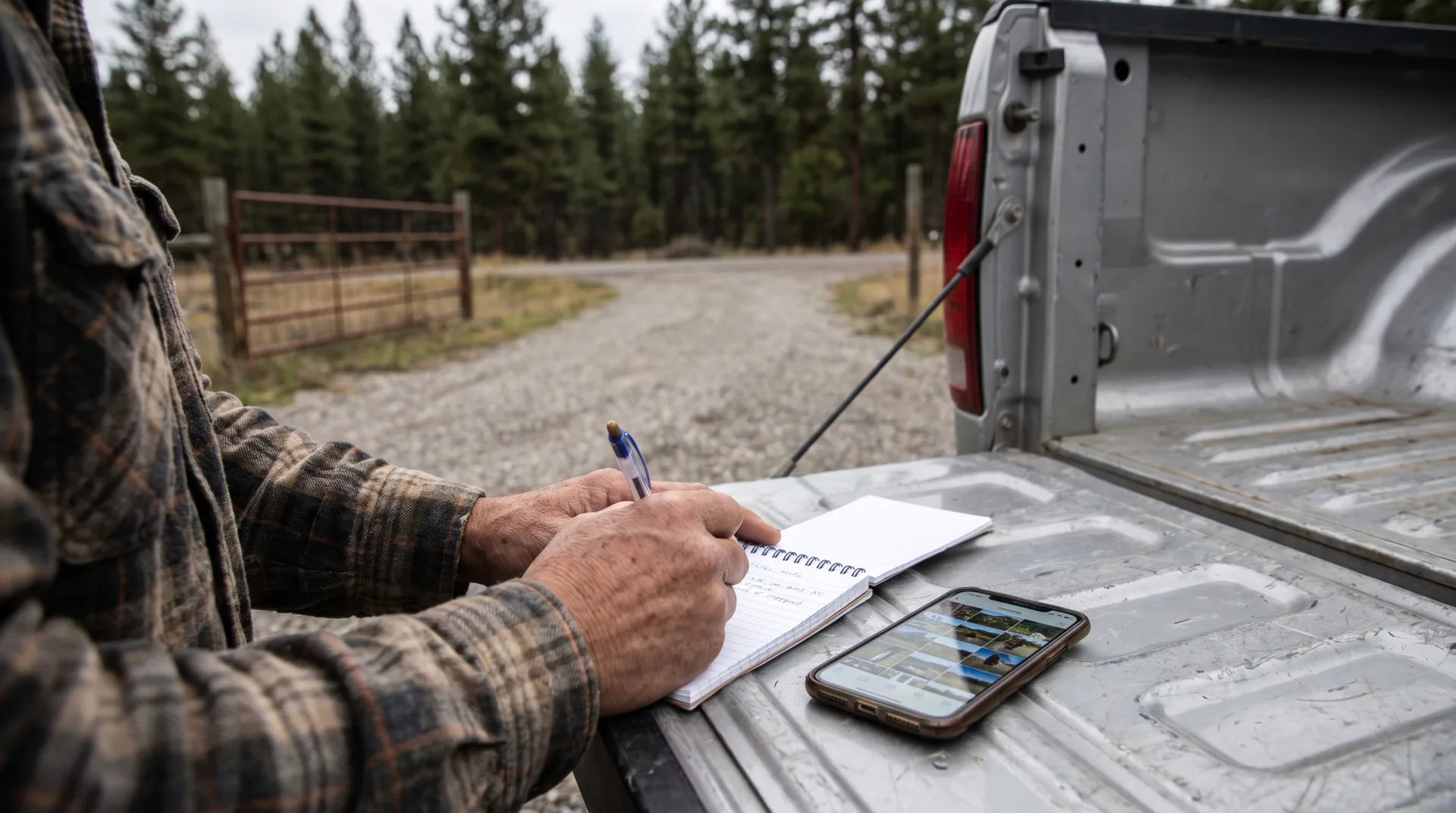
Lead with the three things dispatch needs to create a call: the address, what you can see, and whether the animal is in immediate danger. Everything else is detail you can offer after those are written down. Then ask for two specific items before you hang up: a case or incident number, and the name of the officer or division assigned. Without a case number you have no way to follow up, and “I called last week” is not a record.
Give your name and a working callback number if you can. Anonymous tips are accepted by many county agencies, but they are weaker in every direction. An officer who cannot call you back cannot confirm the address, cannot ask what time you saw the animal outside, and cannot come back to you as a witness. The Attorney General’s hotline will not process an anonymous complaint at all. If you are worried about retaliation, say that explicitly and ask how your identity is handled, rather than withholding it by default.
Then follow up on a schedule instead of waiting to be called. Check back in three to five business days with your case number, ask what the officer observed, and ask what the agency’s next step is. If nothing has happened and the conditions persist, that is the signal to escalate, and North Carolina gives you two escalation routes that have nothing to do with calling animal control again.
The Animal Cruelty Investigator Almost Nobody Uses
Chapter 19A, Article 4 of the General Statutes creates a position most North Carolina residents have never heard of. A board of county commissioners “is authorized to appoint one or more animal cruelty investigators to serve without any compensation or other employee benefits” in that county, and in making the appointment the board may consider people nominated by any North Carolina society for the prevention of cruelty to animals.
These are not hobbyists with opinions. An appointed investigator takes and subscribes the oath of office required of public officials, files it with the clerk of superior court, and wears a county-approved badge in plain view while on duty. The term is one year, subject to removal for cause. And the authority is real: under G.S. 19A-46, an investigator may file a sworn complaint with a magistrate requesting an order to provide suitable care for an animal and take immediate custody of it, and the magistrate issues the order on a finding of probable cause that the animal is being cruelly treated and that immediate custody is necessary.
| What the statute gives them | The limits written into it |
|---|---|
| May petition a magistrate for an order to take immediate custody of a cruelly treated animal (19A-46(a)) | The magistrate’s order is valid for only 24 hours after issuance, and the executed order must be returned to the clerk of court with a written inventory of the animals seized |
| May request a law enforcement officer or animal control officer to accompany the seizure (19A-46(b)) | Forcible entry is allowed only when accompanied by a law enforcement officer, only in daylight, and only when the investigator reasonably believes the premises are unoccupied by any person |
| Care costs for a seized animal are a charge against the owner and a lien on the animal (19A-47) | Until that is collected, the expenses fall on the investigator or on a humane society willing to bear them under an agreement with the county |
| Interfering with an investigator on duty is a Class 1 misdemeanor (19A-48) | Any judicial order authorizing forcible entry must come from a district court judge, not a magistrate |
| May be reimbursed for necessary and actual expenses, paid by the county (19A-45(d)) | Only “upon approval by the board of county commissioners.” The role itself carries no compensation and no benefits |
| Must attend at least six hours of annual instruction from the NC Humane Federation or another agency (19A-49) | At the investigator’s own expense. Failure to attend an approved course is cause for removal from office |
Here is why this matters for you. Call your county clerk’s office or the clerk to the board of commissioners and ask whether your county has an appointed animal cruelty investigator. If it does, you have a second door with subpoena-adjacent teeth. If it does not, you have just found a concrete, no-cost ask to bring to your commissioners at a public meeting, which is a far more winnable local campaign than most people expect. The statute already exists. The county only has to use it.
The Civil Route: Anyone Can File
The second underused route is Article 1 of the same chapter, and its scope surprises people. G.S. 19A-2 states the purpose is “to provide a civil remedy for the protection and humane treatment of animals in addition to any criminal remedies that are available.” Then comes the sentence that opens the door: “A real party in interest as plaintiff shall be held to include any person even though the person does not have a possessory or ownership right in an animal.”
You do not have to own the animal. You do not have to be a government agency. Under this article, “cruelty” and “cruel treatment” include “every act, omission, or neglect whereby unjustifiable physical pain, suffering, or death is caused or permitted,” and a verified complaint filed in district court in the county where the cruelty allegedly occurred can get a preliminary injunction under Rule 65. That injunction can give the plaintiff the right to provide suitable care for the animal and, where the complaint shows the animal must be removed from its owner, possession of the animal as custodian.
| Criminal route (Chapter 14, Article 47) | Civil route (Chapter 19A, Article 1) | |
|---|---|---|
| Who starts it | Law enforcement or animal control investigates; the district attorney charges | Any person, including someone with no ownership interest in the animal |
| Where it is filed | Criminal court, after charges | District court, in the county where the cruelty is alleged to have occurred, by verified complaint |
| What it can produce | Misdemeanor or felony conviction, plus discretionary confiscation of the animals on conviction under G.S. 14-363.2 | Preliminary and permanent injunctions, custody of the animal pending trial, and costs of care awarded to a prevailing plaintiff |
| Strongest remedy | Criminal penalties against the person | Termination of the defendant’s ownership where the court finds a substantial risk of further cruelty, plus an order limiting or barring future animal acquisition |
| Up-front court costs | None to you; the state prosecutes | None before final judgment. A person who commences a proceeding under Article 1 or Article 4 is not required to pay court costs or fees prior to a final judicial determination |
| The practical catch | You have no control over whether charges are brought | You need a lawyer, a verified complaint, and the willingness to fund care while the case runs |
This route is not for a single empty water bowl. It is the tool for a documented, ongoing situation that local enforcement has declined to act on, and it is worth a conversation with a North Carolina attorney who handles animal cases before you dismiss it. The permanent injunction provision in G.S. 19A-4 is unusually strong: on a preponderance of the evidence that a substantial risk of further cruelty exists, a district court judge may terminate the defendant’s ownership entirely and, for good cause shown, enjoin them from acquiring new animals for a specified period or cap how many they may own.
What Happens After You Report
Expect a slower and quieter process than a television version. An officer visits, documents conditions, and in many cases issues a notice to correct with a deadline rather than seizing anything. That is not indifference. A warning that produces a functioning water supply and a shade structure within 48 hours is a better outcome for the animal than a seizure that lands it in an overcrowded county shelter, which is why officers use it first when conditions are correctable.
Seizure changes the clock in ways worth understanding. When a shelter takes custody of an animal after a cruelty arrest or the start of a civil action, G.S. 19A-70 lets the court order the owner to deposit funds covering at least 30 days of reasonable care costs, at a hearing held no fewer than 10 and no more than 15 business days after the petition is filed. If the owner fails to deposit within five business days of that hearing, or within five business days after a 30-day period expires, the animal is forfeited by operation of law and the shelter may place it for adoption. That provision is the reason cost-of-care petitions matter so much in hoarding cases, where care costs can dwarf any fine.
| Stage | What the statute sets |
|---|---|
| Officer visit | No statutory deadline. Timing is a county staffing question, which is why an immediate-danger call should go to law enforcement rather than into a queue. |
| Notice to correct | Also not statutory. The deadline is set by the officer or local ordinance, and it is the number to write down and hold the agency to. |
| Cost-of-care hearing after seizure | No fewer than 10 and no more than 15 business days after the petition is filed (G.S. 19A-70). |
| Owner’s deposit deadline | Five business days after the hearing, covering at least 30 days of reasonable care costs, then renewed every 30 days. |
| Forfeiture | If the deposit is missed, the animal “is forfeited by operation of law” and the shelter may arrange adoption. |
| Shelter holding period | Minimum 72 hours, or longer where the county commissioners have set a longer period (G.S. 19A-32.1). |
There is also a holding-period wrinkle that cuts both ways. State law requires shelters to hold animals for a minimum of 72 hours, or longer if the county commissioners set a longer period, before euthanasia or other disposition. But the statute exempts an animal “being held as evidence in a pending criminal case” from being made available for adoption during that window, which is exactly what you want in a case you have reported, because it keeps the animal in place while the investigation runs.
You will probably not be told how it ends. Most agencies cannot discuss an open investigation, and the Attorney General’s office directs anyone seeking follow-up information on a complaint to contact their local animal control office or local law enforcement agency directly. Ask for the case number, ask what the officer observed on the visit, and if conditions have not changed after the correction deadline, call again and reference the number. A second documented call on the same address is materially different from a first one.
Where North Carolina’s Law Falls Short
If you report and nothing much happens, it is often not a failure of the officer. It is the statute they are working with. North Carolina has a felony for malicious cruelty and essentially no baseline standard of care for a privately owned dog or cat.
Look at what the state actually specifies. The Animal Welfare Act sets detailed standards for adequate feed and adequate water, defined down to intervals “not to exceed 24 hours,” but it defines “animal” for its own purposes as only a domestic dog or domestic cat, and it applies to registered shelters and licensed pet shops, kennels, auctions and dealers. It does not reach a private backyard. The only tethering provision in the criminal code, G.S. 14-362.3, reaches a chain or wire “grossly in excess of the size necessary to restrain the dog safely,” and only when the restraint was imposed “maliciously.” A dog on an appropriately sized chain in 95-degree heat with no shade is outside it.
The penalty ceilings tell the same story. Under the general misdemeanor punishment statute, the maximum fine is $200 for a Class 3 misdemeanor and $1,000 for a Class 2, and the judgment for a Class 3 offender with no more than three prior convictions “shall consist only of a fine.”
Two bills would change part of this picture, and both are stalled. House Bill 657, whose short title is Duke’s Rescue Act, is “AN ACT TO PROVIDE MINIMAL STANDARDS OF CARE FOR COMPANION ANIMALS.” It would add a new G.S. 14-360.5 requiring any owner of a companion animal to provide adequate care, exercise, feed, shelter, space, water and appropriate veterinary treatment, and it specifies that adequate shelter “does not include the outdoor tethering of an animal during any period of extreme weather at the site where the animal is tethered.” A committee substitute was reported favorably on 6/16/2026 and re-referred to the House Committee on Rules, Calendar, and Operations, where it has had no action since. Senate Bill 573, which would reform the cruelty and neglect laws, has sat in the Senate Rules committee since 3/26/2025. Neither has passed a chamber. Our post on North Carolina’s breeder regulation gap covers the parallel hole on the commercial side, and what puppy mills look like in this state shows what the gap produces in practice.
Special Cases You Will Actually Run Into
A handful of situations route differently, and getting them wrong costs time the animal may not have. The dog-in-a-hot-car case is the one people most often get wrong in a way that hurts them. North Carolina does give a rescue authority, but it names who has it: an animal control officer, an animal cruelty investigator appointed under G.S. 19A-45, a law enforcement officer, a firefighter, or a rescue squad worker, each of whom may enter a vehicle by any reasonable means when there is probable cause to believe an animal is confined under conditions likely to cause suffering, injury or death, and after making a reasonable effort to locate the owner. A passerby is not on that list.
| Situation | Where to take it |
|---|---|
| Dog in a hot or freezing car | Call 911 or the non-emergency police line immediately and stay with the vehicle. Statutory entry authority under G.S. 14-363.3 belongs to officers, investigators, firefighters and rescue workers, not to bystanders. The section does not apply to livestock transport. |
| Suspected dog fighting or cockfighting | Law enforcement, not animal control. These are felonies under G.S. 14-362 and 14-362.2, attending as a spectator is itself the offense, and organized fighting cases often involve other crimes. Do not investigate it yourself. |
| Conditions inside a county or municipal animal shelter | The NC DACS Animal Welfare Section, which registers and inspects shelters. Submit a request for an inspection in writing. The Director “shall cause the investigation of all reports of violations” of the Animal Welfare Act. |
| A pet store, boarding kennel, or animal auction | The Animal Welfare Section again. These are licensed facilities under G.S. 19A-27 and 19A-28, and an unlicensed one is itself a violation. |
| A breeder selling puppies | Depends entirely on scale and licensing. Dealer licensing under G.S. 19A-29 reaches some sellers and not others, which is the gap itself. Report conditions to animal control regardless. |
| An abandoned animal in a vacated home or on a roadside | Animal control, and note that abandonment by an owner, possessor or custodian is a Class 2 misdemeanor under G.S. 14-361.1. Do not assume someone else called. |
| Farm or livestock conditions | Report it, but know that lawful production of livestock and poultry is exempt from both the criminal article and the civil remedy, so the outcome often turns on whether conditions fall outside accepted practice. |
| You are a veterinarian who saw something | Report it. G.S. 14-360.1 gives a licensed NC veterinarian who reports suspected cruelty in good faith immunity from civil, criminal and professional disciplinary liability, with a rebuttable presumption of good faith, and no breach of veterinarian-patient confidentiality. |
That last one deserves emphasis, because veterinary reporting is one of the most reliable paths to a substantiated case and one of the most underused. The legislature deliberately removed the liability risk in 2007. The same statute also says that a failure to report is not grounds for discipline, so it is protection without a mandate, which means the decision sits with the individual veterinarian every time. If you are a vet tech, a groomer or a boarding kennel employee who sees something, you are not covered by that immunity, so route what you saw through the practice’s licensed veterinarian rather than reporting on your own account.
Beyond the Phone Call
Reporting is triage. It handles the animal in front of you and does nothing about the next one, and the reason there is always a next one is that North Carolina asks too little of owners on the front end and gives too little to the agencies on the back end. The number of animals entering this state’s shelters, and the conditions our own pet overpopulation crisis creates, are what make cruelty calls a weekly event for county animal control officers rather than a rare one.
The good news is that the highest-leverage fixes are not all in Raleigh. Two of the five asks below are decisions a county board can make on its own, at a meeting you can attend, without waiting on the General Assembly to schedule anything.
| The ask | Where it goes | Why it is winnable |
|---|---|---|
| Appoint a county animal cruelty investigator under G.S. 19A-45 | Your board of county commissioners, at a public meeting | The statute already exists, the role is uncompensated, and the board may consider nominees from an existing humane society |
| Fund an additional animal control officer or after-hours coverage | County budget process, during the spring budget hearings | It is a line item, not a law. Public comment at a budget hearing is the single most direct lever a resident has |
| Move H657 out of House Rules | Your NC House member, by name | The bill already cleared a judiciary committee on a favorable report. It needs a calendar slot, which is a leadership decision that constituent pressure reaches |
| Support accessible spay and neuter access in your county | County commissioners and your state legislators | Fewer unwanted litters is fewer animals in the situations that generate cruelty calls. Prevention is cheaper than enforcement in every county budget |
| Ask your county for a published animal control contact and after-hours protocol | County manager or animal services director | Costs nothing, and it fixes the exact confusion that makes residents hesitate before calling |
If you are ready to do the legislative version of this, look up your NC representative and send a message that names H657 and asks for a floor vote. Specific asks move; general concern does not. And if you want the fuller picture of what changes when a state decides to take this seriously, our look at states that got it right lays out the programs North Carolina keeps declining to copy.
Frequently Asked Questions
Sources
- N.C.G.S. 14-360, Cruelty to animals; construction of section
- N.C.G.S. Chapter 14, Article 47, Cruelty to Animals (14-360.1 veterinarian immunity, 14-361, 14-361.1 abandonment, 14-362 cockfighting, 14-362.2 dog fighting, 14-362.3 cruel restraint, 14-363, 14-363.2 confiscation, 14-363.3 animals in motor vehicles)
- N.C.G.S. Chapter 19A, Article 1, Civil Remedy for Protection of Animals (19A-1 definitions, 19A-1.1 exemptions, 19A-2 purpose and real party in interest, 19A-3 preliminary injunction, 19A-4 permanent injunction)
- N.C.G.S. Chapter 19A, Article 3, Animal Welfare Act (19A-23 definitions, 19A-25 investigations and right of entry, 19A-26 through 19A-29 registration and licensing, 19A-32.1 minimum holding period, 19A-33 through 19A-36 penalties, 19A-40 civil penalties)
- N.C.G.S. Chapter 19A, Article 4, Animal Cruelty Investigators (19A-45 appointment, 19A-46 powers and magistrate’s order, 19A-47 care of seized animals, 19A-48 interference, 19A-49 educational requirements)
- N.C.G.S. 19A-70, Care of animal subject to a cruelty proceeding; cost of care
- N.C.G.S. 15A-1340.23, Punishment limits for each class of offense and prior conviction level
- NC Department of Justice, Animal Welfare Complaint Form and Animal Welfare Hotline
- NC Department of Agriculture and Consumer Services, Animal Welfare Section FAQ
- NC Department of Agriculture and Consumer Services, Animal Welfare Section
- NC General Assembly, House Bill 657 (2025-2026), Duke’s Rescue Act, bill history and the Edition 2 committee substitute favorable 6/16/26
- NC General Assembly, Senate Bill 573 (2025-2026), Reform Animal Cruelty and Neglect Laws, bill history
Your voice matters in Raleigh.
Contact your NC state representative and sign our petition to push for stronger animal welfare legislation in North Carolina.