North Carolina Leash Laws: What Your County Actually Requires
NC has no statewide leash law, and only 36 of 100 counties require a leash off your property. Find your county's rule and your town's rule.
The short version: North Carolina has no statewide leash law. State law only says a dog over six months old can't run loose at night unless someone from its household, or someone the owner allows, is with it (G.S. 67-12), and a 1986 local act exempts Yancey County even from that. Everything else is local. We read the animal code of all 100 counties: 36 require a leash off your property, 12 accept a leash or voice control, 6 have a leash rule in some areas only, 20 restrict only roaming or nuisance animals, 19 have no county rule beyond the state night rule, and 7 we could not confirm. Inside town limits, the town's rule applies, and many towns are stricter. Look up your county on our new NC animal laws by county page.
Ask ten North Carolinians whether the state has a leash law and you'll get ten confident answers. Some will tell you every dog has to be leashed. Others will say there's no rule at all. Both are partly right, because the answer depends on which county you live in, and whether you live inside a town's limits.
We wanted a straight answer for every part of the state, so we read the animal control ordinance of all 100 counties, plus the rules of more than 130 towns inside them. The result is our new NC animal laws by county page, with a map and a searchable table, and a "Dog chaining and community cat laws" section on every county page. This post explains what we found about leash rules, how county and town rules fit together, and how to find and report on the rule where you live. It closes with a short look at chaining and community cats, which the same pages cover.
One note before we start: this is a plain-language guide, not legal advice. Codes change, and the section numbers we cite are there so you can read the rule yourself.
Does North Carolina Have a Leash Law?
No. North Carolina has no statewide law that requires dogs to be leashed. The closest thing is a night rule in the dog chapter of the General Statutes. G.S. 67-12 says: "No person shall allow his dog over six months old to run at large in the nighttime unaccompanied by the owner or by some member of the owner's family, or some other person by the owner's permission." A violation has to be intentional, knowing and willful, and it's a Class 3 misdemeanor, the lowest class of misdemeanor.
That rule applies in every county by statute (G.S. 67-18), with one exception we found. A 1986 local act, S.L. 1985-897, says "Yancey County is exempted from the provisions of G.S. 67-12" and hands the county board the power to regulate domestic animals itself. We could not find a Yancey County animal ordinance online, so Yancey is one of the seven counties we list as not confirmed.
State law even says out loud that it doesn't require leashes. The hunting dog statute, G.S. 113-291.5(f), ends: "Nothing in this section is intended to require the leashing or confining of pet dogs." Stricter state rules exist, but only in special situations.
| Situation | What state law requires | Statute |
|---|---|---|
| Any dog over six months old, at night | Can't run loose unless the owner, a family member or someone the owner allows is with it | G.S. 67-12 |
| A dog legally declared dangerous | Leashed and muzzled, or securely restrained and muzzled, off the owner's property | G.S. 67-4.2 |
| A declared rabies quarantine area | Dogs, cats and ferrets stay home unless on a leash or under the control and in sight of a responsible adult | G.S. 130A-194 |
| Every other dog, every other time | No state leash rule; your county or town decides | G.S. 153A-121, G.S. 160A-186 |
Daytime roaming, leash length, voice control and whether cats count are all left to local governments. That's why the rules vary so much from one county line to the next, and why the next question matters more than the first one.
How Many NC Counties Require a Leash?
Thirty-six of North Carolina's 100 counties require a dog to be on a leash or other physical restraint when it's off your property. That's the headline number from our read of every county code, checked October 23, 2026. The other 64 counties fall into five groups, and the differences between them are real.
Twelve counties accept either a leash or voice control: a dog off your land has to be under your control, but a leash isn't strictly required. Six have a leash rule in some areas only, such as one neighborhood or certain public places. Twenty have no leash law but restrict roaming in a narrower way, for example by acting only on an animal that has been declared a nuisance or one that roams again and again. Nineteen have no county rule at all beyond the state night rule. And seven we could not confirm, usually because the county's code isn't posted online.
Put another way, a little over a third of counties have the kind of leash law most people picture. In the other two thirds, a dog trotting down a county road in daylight may be breaking no county rule at all, though state rules on bites, livestock and dangerous dogs, and any local nuisance rule, still apply.
These counts describe the county rule, which covers the areas outside town limits. Town rules are separate, and we'll get to them below. If you only remember one thing from this section, make it this: "North Carolina's leash law" is really 100 county rules plus hundreds of town rules.
What Each Kind of County Leash Rule Means
The six groups on our map are plain-language labels for what the code text actually says. The table below shows what each one means in practice, with an example county re-read at its official code for this post. A few of them show how wide the range is.
Durham County bars dogs from running at large, and its definition of restraint is blunt: "Voice command is not recognized as adequate restraint." Durham's rule covers dogs only. Dare County has no countywide rule, but in Colington Harbour and the common areas of Martin's Point no owner may let a dog run at large. Harnett County accepts voice control: a dog off its owner's land must be under "direct control," which includes being "obedient to a competent person's commands at all times."
| County rule | What it means off your property | Counties | Example |
|---|---|---|---|
| Leash required | Dog must be on a leash or other physical restraint | 36 | Durham County, Sec. 4-86 |
| Leash or voice control | Dog must be under your control, by leash or by voice | 12 | Harnett County, Secs. III(9) and VI(1) |
| Some areas only | Leash rule applies only in named places | 6 | Dare County, Sec. 91.031 |
| Limited roaming rule | No leash law; only nuisance or repeat roaming animals are restricted | 20 | Alamance County, Sec. II.B.4 |
| No county rule | Only the state night rule applies | 19 | Ashe County, Ch. 90 |
| Not confirmed | Code not online or couldn't be verified | 7 | Yancey County |
Alamance County has no general leash rule. Its ordinance says that once an animal "has been determined to be a public nuisance, it shall be unlawful for the keeper to permit the animal to be at large." Ashe County has no at-large section at all, though an animal that chases or harasses people, bicyclists or vehicles can still be a nuisance under its Sec. 90.04.
Even counties in the same group differ in the details. Some leash counties exempt hunting dogs while they hunt. Some exempt dog parks. Some let owners of larger tracts leave animals unrestrained on their own land. Each county page lists the citation so you can check the fine print that applies to you.
County Rules vs. City and Town Rules
Here's the part that trips most people up. A county ordinance generally covers the unincorporated area, outside town limits. Inside a town's limits, the town's own ordinance usually applies, and many towns are stricter than their county. State law gives cities a specific power to "regulate, restrict, or prohibit the keeping, running, or going at large of any domestic animals, including dogs and cats" (G.S. 160A-186). Counties regulate through their general ordinance power (G.S. 153A-121).
Alamance is a clear example. The county restricts only nuisance animals, but in the City of Burlington a dog has to stay on its owner's premises unless it's with a competent person and "restrained by a chain or leash" or other adequate physical control (Burlington Code Sec. 6-20(b)). Cross the city line and the rule changes.
Craven County works the same way in the other direction. The county's own animal services page says: "While there is no leash law in Craven County, some incorporated municipalities have their own local ordinances" (Craven County). In Raleigh, a dog, cat or other domestic animal off its owner's property must be under physical restraint, and the city code adds that "voice command is not recognized as sufficient physical restraint" (Raleigh City Code Ch. 3, Secs. 12-3004 and 12-3007).
Some towns skip writing their own rule and adopt the county's, so the county rule applies inside town limits too. To know which rule covers your address, check two things: are you inside town limits, and if so, does that town have its own animal chapter? Each county page lists the towns we checked and their rules side by side.
How to Find Your County's Leash Rule
Our NC animal laws by county page is the fastest route. Switch the map to "Leash rules" to see every county color-coded, or type your county or town into the search box above the table. You can filter the table by leash rule, chaining rule or TNR. Each row links to that county's page.
On your county page, open the "Dog chaining and community cat laws" section. The "Leash and roaming" row gives the county rule in a sentence or two, with the code section linked. Below it, each town we checked gets its own leash line. Here's how that looks for North Carolina's five most populous counties:
| County | Rule off your property | Cats covered? | Code |
|---|---|---|---|
| Wake | Leash no longer than 6 feet held by an adult, or in a vehicle | Yes; community cat caregivers exempt | Sec. 91.07 |
| Mecklenburg | Leash or physical restraint, or secure enclosure, on and off your land; 5 acres or more exempt on your own land | No | Sec. 3-71 |
| Guilford | Leash or physical restraint, fence or vehicle; 1 acre or more in unincorporated areas exempt on your own land | No | Sec. 5-9 |
| Forsyth | No running at large; hunting dogs exempt while lawfully hunting | Yes | Sec. 6-13 |
| Durham | Attended leash or an electronic device strong enough to restrain the dog | No (dogs only) | Sec. 4-86 |
All five require restraint, but notice how differently. Mecklenburg's ordinance applies to "any animal, excluding cats," and Guilford's also excludes cats. Wake's rule covers every animal, cats included. The details matter if you're a cat owner or someone who feeds outdoor cats.
Two cautions. First, our read is dated: we checked these codes on October 23, 2026, and counties amend ordinances. The code link on each county page goes to the official source, so read it there before you rely on it. Second, if a rule matters for a dispute or a citation, call your county's animal control. They enforce the rule and can tell you how they apply it.
Spot something out of date, or know a rule we missed? The statewide page explains how we checked every rule. Email info@ncpetproject.org and we'll check it and update the page.
How to Report a Loose Dog or a Leash Concern
Report a loose or roaming dog to the agency that enforces the rule where you saw it. Outside town limits that's usually county animal control, which in many North Carolina counties is a division of the sheriff's office. Inside town limits it may be the town's own animal control or police department. Every county page lists who enforces the rules and the number to call under "Report a concern."
Wake County shows how this splits. Wake County Animal Control (919-856-6911) covers unincorporated Wake and the towns it serves, while Raleigh, Cary, Garner and Holly Springs run their own animal control (Wake County Animal Control). Calling the right one first saves a transfer and a delay.
When you call, have the basics ready: where and when you saw the dog, a description, which way it went and whether it seemed hurt or aggressive. A photo helps. If you know where the dog lives, say so, since many local rules act on the owner rather than the dog. If a dog is attacking someone or is a danger on a busy road, call 911.
A loose dog is a different problem from a neglected one. If you see a dog without food, water or shelter, or kept in a way that seems cruel, that's covered by state cruelty law in every county, with or without a local rule. Our guide on how to report animal cruelty or neglect in North Carolina walks through who to call, what to document and what happens next.
What About Dogs Kept on a Chain?
The same county pages cover what happens on your own property: whether a dog can be kept on a chain or tether, and for how long. People often say "leash law" when they mean this, so here's a short overview of the numbers. For the full story, including how one town passed its rule, read Is It Illegal to Chain a Dog in NC?
| County chaining rule | Counties |
|---|---|
| Banned unless someone is with the dog | 9 |
| Time limit | 3 |
| Equipment or length rules only | 46 |
| No county rule | 36 |
| Not confirmed | 6 |
Only 12 counties limit whether or how long a dog can be chained. Most rules that exist set equipment standards, such as a minimum tether length, a swivel and access to water and shelter, which still allow a dog to live on a chain. As with leash laws, many towns set their own stricter limits inside town limits.
State law applies everywhere, with or without a local rule. G.S. 14-360 makes it a crime to intentionally deprive an animal of "necessary sustenance," and G.S. 14-362.3 makes it a Class 1 misdemeanor to maliciously restrain a dog "using a chain or wire grossly in excess of the size necessary to restrain the dog safely." Your county page shows the local chaining rule, who enforces it and how to report a concern.
Community Cats and TNR in County Law
Leash laws matter for cats too, and that surprises people. When a county's at-large rule covers "any animal," it can technically apply to an outdoor cat, and to the person who feeds one. Mecklenburg and Guilford write cats out of their restraint rules. Wake keeps cats in its at-large rule but says plainly that "this section shall not apply to a community cat caregiver" (Wake County Code Sec. 91.07).
Feeding rules matter as well. Under the Alamance County ordinance, an animal "shall be deemed to be harbored if it is fed or sheltered for ten days or more," which makes the feeder its keeper, and feeding an animal that isn't yours is unlawful unless you have the owner's consent or notify the animal shelter within 72 hours. Rules like these can put a well-meaning neighbor on the wrong side of the code.
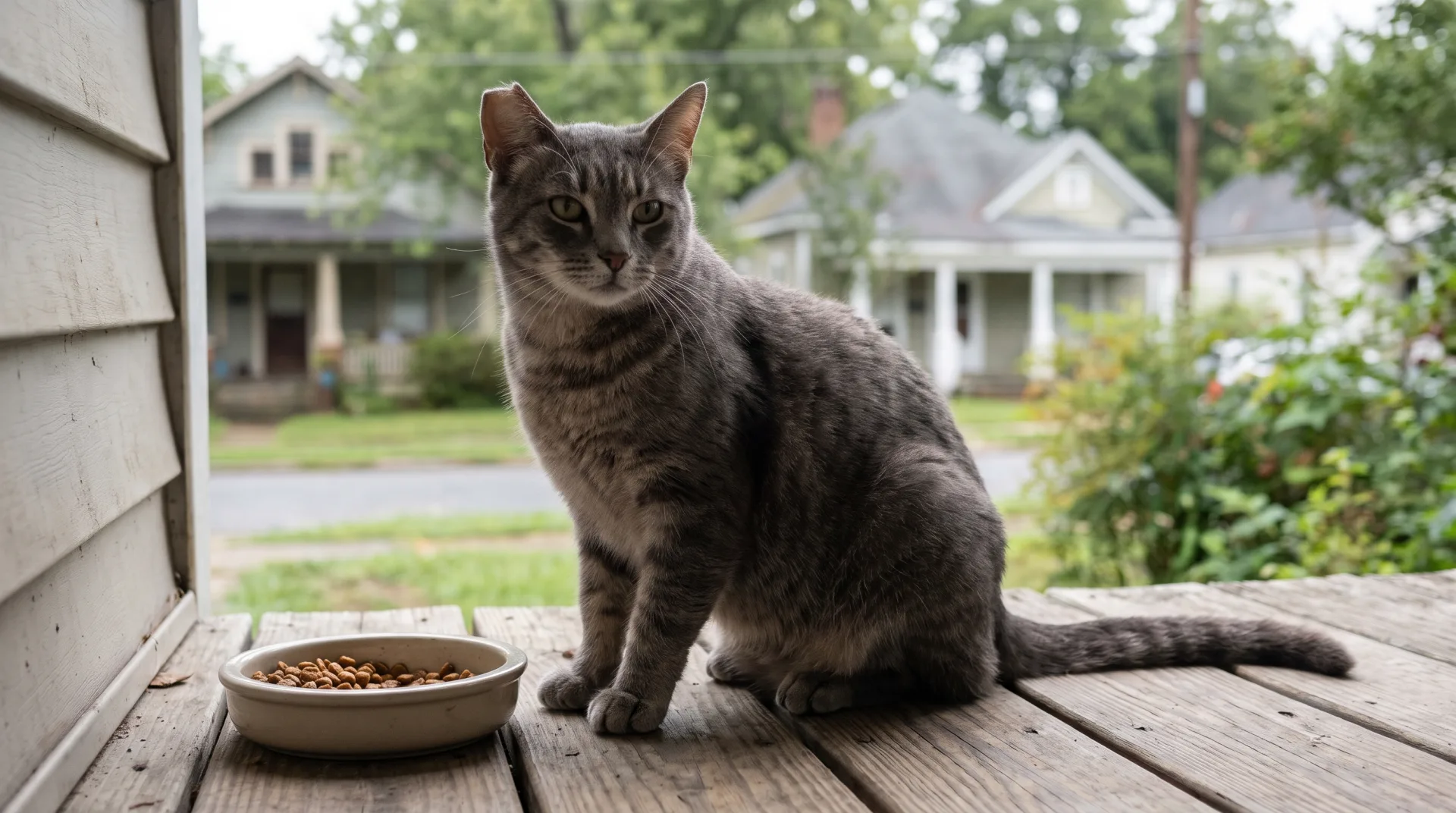
Trap-neuter-return, where community cats are trapped, sterilized, vaccinated, ear-tipped and returned, is how many North Carolina communities bring outdoor cat numbers down. By our count, 14 counties write TNR into county law, 80 don't, and 6 we couldn't confirm. Not being in county law doesn't mean TNR is banned. Some shelters and rescues run community cat programs in counties whose code never mentions TNR, and each county page lists the community cat help we found alongside the legal fine print.
If you care for outdoor cats, read your county's cat section before you start: whether TNR is in county law, any feeding or keeper rules, and who runs community cat help nearby. Our guides to community cat programs and starting a TNR program in North Carolina cover the practical side.
What We Don't Know Yet
Seven counties' leash rules are marked not confirmed, mostly because their codes aren't online. Some towns' codes weren't readable either, and those are marked on the county pages. We don't cover dangerous dog designations, rabies licensing or barking rules. If you can point us to an official copy of a code we're missing, we'll read it and update the page.
Leash and chaining rules are set locally, so changes happen at county commission and town council meetings. Knowing your county's rule is the first step to having a say in it.
Frequently Asked Questions
There's no statewide leash law. State law (G.S. 67-12) only bars letting a dog over six months old run loose at night unless the owner, a family member or someone the owner allows is with it, and Yancey County is exempt from even that. Leash rules come from counties and towns: 36 of the 100 counties require a leash off your property.
Usually, yes, as long as the dog stays on your land. A few counties also require restraint on your own property unless it's fenced or the dog is under control, and some exempt larger tracts, such as 5 acres or more in Mecklenburg or 1 acre or more in unincorporated Guilford. Check your county page for the exact rule.
It depends on where you are. Twelve counties accept a leash or voice control. Others, including Durham County and the City of Raleigh, say in their codes that voice command is not adequate restraint. Town rules apply inside town limits.
Some do. State law has no roaming rule for cats outside a rabies quarantine. Wake and Forsyth counties' at-large rules cover cats, while Mecklenburg and Guilford exclude cats from their restraint rules. Wake also exempts community cat caregivers from its at-large rule.
Call the animal control agency where you saw the dog: usually county animal control or the sheriff's office outside town limits, and the town's animal control or police inside them. Each county page on ncpetproject.org lists the number. If a dog is attacking someone, call 911.
It varies by county and town. Breaking the state night rule on purpose is a Class 3 misdemeanor. Local rules usually carry civil penalties; Wake County's at-large rule, for example, carries a $200 civil penalty per violation.
Sources
- N.C. General Statutes G.S. 67-12, G.S. 67-18, G.S. 67-4.2, G.S. 130A-194, G.S. 113-291.5, G.S. 160A-186, G.S. 153A-121, G.S. 14-360 and G.S. 14-362.3, ncleg.gov.
- Session Law 1985-897 (Yancey County exemption from G.S. 67-12), ratified July 3, 1986.
- County codes: Wake County Code Ch. 91; Mecklenburg County Animal Control Ordinance (adopted text, Sec. 3-71); Guilford County Code Sec. 5-9; Forsyth County Code Ch. 6; Durham County Code Ch. 4; Dare County Code Ch. 91; Harnett County Animal Services Ordinance; Alamance County Animal Control Ordinance; Ashe County Code Ch. 90; Craven County Leash Laws page.
- Town codes: Burlington City Code Sec. 6-20; Raleigh City Code Part 12, Ch. 3.
- Wake County Animal Control (service area and contact).
- County counts: NC Pet Project, NC animal laws by county, all 100 county codes read and checked October 23, 2026.