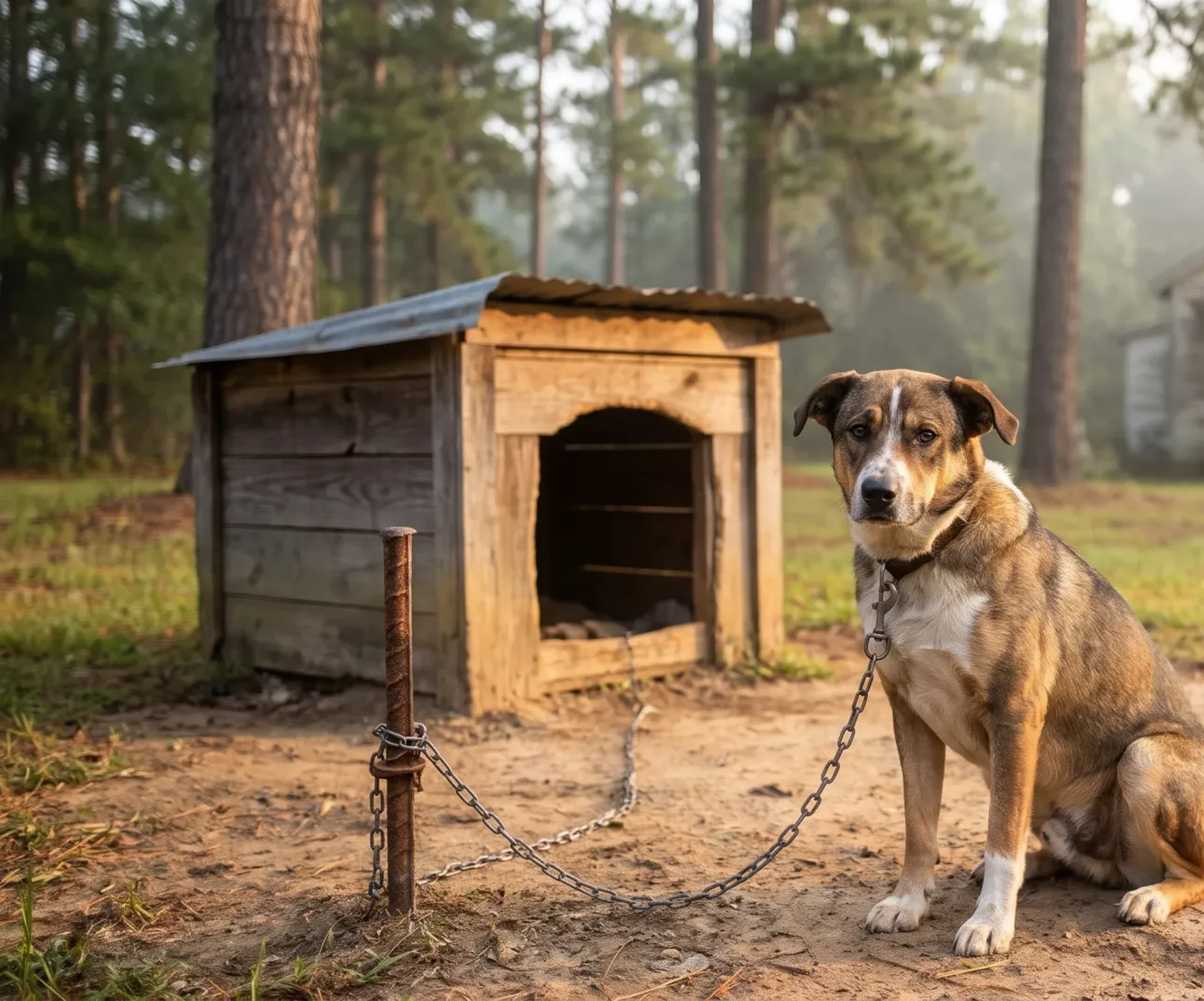
Is It Illegal to Chain a Dog in NC? What the Law Says Where You Live
North Carolina has no statewide chaining law. Only 12 of 100 counties limit chaining. See what the rules say, how Garner passed one, and what you can do.
The short version: Not statewide. North Carolina has no law that limits how long a dog can be kept on a chain, so the answer depends on the county and town where the dog lives. Only 12 of the state's 100 counties limit whether or how long a dog can be chained, and at least 28 towns have their own limit. Most counties either set equipment rules that still let a dog live on a chain, or have no rule at all. State cruelty law still applies everywhere, so a dog left without food, water or shelter can be reported in any county.
Drive across almost any county line in North Carolina and the rules for a chained dog can change. In Garner, it's against the law to leave a dog tied up alone. A few miles away, in unincorporated Wake County, there's no local chaining rule at all, only state cruelty law. In Laurinburg, a dog can be tethered for one hour a day. In most of the state, there's no time limit.
We checked the animal ordinance of every county in North Carolina (94 of them are posted online), and the towns inside them, to build our statewide guide to animal laws by county. This post explains what we found: why the rules are so uneven, what the different kinds of rules actually require, how one Wake County town got a strong rule, and what's changing right now. If you just want your own county's rule, the guide and each county page have it, along with who enforces it and the number to call.
Is It Illegal to Chain a Dog in North Carolina?
No state law bans it or puts a time limit on it. The one state statute written about chaining is narrow. Under G.S. 14-362.3, it's a Class 1 misdemeanor to "maliciously" restrain a dog "using a chain or wire grossly in excess of the size necessary to restrain the dog safely." That covers an oversized chain put on with malice. It says nothing about how long a dog can be chained, how long the chain must be, or where the dog sleeps.
The state's general cruelty law, G.S. 14-360, does reach chained dogs. It makes it a crime to deprive an animal of "necessary sustenance," and it defines cruelty to include any "act, omission, or neglect causing or permitting unjustifiable pain, suffering, or death." So a chained dog with no water, no food or no protection from the weather can be a cruelty case anywhere in the state, with or without a local rule. Leash rules work the same way, county by county; our guide to North Carolina leash laws covers them.
Everything beyond that is left to local governments. State law lets counties "define and prohibit the abuse of animals" (G.S. 153A-127) and lets cities and towns "regulate, restrict, or prohibit the keeping" of dogs and cats (G.S. 160A-186). That's why North Carolina ends up with a separate set of rules for every county and town instead of one standard. Here's how the counties break down.
The Four Kinds of County Rules, and What They Allow
When people say a county "has a tethering law," they can mean very different things. The county codes fall into four groups.
Banned unless someone is with the dog (9 counties). These are the strongest rules. In most of them, a dog can be tied out only while its owner or another responsible person is outside with it, with short lists of exceptions such as hunting, herding, training, camping and events. Randolph instead bans tethering as the regular way to keep a dog. New Hanover goes furthest: its code says "Ropes, chains, and the like are prohibited," apart from "organized and lawful dog functions" such as hunting and training.
Time limits (3 counties). Dare and Orange cap tethering at 3 hours total in any 24. Burke allows up to 14 hours in a row, after which the dog must be let off for supervised exercise.
Equipment or length rules only (46 counties). This is the most common kind of rule, and the easiest to misread. These codes set a minimum tether length, often 10 feet, and may require a swivel, a fitted collar, or access to water and shelter. They don't limit how many hours a day a dog spends on the chain, so a dog can still live its whole life at the end of one, as long as the chain is the right length.
No county rule (36 counties). These codes have no chaining section at all. Only general care rules and state cruelty law apply. Six more counties have ordinances that aren't posted online, so we couldn't confirm what they say.
These are the 12 counties whose own law limits whether or how long a dog can be chained:
| County | What the county rule says | Code section |
|---|---|---|
| Burke | No more than 14 hours in a row in any 24, then supervised exercise | Sec. 6-12 |
| Cumberland | Only while the owner or keeper is outside and in sight; a permit is needed otherwise | Sec. 3-22(h) |
| Dare | No more than 3 hours total in 24, and never on empty property | Sec. 91.033 |
| Durham | Only while a responsible person attends the dog; up to 7 days for hunting, herding, training or camping | Sec. 4-62 |
| Edgecombe | Only while someone is outside and within sight (effective Nov. 3, 2025) | Sec. 4-41(14) |
| Forsyth | Only while the owner is outside with the dog and in visual range, plus listed exceptions | Sec. 6-6(d) |
| Guilford | Only while the owner is outside with the dog and in visual range, plus listed exceptions | Sec. 5-15(i) |
| Halifax | No unattended tethering outdoors, hunting dogs included | Sec. 14-12 |
| New Hanover | Ropes and chains banned, except organized dog functions such as hunting and training | Sec. 5-30 |
| Orange | No more than 3 hours total in 24 unless the owner is outside in sight (not in Chapel Hill or Carrboro) | Sec. 4-41(k) |
| Randolph | Tethering can't be the regular way to keep a dog, and never 24 hours a day | Ordinance Sec. 3(G) |
| Surry | Only while the owner is outside with the dog and in visual range, plus listed exceptions | Secs. 90.097, 90.098 |
Why the Town Line Matters as Much as the County Line
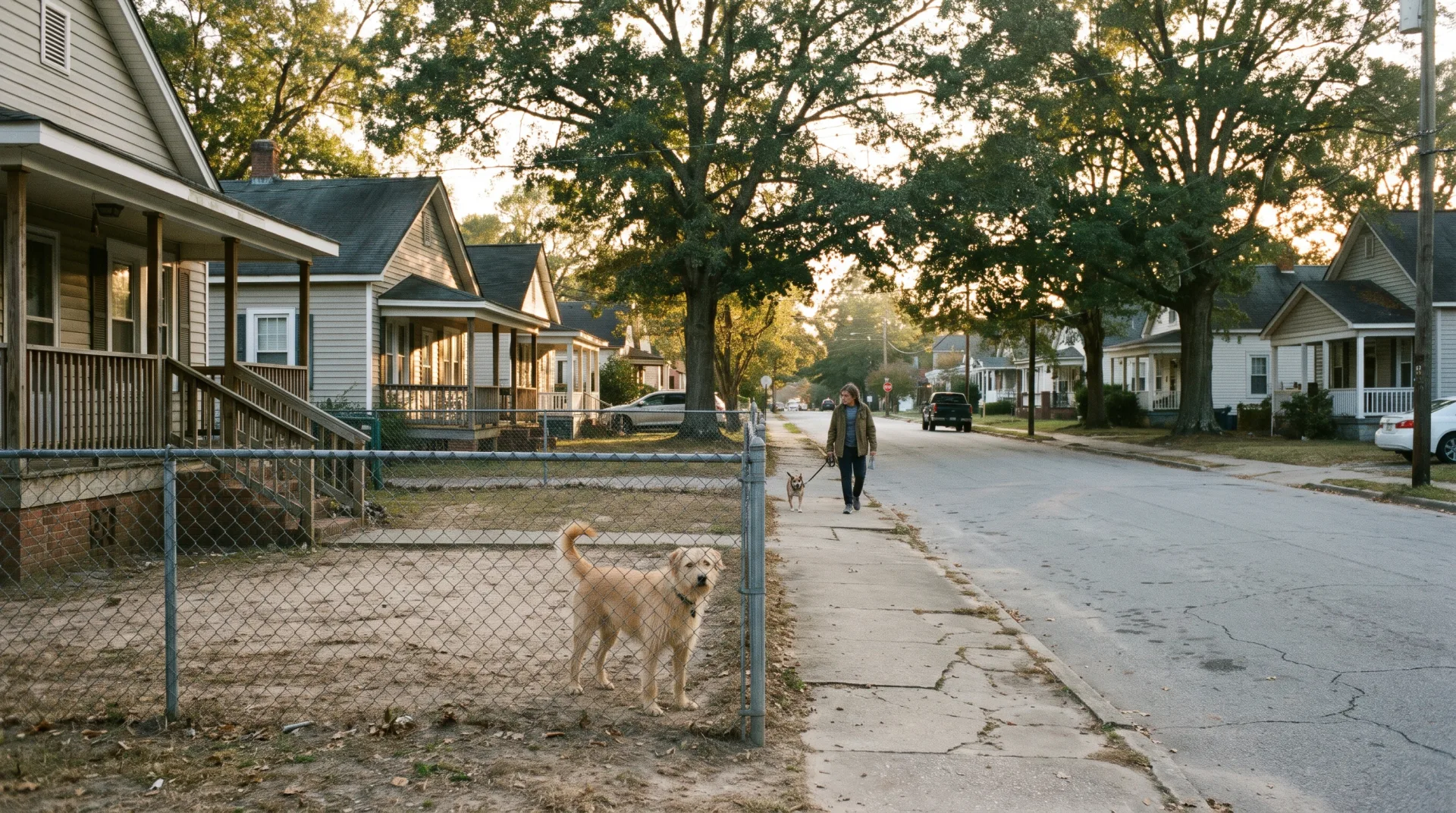
A county's animal ordinance usually covers only the areas outside town limits. Inside a town, the town's own rule applies, and towns are often stricter than their counties. We found at least 28 towns with their own limit on chaining, many of them in counties with weak rules or none.
Wake County shows how much this matters. The county code has no chaining section. But Raleigh, Cary and Garner each wrote their own rule. Raleigh's current rule (Sec. 12-3013) allows a dog to be tethered for no more than 3 hours total in any 24, on a tether at least 10 feet long with a buckle collar or harness, with a $100-a-day civil penalty on top of the misdemeanor. Cary bans tethering "without a responsible person remaining outside with the animal." Garner bans leaving a dog tied up alone. Two neighbors a mile apart can live under completely different rules, though state cruelty law covers both.
Some of the strongest rules in the state come from small towns. Wadesboro and Laurinburg limit tethering to one hour in every 24. Warrenton allows 3 hours total in 24. Edenton allows a dog on a chain or leash outside its enclosure only while a person is holding it, and says "No dogs shall be leashed to any inanimate object." None of their counties has a confirmed county rule as strong. In Anson, Wadesboro's county, we couldn't find a county animal ordinance online at all, so outside town limits only state cruelty law is confirmed.
Each county's row in our guide lists the towns we found with their own rules, and each county page links to the code sections. If you live inside a town, check the town rule first.
How Garner Got One of Wake County's Strongest Rules
Rules like Garner's don't appear on their own. Someone has to ask for them. In Garner, one of the people asking was Hailey Queen, who led the Raleigh chapter of the Coalition to Unchain Dogs from 2009, continuing with Beyond Fences until 2018.
She pushed for Garner's rule because of what she and other volunteers saw working with dogs kept on chains: the dangers those dogs face, and the harm to the wider community. She says the bite statistics of that time showed that tethered, unaltered dogs were the most likely to bite, and that most bite victims were children. Raleigh and Durham had recently passed anti-chaining rules that were working, she says, and her group wanted to see the same in other communities.
What chained dogs face. From her years working with chained dogs, Hailey lists these dangers:
- Attacks from wild animals, roaming dogs and cruel people
- Strangulation and getting tangled
- No way to get away from their own waste, which means more exposure to flies and parasites
- Knocked-over water bowls
- Losing access to water, shelter or shade because the chain gets tangled, or because kinked chains lose length over time
Garner's code shows the result. Section 3-11 makes it "unlawful to tether, fasten, chain, tie or restrain an unattended dog to any tree, fence, post, dog house or any other object," and says no tethering is lawful "on and after May 1, 2011" except as the section allows. Attended tethering is allowed only while the owner or another responsible person is on the property, on a line at least 10 feet long, for no more than 3 hours in a row in 24. Dogs kept outside must be in a fenced yard or pen with a shelter. An owner who's notified has 30 days to take the dog off the tether before animal control can take custody.
Hailey recalls a few things that helped win the vote. Her group brought data on how many animal control calls involved dogs kept outdoors, so the rule could be pitched as a way to save officers' time. They talked to law enforcement early. They supported grandfathering for dogs already kept within the existing rules, which the code still reflects: owners could register those dogs within 60 days. And the Coalition offered to build fences for owners who couldn't afford another option.
What Changed in 2025 and 2026
The map isn't standing still. Since August 2025, a county and two towns have adopted new chaining limits, another county has strengthened its equipment rules, and tethering has come up at two more county boards without action.
Edgecombe County is the newest county to ban unattended tethering, and the town of Tarboro adopted a matching rule two months later. Tarboro's council gave residents time to adjust, agreeing to a one-year stay of enforcement. In Duplin County, the town of Wallace adopted a 4-hour limit unless the owner is present.
| Place | When | What happened |
|---|---|---|
| Edgecombe County | Nov. 3, 2025 | Tethering allowed only while someone is outside and within sight (Sec. 4-41(14)) |
| Tarboro (Edgecombe) | Jan. 12, 2026 | Council adopted a matching attended-only rule with a one-year stay of enforcement |
| Wallace (Duplin) | Aug. 11, 2025 | No tethering for more than 4 hours in a row unless the owner is present (Sec. 90.07) |
| Currituck County | Aug. 4, 2025 | Tethers must be at least 15 feet or 4 times the animal's length, with limits during hurricanes, heat advisories and extreme heat or cold (Sec. 3-64); no time limit |
| Bertie County | Mar. 16, 2026 | Commissioners voted 4 to 0 to put a tethering ban to voters in November; it was not authorized for the ballot |
| Northampton County | Mar. 2026 | Mar. 2: commissioners heard a presentation on protecting animals in extreme heat and cold; Mar. 18: a commissioner raised tethering. No action taken |
Bertie is the most unusual case. Its only county animal ordinance dates from 1982, and it counts a chain as a legal way to restrain a dog, though state cruelty law still applies there. In March 2026, commissioners voted to let voters decide on a tethering ban in the November election. The county's elections director later told the Daily Advance that, according to the State Board of Elections, "there's no authorization for this particular referendum," so it won't be on the ballot. Nothing has been adopted since.
If your county is weighing a change, the debate is happening at regular commissioner meetings, which are open to the public. Your county's page has the number for its animal control office, and our guide shows what neighboring counties already do.
Is a Statewide Rule Coming?
One bill would set a statewide floor. House Bill 657, the "Duke's Rescue Act," would add a new section to the state's cruelty laws, G.S. 14-360.5, requiring anyone who owns a dog or cat to provide adequate care, exercise, feed, shelter, space, water and veterinary treatment.
For tethered animals, the version the House Judiciary 1 committee approved on June 16, 2026 says a tether must be at least 15 feet long or four times the animal's length, whichever is greater, weigh no more than one-tenth of the animal's body weight, and be attached by a collar or harness that prevents injury and tangling. It says outdoor tethering doesn't count as adequate shelter during "extreme weather," which the bill defines to include severe weather warnings, heat advisories, and temperatures at or above 85 degrees or at or below 32 degrees Fahrenheit. It exempts dogs used for hunting, sledding, sporting and field trials, along with training, herding, agriculture and camping areas, from the shelter and space requirements.
| Rule | What the bill says |
|---|---|
| Tether length | At least 15 feet, or four times the animal's length, whichever is greater |
| Tether weight | No more than one-tenth of the animal's body weight |
| Attachment | A collar or harness that prevents injury and tangling |
| Extreme weather | Outdoor tethering isn't adequate shelter during severe weather warnings, heat advisories, or temperatures at or above 85 or at or below 32 degrees Fahrenheit |
| Exemptions | Hunting, sledding, sporting and field trial dogs, plus training, herding, agriculture and camping areas, from the shelter and space requirements |
| Daily time limit | None |
| Status | In the House Rules, Calendar, and Operations committee since June 16, 2026; not law |
The bill doesn't set a daily time limit. And it isn't law. After the committee approved it, the bill was sent to the House Rules, Calendar, and Operations committee on June 16, 2026, and that's where it has stayed, according to its bill page on ncleg.gov. It hasn't had a vote in the full House. If it doesn't move before the 2025-26 session ends, it would have to be filed again in the next session, which convenes on January 13, 2027. Our post on why NC can't seem to fix spay/neuter funding explains how bills move, and stall, in the General Assembly.
Until something passes statewide, local rules are the only rules. That's why the county and town picture matters.
What You Can Do
Know your rule. Look up your county in our animal laws by county guide, then open your county page for the towns, the code sections and who enforces them. If you live in a town, its rule usually applies instead of the county's.
Report a dog in trouble. If a chained dog has no water, no food, no shelter or is hurt, call your county's animal control or sheriff's office. The number for every county is on its page. State cruelty law applies everywhere, so you don't need a local chaining rule to report neglect. If a dog is in danger right now, call 911. Our guide on how to report animal cruelty in NC walks through what to say and what happens next.
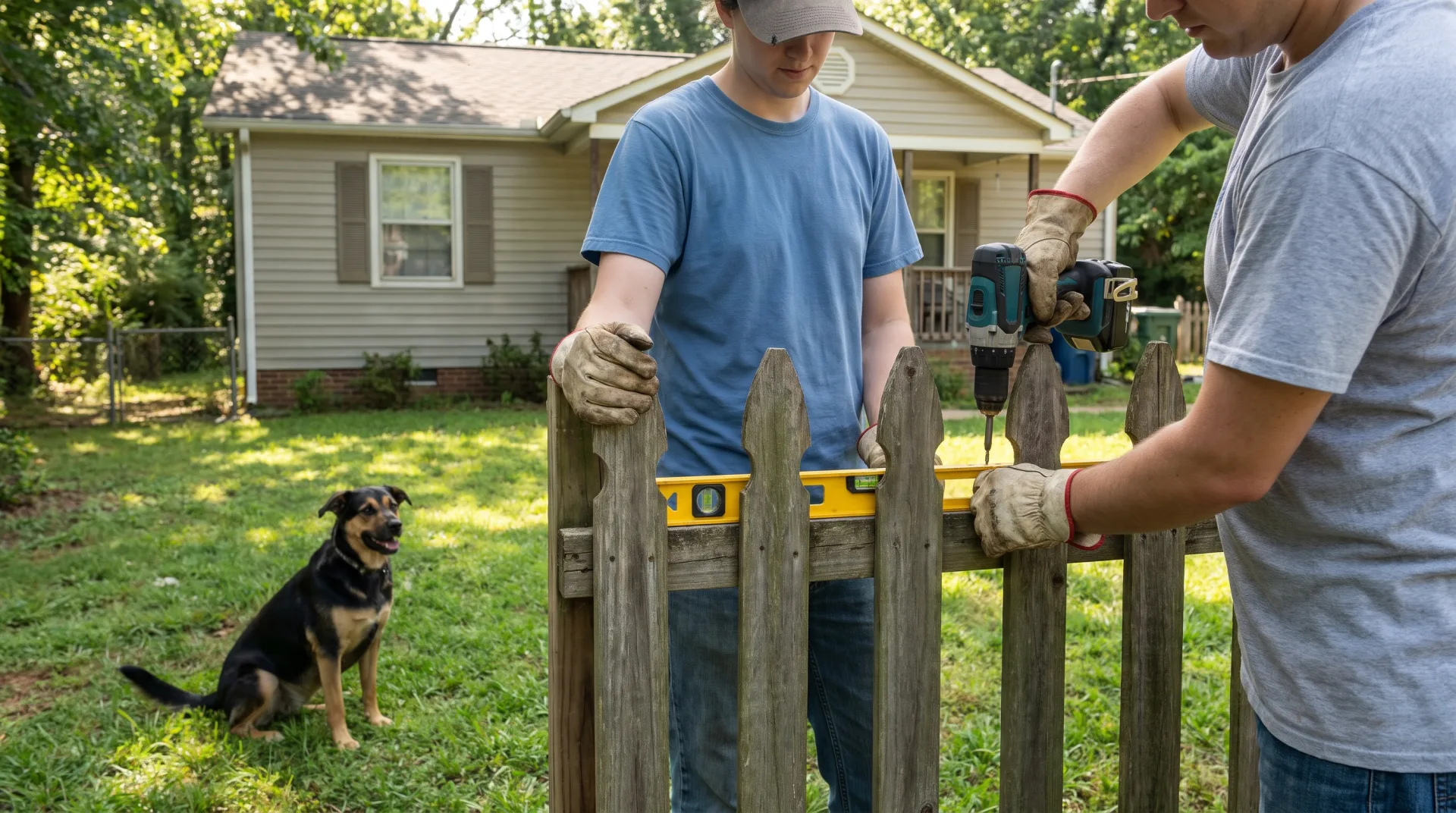
Help a neighbor instead of judging one. Some dogs end up on chains because their owners can't afford a fence or don't know another way. Volunteer fence-building, like the help the Coalition chapter Hailey led offered in Garner, gives a dog a way off the chain without anyone losing their pet. Low-cost spay/neuter helps too. Our low-cost spay/neuter guide lists options by county.
Ask for a better rule. County commissioners and town councils write these ordinances, and they meet in public. Advocates pushed for Garner's rule. If you want a stronger rule where you live, bring your county's current rule, the rules in neighboring counties from our guide, and a plan for helping owners comply, such as a grace period or fence help.
Tell your legislators. A statewide standard would need the General Assembly. You can email your state legislators in a couple of minutes and tell them dog welfare matters to you.
Frequently Asked Questions
Not statewide. North Carolina has no law that limits how long a dog can be chained. Only 12 of the 100 counties limit it in county law, and at least 28 towns have their own limits, so it depends where the dog lives. State cruelty law (G.S. 14-360) still makes it a crime to deprive a dog of necessary sustenance, and G.S. 14-362.3 bans maliciously restraining a dog with a chain grossly heavier than needed.
It depends on your county and town. In most of North Carolina there is no time limit. Dare and Orange counties allow 3 hours total in 24, Burke allows 14 hours in a row, and nine counties ban it outright or unless someone is with the dog. Some towns are stricter: Wadesboro and Laurinburg allow one hour in 24, and Raleigh and Warrenton allow 3 hours.
Call your county's animal control or sheriff's office; the number for every county is on its page in our animal laws by county guide. Neglect can be reported in any county, with or without a local chaining rule, because state cruelty law applies everywhere. If the dog is in immediate danger, call 911.
House Bill 657, the Duke's Rescue Act, would set statewide care standards, including a tether of at least 15 feet or four times the animal's length and no outdoor tethering as shelter in extreme weather. It does not set a daily time limit. A House committee approved it on June 16, 2026, and it has been in the House Rules committee since that day without a House vote.
Yes. State law lets cities and towns regulate the keeping of dogs and cats (G.S. 160A-186), and inside town limits the town's rule applies. Many towns are stricter than their county. In Wake County, for example, the county has no chaining section, while Raleigh, Cary and Garner each have their own limits.
Sources
- N.C. Gen. Stat. § 14-362.3, Restraining dogs in a cruel manner. ncleg.gov
- N.C. Gen. Stat. § 14-360, Cruelty to animals. ncleg.gov
- N.C. Gen. Stat. § 153A-127, Abuse of animals (counties). ncleg.gov
- N.C. Gen. Stat. § 160A-186, Regulation of domestic animals (cities). ncleg.gov
- North Carolina General Assembly. House Bill 657 (2025-2026 Session), Duke's Rescue Act, bill history and Edition 2. ncleg.gov
- Town of Garner Code of Ordinances, Sec. 3-11. library.municode.com
- City of Raleigh Code, Sec. 12-3013, Tethering requirements. library.municode.com
- Town of Cary Code, Sec. 6-67. codelibrary.amlegal.com
- New Hanover County Code, Sec. 5-30. library.municode.com
- Edenton Town Code, Sec. 90.42; Wadesboro Code, Sec. 4-10; Laurinburg City Code, Sec. 4-19; Warrenton Code, Sec. 90.10; Wallace Code, Sec. 90.07. Linked from each county page.
- Edgecombe County Animal Services Ordinance text amendment, effective November 3, 2025. edgecombecountync.gov
- Town of Tarboro Council minutes, January 12, 2026. tarboro-nc.com
- Currituck County Code, Sec. 3-64. library.municode.com
- Bertie County Board of Commissioners minutes, March 16, 2026. co.bertie.nc.us
- Daily Advance. Bertie tethering debate won't be on midterm ballots, May 28, 2026. dailyadvance.com
- Northampton County Board of Commissioners minutes, January to March 2026, including the March 2 and March 18, 2026 meetings. northamptonnc.com
- NC Pet Project. Leash, chaining and community cat laws in all 100 NC counties (county codes checked October 23, 2026). ncpetproject.org