Found a Stray Dog in NC? What to Do in the First 24 Hours
Found a stray dog in North Carolina? Get it safe, get it scanned for a microchip and report it fast, because some NC communities give you only 24 hours.
The short version: If you find a stray dog in North Carolina, get it (and yourself) safe, check for tags, and get it scanned for a microchip at a vet clinic or your county shelter. Then report it to your county's animal services, and do it fast: in Charlotte and New Hanover County the local code gives you 24 hours, in Cumberland County one business day, and in Alamance and Guilford counties 72 hours. Post a found report where owners look, keep the dog apart from your own pets if you hold it, and if it goes to a shelter, know that state law requires a hold of at least 72 hours before it can be euthanized or adopted out. Every dog that goes home instead of into a kennel is one less shelter intake.
A loose dog in your yard, a dog trotting down the shoulder of a two-lane road, a dog sitting outside the grocery store with nobody around: most of us have been there, and most of us want to help. The trouble is that the right moves aren't obvious, and in North Carolina the rules change at the county line.
This guide walks through the first 24 hours in order. It covers how to approach a dog safely, where to get a microchip scan, the local reporting deadlines that catch good Samaritans off guard, where owners actually look for lost dogs, what a shelter has to do under state law, and what happens if nobody comes forward. It's for dogs. If you've found a cat, start with our guide to telling a feral cat from a stray, because the right answer for a cat is often different.
This is a plain-language guide, not legal advice. Local rules change, so check your county's current code or call its animal services.
Step 1: Make It Safe for You and the Dog
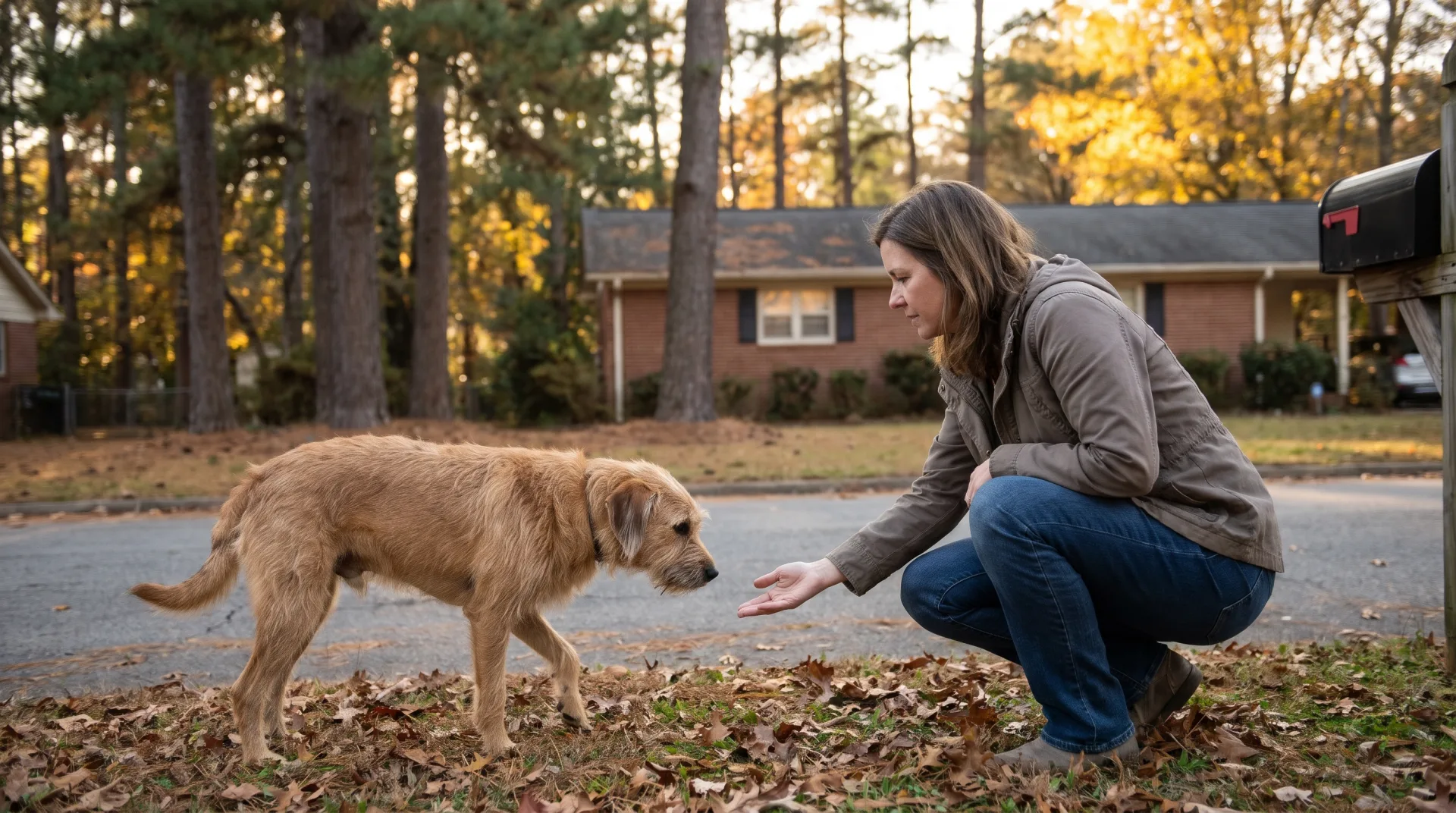
Your first job is to keep everyone in one piece, including the dog. A frightened dog that bolts into traffic is the worst outcome of all, so don't chase. Chasing turns a lost dog into a running dog. Instead, stay low and calm, turn your body a little sideways, and let the dog come to you. Avoid staring it in the eye. Speak quietly, toss a bit of food short of your feet, and give it time. If it comes close, a slip lead or a leash looped through its own handle is easier than grabbing a collar.
Watch the dog's body language. A loose, wiggly dog with a soft face is often a lost pet that wants help. A dog that's stiff, growling, showing teeth or hiding with its tail tucked may bite out of fear, even if it's someone's beloved family dog. You don't have to catch every dog yourself. Wake County's lost and found page tells finders to contact animal control "if the pet cannot be safely handled due to medical or behavioral concerns" (Wake County), and that's good advice anywhere in the state. If a dog is hurt, call animal control or an emergency vet rather than moving it yourself.
A bite changes everything, so know the rule before it happens. Under state law, when a dog bites a person, the person bitten (or a parent) and whoever has the dog must notify the local health director immediately. If the dog is a stray, the local animal control agency has to make a reasonable attempt to find its owner. If no owner is identified within 72 hours, the local health director may authorize euthanasia so the dog can be tested for rabies. Every biting dog must be confined for 10 days in a place the health director chooses (G.S. 130A-196). North Carolina requires every dog over four months old to be vaccinated against rabies (G.S. 130A-185), but you can't know whether a stray is, so treat any bite seriously and see a doctor.
| If the dog... | Do this |
|---|---|
| Is loose near traffic | Don't chase. Get low, turn sideways and let it come to you, or call animal control. |
| Is hurt or seems sick | Call animal control or an emergency vet. Don't move a badly injured dog yourself. |
| Is growling, stiff or hiding | Keep your distance and call animal control. Note where you saw it. |
| Bites someone | Notify the local health director right away (G.S. 130A-196), call animal control and see a doctor. |
| Has a tag with a phone number | Call the number. It is the fastest way home. |
| Has only a rabies tag | Call animal services with the tag number. Wake County notes an NC rabies tag can be traced to the clinic that issued it. |
| Has no ID at all | Get a microchip scan at a vet or shelter (Step 2). |
Step 2: Check for ID and Get a Microchip Scan
Look the dog over for a collar, an ID tag, a rabies tag or a county license tag. A tag with a phone number is the fastest way home. A rabies tag helps too. Wake County's page notes that an "NC rabies tag can be traced to the clinic that issued it" (Wake County).
No tags? Get the dog scanned for a microchip. A chip is a small implant under the skin that holds a number linked to the owner's contact details in a registry. Wake County says "any veterinary clinic can do this, as well as the Wake County Animal Center." Forsyth County's found pet checklist says to bring the dog "to a nearby veterinarian, rescue, or FCAS during normal business hours to have them scanned for a microchip" (Forsyth County Animal Shelter). In Charlotte, you can call 311 and ask an officer to come to your home and scan the dog (Charlotte-Mecklenburg Animal Care & Control). Don't be surprised if the clinic won't hand you the owner's details. Wake County explains that a clinic may keep that private but can ask your permission to pass your contact information to the owner.
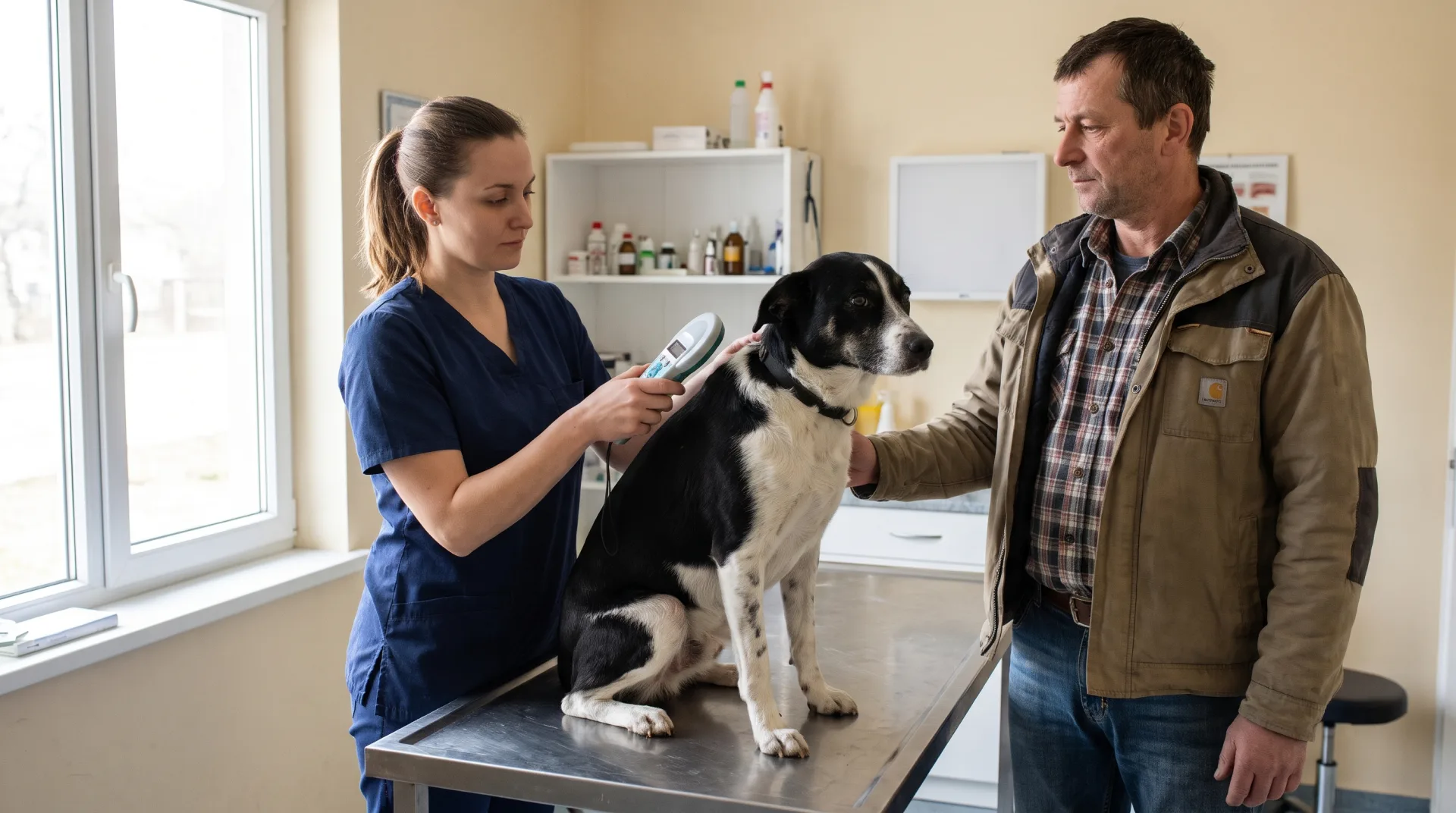
Chips work, but they aren't magic. In a study of 7,704 microchipped animals entering 53 U.S. shelters, owners were found for 74.1% of the microchipped stray dogs (2,191 of 2,956). When owners couldn't be found, the most common reason was an incorrect or disconnected phone number (35.4%), and when shelters contacted a microchip registry, only 58.1% of the chips were registered there at all (Lord et al., JAVMA, 2009). So a chip with no answer doesn't mean nobody is looking. Keep going with the next steps.
State law backs the scan up once animal control is involved. When an animal control officer impounds a dog with no rabies tag and no known owner, the officer must make "a reasonable effort to locate the owner," and if the officer has a microchip scanner available at no cost or a reasonable cost, must scan the animal and use what the chip shows (G.S. 130A-192).
Step 3: Report the Dog, and Know Your Local Deadline
This is the step that trips up kind people. Several North Carolina counties and cities make it unlawful to keep a stray that isn't yours unless you tell animal services within a set time. The idea is simple: an owner searching for a lost dog calls the shelter, and if nobody there knows the dog is in your laundry room, the owner never finds it.
The deadlines vary a lot, and some are short. Charlotte's city code requires anyone who keeps a stray to notify Charlotte-Mecklenburg Animal Care & Control "within 24 hours of the time the animal came into his possession" (Charlotte City Code Sec. 3-72, as quoted on the city's found pet page). New Hanover County also gives you 24 hours, and you have to say whether you'll surrender the dog or advertise it. Cumberland County gives you one business day, and Alamance and Guilford counties give you 72 hours. Even where there's no deadline, reporting a found dog protects you and gets the dog home faster.
| Where | Deadline to notify animal services | What else the code says | Code section |
|---|---|---|---|
| Charlotte | 24 hours | Feeding or sheltering a pet for 14 or more consecutive days counts as harboring it. | Charlotte City Code Sec. 3-72 |
| New Hanover County | 24 hours | Say whether you'll surrender the dog or advertise it; if advertising hasn't started within 72 hours, Animal Services requires surrender. | Sec. 5-6 |
| Cumberland County | One business day | A reported dog becomes the finder's legal property if no verified owner reclaims it within ten business days. | Sec. 3-14 |
| Alamance County | 72 hours | An animal fed or sheltered for ten days or more counts as harbored, which makes you its keeper. | Sec. I and II.A |
| Guilford County | 72 hours | Contact animal control or the shelter to arrange impoundment or to report the dog's description and location. | Sec. 5-22 |
How you report depends on where you are. Forsyth County says to "file a report with Forsyth County Animal Shelter by calling 336-703-2480," with a photo if you can. Charlotte takes a Found Pet Report online or through 311. Wake County asks finders to "contact your local Animal Control Agency to report the found pet" and, if you live near a county line, to notify the neighboring county too, because dogs don't read maps. The Animal Protection Society of Durham, which runs the Durham County shelter, has a Report a Found Pet link on its lost pets page.
Our 100 county pages list who handles animal control in each county, with a phone number for all but one, and our NC animal laws by county page covers each county's leash, chaining and community animal rules. Inside town limits, the town's own code can apply instead of the county's, as our guide to North Carolina leash laws explains.
Step 4: Get the Word Out Where Owners Look
Think like a frantic owner. Research on how owners search shows where to put your found report. In a survey of owners of 187 dogs lost in Montgomery County, Ohio, in 2005, 71% got their dogs back, with a median time to recovery of just 2 days. The most common way home was a call or visit to an animal agency (34.8% of recovered dogs), followed by a dog license tag (18.2%) and neighborhood signs (15.2%). Owners who called an animal agency got their dogs back about twice as fast (Lord et al., JAVMA, January 2007). In other words, owners go to the shelter, so your report needs to be there.
The same research team surveyed 156 people who had found a lost pet. Finders reunited 58 dogs with their owners, 46% of the dogs, against just one cat. But only 8% of finders first took the pet to an animal agency, and the main reason, given by 57%, was fear that it would be euthanized (Lord et al., JAVMA, June 2007). That fear is understandable, and it's one reason a report matters even if you keep the dog at home: the shelter can connect the owner to you without the dog ever entering a kennel.
| How the owner was found | Share of reunions | The 2026 version |
|---|---|---|
| Information from an animal agency | 25% | File a found report with your county shelter or animal control |
| Newspaper found ad | 24% | Post on Petco Love Lost, PawBoost and local lost and found groups |
| Walking the neighborhood | 19% | Knock on doors and ask neighbors, delivery drivers and mail carriers |
| Signs in the neighborhood | 15% | Put up found dog signs where the dog was found |
| Information on a pet tag | 10% | Call the number on any tag, or give animal services a rabies tag number |
| Other methods | 7% | Nextdoor, Facebook and word of mouth |
Online, start with Petco Love Lost, which describes itself as "a free and easy way to search 300K+ lost and found pets" and says it searches more than 3,000 shelters (Petco Love Lost). Both Wake County and Charlotte point finders there, and Wake also lists PawBoost, Nextdoor and its Wake County Lost & Found Pets Facebook group. Use a clear photo of the dog's face and body, the cross streets where you found it, and the date. Keep one detail back, such as a marking or the color of the collar, so you can tell a real owner from a scammer.
Offline still works. Forsyth County suggests you "post signs in your neighborhood and within a radius of two miles" and talk to your neighbors. Wake County suggests a sign in front of your house saying you found a dog, and checking with neighbors "in case someone has a new pet."
Step 5: Decide Whether to Keep the Dog While You Search
You often don't have to choose between taking the dog to a shelter and doing nothing. Charlotte-Mecklenburg Animal Care & Control encourages finders to "keep and care for the pet while you actively look for its owner," as long as they file a Found Pet Report, and lists the shelter as the second option (Charlotte-Mecklenburg Animal Care & Control). When shelters are short on space, a dog that waits in your home instead of a kennel keeps a space open for a dog with nowhere else to go.
State law makes room for this, too. During the holding period, a shelter may place an animal in foster care with an approved foster care provider, an approved rescue or "the person who found the animal." When it does, the shelter has to display at least one photo of the dog's head and face "in a conspicuous location that is available to the general public during hours of operation," and keep it posted until the dog's case is resolved, so an owner who walks in can still recognize it (G.S. 19A-32.1(d)). Ask your shelter whether it offers this. Not every shelter does, and some, like the Wake County Animal Center, ask finders who can't find the owner to "call the Wake County Animal Center at 919-212-7387 to schedule an appointment" before bringing a dog in.
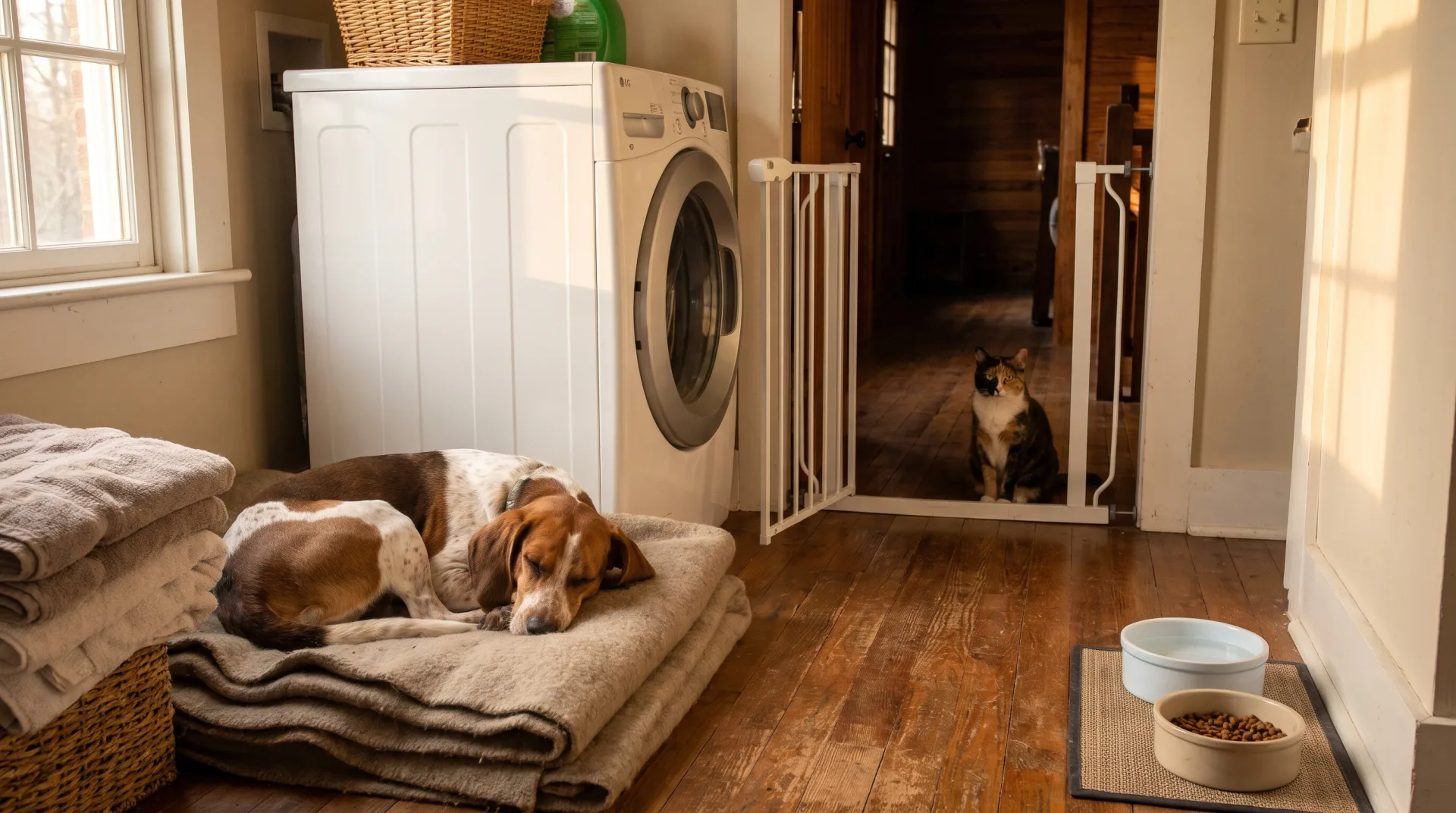
If you keep the dog for a day or two, set it up somewhere quiet and easy to clean, like a laundry room or a bathroom, with water, a bit of plain food and a towel to lie on. Keep it apart from your own pets and away from small children until you know more about it. You don't know its vaccination history or its temper yet, and a stressed dog in a strange house can surprise everyone, including itself. Walk it on a leash, even in a fenced yard, because a scared dog can climb or dig out of places you'd never expect.
If you can't keep the dog safely, that's fine. Call your county's animal services, explain what you found and where, and follow their instructions. Turning a dog over to the shelter that its owner will call is a responsible choice, not a failure.
If the stay runs longer than a few days, our beginner's guide to fostering in NC covers the practical side of caring for a dog that isn't yours, from crate setup to vet visits.
What Happens If the Dog Goes to a Shelter
North Carolina sets a floor, not a ceiling. Every animal a shelter receives must be held for at least 72 hours, "or for any longer minimum period established by a board of county commissioners," before it can be euthanized or otherwise disposed of (G.S. 19A-32.1(a)). Before a dog can be euthanized, it has to be made available for adoption, with exceptions for dogs the shelter finds unadoptable because of health or temperament, dogs that are seriously ill or injured, and dogs held as evidence in a criminal case (G.S. 19A-32.1(b)).
The law also protects owners who come looking. A person trying to find a lost pet is entitled to view every animal at the shelter, during at least four hours a day, three days a week, and the shelter has to make reasonable arrangements when some animals are kept apart for health, safety or evidence reasons (G.S. 19A-32.1(c)). That's another reason to tell the shelter about a dog you're keeping at home: the owner will be looking there.
| Rule | Minimum hold or redemption window | Source |
|---|---|---|
| Any NC animal shelter | 72 hours, or longer if the county sets it | G.S. 19A-32.1(a) |
| Dog impounded with no rabies tag and no known owner | Set by county commissioners, never less than 72 hours | G.S. 130A-192(a) |
| Wake County | The owner can redeem the dog within 72 hours or three business days after notice of impoundment is given or posted | Wake County Code Sec. 91.52 |
| New Hanover County | Five business days | New Hanover County Code Sec. 5-16(a) |
| Guilford County | "Typically" a minimum of 72 hours, per the shelter | Guilford County Animal Services |
Seventy-two hours is not long, especially over a weekend. Where the hold is the state minimum of 72 hours, a dog that comes in on a Friday evening reaches the end of its hold on Monday evening. (Wake County's clock starts when notice of the impoundment is given or posted.) That's why the first 24 hours matter so much. A found report filed on day one, a chip scan and a photo on Petco Love Lost give the owner the best chance to get there in time.
A shelter hold isn't a death sentence. Many dogs are adopted, transferred to rescues or held longer when space allows. But it is a clock, and you can help the dog beat it.
Why Getting Dogs Home Matters for NC Shelters
Going home to its owner is the fastest and happiest outcome a shelter dog can have. It frees a kennel and spares the dog a long stay. Yet in North Carolina it's a small slice of what happens to dogs. In the state's 2025 public animal shelter report, shelters in 65 counties filed dog numbers. Together they took in 75,521 dogs. That year they adopted out 34,995 dogs and euthanized 17,140, equal to 22.7% of intake. Only 13,357, equal to 17.7% of intake, went home to their owners (NC Department of Agriculture and Consumer Services, 2025 CY Public Animal Shelter Report).
Two caveats keep these numbers honest. The report doesn't split strays from dogs surrendered by their owners, so 17.7% isn't the return rate for strays alone. And it has no column for transfers to rescues, so the "not accounted for" bar is simply what's left over. Several large counties, including Wake and Forsyth, aren't in the 2025 dog totals. Our county-by-county shelter report has the full picture for each county.
Even so, the direction is clear. Every found dog that goes home in a day is a kennel that stays open and a dog that never enters the system. That's why a quick scan and a found report matter more than they seem.
If No Owner Turns Up
Some dogs were dumped, and some owners never look. If nobody claims the dog, what happens next depends on where you live and what you've done. In Cumberland County, a dog you reported becomes your legal property if no verified owner reclaims it within ten business days of your report (Cumberland County Code Sec. 3-14(c)). In New Hanover County, if you advertise the dog and the prior owner doesn't respond by the tenth day, you're deemed the legal owner (Sec. 5-6). Charlotte lists options after 14 days, including keeping the dog, rehoming it with someone you know or contacting a rescue, but warns that "original owners retain the right to reclaim their pets," even after 14 days, and calls ownership disputes "a civil matter."
| Where | What you have to do | When the dog can become yours | Code or source |
|---|---|---|---|
| Cumberland County | Report the dog to animal services within one business day | If no verified owner reclaims it within ten business days of your report | Sec. 3-14(b), (c) |
| New Hanover County | Notify Animal Services within 24 hours and advertise it in the local newspaper for five consecutive days | If the prior owner doesn't respond by the tenth day | Sec. 5-6 |
| Charlotte | File a Found Pet Report or call 311, and look for the owner | The city lists options after 14 days, but the original owner keeps the right to reclaim the dog | City found pet page |
If you decide to keep the dog, treat it like any new pet. Take it to a vet for a checkup and a rabies vaccine if it isn't current, register a microchip in your name, and get it spayed or neutered if it isn't already, which our low-cost spay and neuter guide can help with. If you can't keep it, our guide to rehoming a dog in NC covers how to find it a good home without sending it to a crowded shelter.
And if what you found looks like neglect, such as a starving dog, a dog with an embedded collar or a dog left without food or water, our guide to reporting animal cruelty in North Carolina explains who to call.
Frequently Asked Questions
Make the situation safe, then check for tags and get the dog scanned for a microchip at a vet clinic or your county shelter. Next, report the dog to your county's animal services, post a found report where owners look, such as Petco Love Lost, and keep the dog apart from your own pets if you hold it.
It depends on the county or town. Charlotte and New Hanover County give you 24 hours, Cumberland County one business day, and Alamance and Guilford counties 72 hours. Reporting on day one is the safe choice everywhere, and it's the best way for the owner to find you.
Often you can hold it while you look for the owner, as long as you report it. Some codes then make you the legal owner if nobody claims it: ten business days after your report in Cumberland County, or the tenth day after you advertise it in New Hanover County. In Charlotte, the original owner keeps the right to reclaim the dog, even after 14 days.
State law requires at least 72 hours before a shelter can euthanize or otherwise dispose of an animal, and counties can set a longer hold. New Hanover County, for example, holds strays five business days. Shelters can also hold a healthy dog longer for adoption.
Wake County says any veterinary clinic can scan a found dog, and so can county shelters such as the Wake County Animal Center and the Forsyth County Animal Shelter. Call ahead to ask about hours and any charge. In Charlotte, you can call 311 and ask an officer to scan the dog at your home.
Sources
- N.C. General Statutes G.S. 19A-32.1 (minimum holding period, public viewing, foster with the finder), G.S. 130A-192 (impoundment of untagged animals, microchip scan), G.S. 130A-196 (biting animals), G.S. 130A-185 (rabies vaccination).
- NC Department of Agriculture and Consumer Services, 2025 CY Public Animal Shelter Report (Excel, file replaced October 12, 2026), dog rows summed by NC Pet Project.
- County and city codes: New Hanover County Code Ch. 5 (Secs. 5-6, 5-16); Cumberland County Code Sec. 3-14; Alamance County Animal Control Ordinance; Guilford County Code Sec. 5-22; Wake County Code Sec. 91.52; Charlotte City Code Sec. 3-72 as quoted on the city's I Found a Roaming Pet page.
- Shelter found-pet guidance: Wake County Animal Services; Charlotte-Mecklenburg Animal Care & Control; Forsyth County Animal Shelter; Guilford County Animal Services; Animal Protection Society of Durham.
- Lord LK, Wittum TE, Ferketich AK, Funk JA, Rajala-Schultz PJ. Search and identification methods that owners use to find a lost dog. JAVMA. 2007;230(2):211-216.
- Lord LK, Wittum TE, Ferketich AK, Funk JA, Rajala-Schultz PJ. Search methods that people use to find owners of lost pets. JAVMA. 2007;230(12):1835-1840.
- Lord LK, Ingwersen W, Gray JL, Wintz DJ. Characterization of animals with microchips entering animal shelters. JAVMA. 2009;235(2):160-167.
- Petco Love Lost.